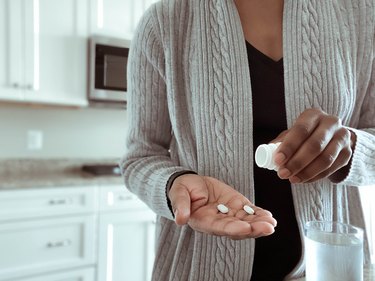
When you're depressed, going to therapy and making lifestyle changes are often the first steps toward relief. You may even be prescribed a depression medication (like an SSRI) by your doctor.
But what about "natural" or non-prescription options to treat depression? Do supplements for depression work, for example?
Video of the Day
Video of the Day
Here, learn about some herbal alternatives and over-the-counter (OTC) depression products, their effectiveness and the side effects to know before taking them.
Tip
Talk to your doctor before trying any over-the-counter depression or anxiety remedy. Even though supplements for depression can seem generally safe, some may cause adverse physical or neuropsychiatric effects in some people.
Is It Safe to Self-Treat Depression?
If you're feeling depressed, it's best to talk to a trusted doctor or mental health professional about what you're going through. They can run some tests to make sure your depression doesn't stem from an underlying health issue. From there, you can work together to find a good treatment for you.
Some depression symptoms to look out for include the following, per the National Institute of Mental Health (NIMH), which must be present for at least two weeks:
- Persistent sad, anxious or "empty" mood
- Feeling hopeless
- Irritability
- Feelings of guilt
- Loss of interest in hobbies or activities
- Fatigue
- Trouble concentrating
- Trouble sleeping (or sleeping too much)
- Changes in appetite
- Physical aches and pains
- Thoughts of death and suicide (in severe cases)
Risk factors for depression include a family history of mental health issues, trauma, major life changes, stress or physical illness, per the NIMH.
Traditional Treatments for Depression
Treatment for depression is often talk therapy and, in some cases, medications called antidepressants. But what do antidepressants do, exactly?
According to the National Health Service (NHS), antidepressants work by increasing neurotransmitters in your brain that affect mood — like serotonin and norepinephrine.
Common antidepressants include the following, per the FDA:
- SSRIs: Short for "selective serotonin reuptake inhibitors." Common brands are Zoloft, Prozac and Lexapro.
- SNRIs: Short for "serotonin and norepinephrine reuptake inhibitors." Brands include Cymbalta and Effexor XR.
- Tricyclic antidepressants: An older class of antidepressants not prescribed as often as SSRIs and SNRIs. Common brand names include Tofranil and Asendin.
- MAOIs: Short for "monoamine oxidase inhibitors." These are also not prescribed as often. Common names include Marplan and Nardil.
There are other types of antidepressants (called atypical antidepressants) that can be prescribed, too. Your doctor or psychiatrist can explain the pros and cons of each kind and help you decide which is right for you.
Should You Take Vitamins or Supplements for Depression?
Sometimes, people turn to natural remedies for depression if traditional options have not helped. If you and your doctor have agreed to try out a natural depression treatment, there are a few different kinds you can try.
It's worth noting, however, that many natural treatments may actually work because of the placebo effect — that is, by just thinking they're working, your symptoms start to improve, per Harvard Health Publishing.
In fact, a February 2019 controlled trial in the Journal of Affective Disorders found that using popular over-the-counter supplements for depression — including S-adenosyl methionine, folinic acid, omega-3 fatty acids, 5-HTP and zinc picolinate — were less effective than adding a placebo to standard depression treatment.
Ultimately, an over-the-counter supplement or herbal alternative could be helpful for you and your symptoms, but you should always talk to your doctor before trying anything new.
Warning
If your depression symptoms continue or get worse while on a natural treatment, check in with your doctor. They can help you come up with other remedies to try.
How to Choose an OTC Depression Treatment
With so many OTC supplements on the market, it's helpful to narrow your search to save you time and energy (and money). If you're feeling unsure about what to try, ask yourself and your doctor some of these questions, per the Mayo Clinic:
- What are my symptoms? The kind of treatment you choose will depend on what your symptoms are. If you're dealing with insomnia from depression and anxiety, you may want to find an OTC supplement that has sedative properties so you're able to relax. But if you're dealing with fatigue and lack of motivation, you may want to avoid feeling sedated.
- What are the supplement's side effects? Some OTC supplements (and prescription medicines) can cause side effects like weight gain, low sex drive, dry mouth or nervousness. Try finding a supplement that works best with your body (or produces side effects that are manageable).
- How does it interact with other substances? Make sure to check if the OTC supplement interacts with other medications, supplements or vitamins you're taking. It could even interact with certain foods, like grapefruit does with some prescription meds.
- Could it affect my other health issues? If the supplement causes high blood pressure, dizziness or other similar side effects, it could worsen other health issues you have, like hypertension or vertigo.
- Can I take it while pregnant? (If this applies to you.) If you're pregnant or chestfeeding, talk with your doctor before taking any natural depression treatments or prescription antidepressants. Many medicines or supplements may negatively affect your baby.
- Has anyone in my family used it? Sometimes picking an OTC supplement means trying what worked for a close family member, such as a parent or sibling. This method can also help you stay away from supplements that caused your family members unwanted side effects.
Below are some top OTC "antidepressants," which have varying amounts of research behind them.
Tip
Keep in mind that OTC supplements, vitamins and herbals aren't approved by the FDA before they're sold. While some companies may use third-party testing and may be verified under certain organizations, they are not as heavily regulated as prescription medications, meaning dosages and ingredients may not always be true to label, per the FDA.
1. St. John's Wort
Some EvidenceDosage: The usual dosage of St. John's wort for mild depression is 300 mg three times per day, with meals, per Mount Sinai.
St. John's wort (aka, Hypericum perforatum) is a plant that grows wild in Europe and some parts of the U.S. Its yellow flower is considered medicinal and thought to increase your brain's serotonin levels (i.e., neurotransmitters that affect mood). The herb is widely prescribed in Europe and is available in pill form at health food stores and pharmacies in the U.S., per the National Center for Complementary and Integrative Health (NCCIH).
A September 2016 review in Systematic Reviews found that St. John's wort was better than a placebo pill at improving symptoms of mild to moderate depression. Its effectiveness was also not too different from prescription antidepressants.
Another September 2022 study in Cureus found that St. John's wort was comparable to standard treatments for depression, and its role in treating anxiety and post-menopause symptoms is also worth researching. But more evidence is needed to prove its effectiveness in these areas.
Some downsides of trying St. John's wort? It doesn't offer consistent results like prescription medications might. It also interacts with many kinds of medications, including the following, per Mount Sinai:
- Antidepressants
- Antihistamines
- Plavix (an antiplatelet drug)
- Cough medicine
- Immunosuppressants
- Birth control pills
- Heart medicines
- Drugs to fight HIV
- Xanax (an anti-anxiety medicine)
- Sedatives
- Migraine medications
- Blood thinners
- Statins
Side effects of St. John's wort can include upset stomach, dry mouth, headache, fatigue, dizziness, sexual dysfunction and sensitivity to sunlight, per the NCCIH.
In some cases, St. John's wort can potentially cause a life-threatening increase in serotonin, called serotonin syndrome. Symptoms of serotonin syndrome include the following, per the NCCIH:
- Increase in body temperature
- Heart palpitations
- Diarrhea
- High blood pressure
- Agitation
If you feel these symptoms, call your doctor or visit the nearest emergency room.
Warning
St. John's wort should not be taken with antidepressants or any other medication that increases your serotonin levels. It can also worsen psychotic symptoms in people with schizophrenia and bipolar disorder. Always talk to your doctor before trying this natural supplement, per the NCCIH.
2. Omega-3 Fatty Acids
Limited EvidenceDosage: There is no standard recommended dose of omega-3s for depression, but some studies suggest taking about 1 gram per day.
Omega-3s are healthy fats that support many different parts of your body, including your brain. Eating foods high in omega-3, like fatty fish, is associated with improved memory ability, cognition and blood flow to the brain, according to an October 2022 study in Cureus. These effects may be especially helpful for older adults at risk of cognitive decline.
There is also some evidence to suggest omega-3s may help relieve depression symptoms, especially the EPA form of omega-3s (as opposed to the DHA form). Per an August 2019 meta-analysis in Translational Psychiatry, omega-3 supplements that are at least 60 percent EPA and dosed at about 1 gram per day seem to help ease depression.
No matter what, getting enough omega-3s from food or supplements is good for your overall health. And they come with few side effects compared to other natural treatments. You may feel some mild stomach upset or bad breath from taking fish oil pills, for instance, per the NCCIH.
Another plus: You can also take fish oil for depression alongside most medications, including antidepressants. Just be careful if you're on blood thinning medications, as fish oil may increase its effects, per the NCCIH.
3. 5-HTP
Limited EvidenceDosage: There is no standard recommended dose for depression, although adults tend to take somewhere between 150 and 800 mg per day, according to the National Library of Medicine.
The chemical known as 5-hydroxytryptophan — or 5-HTP for short — is another natural substance that can increase serotonin levels in the brain and possibly improve your mood.
5-HTP is made naturally in the body as a byproduct of the amino acid L-tryptophan, but it's also available over the counter in pill form, sourced from the seeds of an African shrub (Griffonia simplicifolia), per the Memorial Sloan Kettering Cancer Center (MSKCC).
There's limited evidence that 5-HTP may be helpful for some types of depression, per MSKCC, but more high-quality studies need to be done to confirm its safety and effectiveness.
One November 2016 study in Trends in Pharmacological Sciences, for example, noted that the supplement could be an option for treatment-resistant depression if it came in an extended-release capsule.
If you want to try 5-HTP (and you get cleared by your doctor to do so), you can find it at health food stores or online.
Some common side effects include nausea, heartburn, vomiting, stomach pain, diarrhea, sexual problems and muscle problems, per the National Library of Medicine. Large doses (6 to 10 grams daily) may be unsafe, as they've been linked to severe stomach problems and muscle spasms. There's also a risk of serotonin syndrome, per Mount Sinai.
You should not take 5-HTP if you're pregnant or chestfeeding, have high blood pressure or diabetes, have liver disease or take antidepressants. It's also recommended you stop taking 5-HTP at least two weeks before surgery, to avoid serotonin syndrome, per Kaiser Permanente.
4. S-Adenosyl-L-Methionine (SAMe)
Limited EvidenceDosage: Starting dosage is typically 200 milligrams per day, per Mount Sinai. In studies, the dosage has been 800 to 1,600 mg of SAMe per day, split into two doses (morning and afternoon).
Another substance you may see advertised as a natural treatment for depression is S-Adenosyl-L-Methionine, or SAMe. SAMe is a naturally occuring compound in the body, per the Mayo Clinic, and a synthetic form is sold as a supplement. You can find it in capsule form at most health food stores or online.
According to a December 2017 review in the Journal of Clinical Psychiatry, SAMe has promising but limited evidence to support its effectiveness and safety in treating depression.
Another September 2020 review in the Annals of General Psychiatry found that while SAMe did work better than placebos in a few studies, it worked no better than antidepressants.
In large doses, SAMe can cause a few different side effects, including the following, per Mount Sinai:
- Nausea
- Headache
- Anxiety
- Sweating
- Dizziness
- Heart palpitations
- In some cases, it can cause mania (an abnormally elevated mood)
This is why it's recommended to start taking SAMe at a low dose (about 200 milligrams) and work your way up if needed and if your doctor approves, per Mount Sinai.
People who are pregnant, chestfeeding or have bipolar disorder should not take SAMe. You should also not take SAMe when you're on antidepressants, cough syrups or narcotics for pain, per Mount Sinai.
5. Rhodiola Rosea
Limited EvidenceDosage: There is no standard dosage for depression, although studies have used doses of 340 to 1,360 milligrams daily.
Commonly called Arctic root, Rhodiola rosea is a plant that grows in Alaska, northern Europe, Sweden and Iceland. The plant has been used in traditional European medicine to increase endurance and treat fatigue, among other symptoms, per the NCCIH. Today, it's promoted to help manage a variety of conditions, including depression.
While studies have been done on Rhodiola rosea in animals, few have been done on its effect in people, per the NCCIH.
One clinical trial in people had an interesting finding worth note: Rhodiola rosea may have fewer side effects than standard depression medication. A March 2015 trial in Phytomedicine found that even though Rhodiola rosea was less effective than sertraline (a common SSRI for depression) at treating depression, it produced fewer side effects. Some commonly reported side effects of Rhodiola rosea include dry mouth, excess salivation and dizziness, per the NCCIH.
People who have high blood pressure or take blood pressure medications should not try this herb, as it can naturally lower your blood pressure. People taking antidepressants should also stay away from Rhodiola rosea, per Merck Manual.
6. L-Tryptophan
No EvidenceDosage: No recommended dosage for depression.
Because 5-HTP is sometimes useful and safe for depression, it might be tempting to try out its parent amino acid, L-tryptophan. But there isn't really any evidence showing that L-tryptophan supplementation is effective for treating depression.
If anything, dietary L-tryptophan (from foods like turkey, milk and cheese) has supporting evidence to show it may help improve mood and decrease irritability and anxiety in people with depression, per a December 2014 study in the Archives of Psychiatric Nursing.
If you decide to take L-tryptophan supplements, you may feel side effects like diarrhea, gas, abdominal pain and sleepiness, slowed breathing (when taken in combination with sedative medications) and serotonin syndrome (when taken with other serotonin-increasing drugs), which requires immediate medical attention, per the National Library of Medicine (NLM).
You also shouldn't take L-tryptophan supplements if you're pregnant, chestfeeding or take sedatives or medications that increase your serotonin levels.
Another important note: There's not much information on the long-term effects of taking L-tryptophan, per the NLM.
In 1989, L-tryptophan supplements were linked to cases of eosinophilia-myalgia syndrome (EMS) — a rare condition that affects your muscles, skin and lungs. But this was likely due to a contamination problem because the cases were traced back to a single manufacturer, per the NLM.
When to See a Doctor
If you're feeling depressed and it's affecting your daily life (i.e., keeping you from work, school and other activities), talk to your doctor or a trusted mental health professional. They can help figure out if your depression is caused by an underlying health condition, and what treatment would be best for you. The first line of defense will likely be talk therapy, lifestyle changes and prescription antidepressants.
While there are natural supplements for depression on the market, there's not much research to support their consistent effectiveness, and they may only work because of their placebo effect. Plus, many come with side effects.
If you'd still like to try an over-the-counter depression supplement, talk to your doctor before getting started. They can help you figure out if a natural alternative is safe and healthy for you.



- National Institute of Mental Health: "Depression"
- National Health Service U.K.: "Antidepressants"
- FDA: "Depression Medicines"
- Journal of Affective Disorders: "Nutraceuticals for major depressive disorder- more is not merrier: An 8-week double-blind, randomised, controlled trial"
- Mayo Clinic: "Antidepressants: Selecting One That's Right for You"
- Systematic Reviews: "A systematic review of St. John’s wort for major depressive disorder"
- Cureus: "Advantages and Disadvantages of Using St. John's Wort as a Treatment for Depression"
- Mount Sinai: "St. John's Wort"
- NCCIH: "St. John's Wort and Depression"
- MSKCC: "5-HTP"
- Trends in Pharmacological Sciences: " Adjunctive 5-Hydroxytryptophan Slow-Release for Treatment-Resistant Depression: Clinical and Preclinical Rationale"
- Mount Sinai: "5-Hydroxytryptophan (5-HTP)"
- Kaiser Permanente: "5-hydroxytryptophan"
- NCCIH: "Rhodiola Rosea"
- Phytomedicine: "Rhodiola rosea versus sertraline for major depressive disorder: A randomized placebo-controlled trial"
- Harvard Health Publishing: "The Power of the Placebo Effect"
- Archives in Psychiatric Nursing: "The Effects of Dietary Tryptophan on Affective Disorders"
- National Library of Medicine: "L-Tryptophan"
- Cureus: "Effects of Omega-3 Polyunsaturated Fatty Acids on Brain Functions: A Systematic Review"
- Translational Psychiatry: "Efficacy of omega-3 PUFAs in depression: A meta-analysis"
- NCCIH: "Omega-3 Supplements: In Depth"
- Mayo Clinic: "SAMe"
- Annals of Clinical Psychiatry: "S-Adenosylmethionine (SAMe) for Neuropsychiatric Disorders: A Clinician-Oriented Review of Research"
- Annals of General Psychiatry: "S-Adenosylmethionine (SAMe) in major depressive disorder (MDD): a clinician-oriented systematic review"
- Mount Sinai: "S-adenosylmethionine"
- FDA: "Facts about Dietary Supplements"
- National Library of Medicine: "5-HTP"
- Merck Manual: "Rhodiola"
Is this an emergency? If you are experiencing serious medical symptoms, please see the National Library of Medicine’s list of signs you need emergency medical attention or call 911.