
What does fact checked mean?
At SportsRec, we strive to deliver objective content that is accurate and up-to-date. Our team periodically reviews articles in order to ensure content quality. The sources cited below consist of evidence from peer-reviewed journals, prominent medical organizations, academic associations, and government data.
- Journal of Sports Sciences: A 1% Treadmill Grade most Accurately Reflects the Energetic Cost of Outdoor Running.
- Journal of Sports Sciences: A 1% Treadmill Grade most Accurately Reflects the Energetic Cost of Outdoor Running.
The information contained on this site is for informational purposes only, and should not be used as a substitute for the advice of a professional health care provider. Please check with the appropriate physician regarding health questions and concerns. Although we strive to deliver accurate and up-to-date information, no guarantee to that effect is made.
What Incline on a Treadmill Is the Same As a Flat Surface?
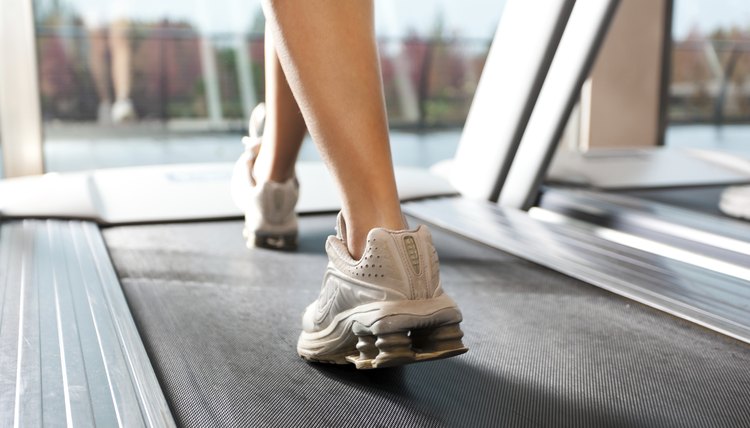
Treadmills are an invaluable training tool for runners who cannot get outside due to the weather, dangerous conditions or scheduling problems. Running on a treadmill offers similar calorie-burning and cardiovascular benefits as running outside. However, there are differences that must be taken into account when using a treadmill. Many coaches and experts recommend setting a slight incline when running on a treadmill to help account for these differences.
Expert Insight
A study from August 1996 in the Journal of Sports Science investigated what incline could make running on the treadmill more accurately duplicate the energy output of outdoor running. In this study, researchers from the University of Brighton in the United Kingdom had nine trained male runners run for six minutes at various speeds at various inclines ranging from 0 to 3 percent. The runners were also tested when running outdoors on a flat road. The researchers tested participants’ oxygen intake—or VO2 max--during each of the runs. They found that a 1 percent grade best matched the intensity of outdoor running.
Wind Resistance
One of the reasons a treadmill run at a zero percent incline is easier than running outdoors is the lack of wind resistance. On a treadmill, you do not move against the air. According to Rick Morris, author of Treadmill Training for Runners, outdoor air resistance can increase the difficulty of your run between 2 and 10 percent. The faster you run, the greater the effect of air resistance.
Terrain Factors
Outdoor terrain is always changing slightly. Even a flat road features bumps, divots and minor hills. Your running surface often changes, too—from a trail to concrete paths to asphalt—creating subtle differences in challenge. A treadmill belt never changes, so setting a slight incline makes a greater challenge which better represents outdoor experiences.
Form Considerations
Your form changes when you run on a treadmill versus outdoors. According to Olympic running coach Nicholas Romanov, your body naturally leans slightly forward when running outdoors. On the treadmill, you should run more upright and quickly pick up your feet because the movement of the belt creates a drag on the feet that, over time, may lead to injury. Dr. Romanov advocates an incline of 1 to 3 percent to mimic the body-leaning-forward position assumed outdoors.
Potential
Running at 1 percent simulates outdoor flat terrains, but you can use the treadmill to run more substantial hills too. Commercial treadmills found in gyms can reach inclines as high as 30 percent, and can also incline downward. Running higher hills improves your ability to use oxygen, enables you to run at higher intensities and enhances your overall running technique. Use a treadmill to simulate hilly outdoor courses that you might encounter in a race.
Explore In Depth
References
- Journal of Sports Sciences: A 1% Treadmill Grade most Accurately Reflects the Energetic Cost of Outdoor Running.
- Eston R. Use of ratings of perceived exertion in sports. Int J Sports Physiol Perform. 2012;7(2):175-82.
- Catapano JS, Chapman AJ, Farber SH, et al. Treadmill associated head injuries on the rise: an 18 year review of U.S. emergency room visits. Brain Inj. 2018;32(6):800-803. doi:10.1080/02699052.2018.1458149
- Van der worp MP, Ten haaf DS, Van cingel R, De wijer A, Nijhuis-van der sanden MW, Staal JB. Injuries in runners; a systematic review on risk factors and sex differences. PLoS ONE. 2015;10(2):e0114937. doi:10.1371/journal.pone.0114937
- Graves JM, Iyer KR, Willis MM, Ebel BE, Rivara FP, Vavilala MS. Emergency department-reported injuries associated with mechanical home exercise equipment in the USA. Inj Prev. 2014;20(4):281-5.
- Lahart I, Darcy P, Gidlow C, Calogiuri G. The effects of green exercise on physical and mental wellbeing: A systematic review. Int J Environ Res Public Health. 2019;16(8)1352.
- Rector RS, Rogers R, Ruebel M, Widzer MO, Hinton PS. Lean body mass and weight-bearing activity in the prediction of bone mineral density in physically active men. J Strength Cond Res. 2009;23(2):427-35.
- Van der Worp MP, Ten Haaf DS, Van Cingel R, De Wijer A, Nijhuis-Van der Sanden MW, Staal JB. Injuries in runners: A systematic review on risk factors and sex differences. PLoS ONE. 2015;10(2):e0114937.
Writer Bio
Andrea Boldt has been in the fitness industry for more than 20 years. A personal trainer, run coach, group fitness instructor and master yoga teacher, she also holds certifications in holistic and fitness nutrition.