What Are the Causes of White Spots on Tan Skin?
White spots on the skin become more noticeable with a tan. This often prompts people to search for the cause. Most white spots are not due to a serious medical condition.
Vitiligo, tinea versicolor and post-inflammatory hypopigmentation are among the most common causes of white spots on the skin. Consultation with a dermatologist can help determine the cause and begin appropriate treatment.
Vitiligo
Possible treatments include:
- topical medications
- various types of light therapy
- depigmentation of surrounding skin
- tattooing to add color to the affected areas and
- occasionally
- surgery
Tinea Versicolor
How to Restore the Pigment to White Spots on the Skin
Learn More
Tinea versicolor is a fungal infection of the skin that can interfere with melanocytes. Spots appear, which may be scaly and mildly itchy. The spots are often white, although they can also be pink, tan or brown. Tinea versicolor is usually found on the back, chest and neck.
Teenagers and young adults are most frequently affected. Although the fungus is naturally present on healthy skin, factors such as humidity, excessive sweating or a weakened immune system can cause it to overgrow and produce tinea versicolor.
Over-the-counter antifungal creams or shampoos are usually effective treatment, but prescription-strength topical or oral medications are sometimes needed. The spots may persist for weeks or months after the fungus is successfully eradicated. Although it is caused by a fungus, tinea versicolor is not contagious.
- Tinea versicolor is a fungal infection of the skin that can interfere with melanocytes.
Post-Inflammatory Hypopigmentation
Post-inflammatory hypopigmentation refers to white spots that develop after any condition causing skin inflammation. The spots appear when inflammation interferes with the ability of melanocytes to function as pigment producers.
Eczema, psoriasis and allergic dermatitis are common skin conditions that may produce hypopigmentation.
The tendency for a person to develop post-inflammatory hypopigmentation often runs in families. Over time, the white spots may improve or even disappear on their own. Treatments are similar to those used for vitiligo.
- Post-inflammatory hypopigmentation refers to white spots that develop after any condition causing skin inflammation.
Poikiloderma of Civatte
White Blotches on the Chest
Learn More
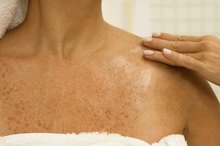
Poikiloderma of Civatte is a chronic skin condition caused by sun damage, especially in fair-skinned adults. White patches with a lacy appearance form on the neck and chest, intermixed with darker areas and redness.
These skin changes usually produce no symptoms, but some people notice mild burning or itching. Poikiloderma of Civatte is not cancerous 5. There is no cure, but protective clothing and sunscreens are important to prevent further sun damage and worsening of the condition. Topical medications and laser therapy may be helpful.
- Poikiloderma of Civatte is a chronic skin condition caused by sun damage, especially in fair-skinned adults.
Lichen Sclerosus
Lichen sclerosus is a disorder that begins as small, smooth white spots on the skin. It most commonly affects the genital and anal areas but may also occur in other locations, including the back, chest, shoulders and upper arms.
Itching is common. The cause of lichen sclerosus is unknown 2.
Treatment generally includes corticosteroid creams. When found in the genital region, lichen sclerosus may increase the risk of developing vulvar cancer in women and cancer of the penis in men.
Reviewed by Mary D. Daley, MD.
- Lichen sclerosus is a disorder that begins as small, smooth white spots on the skin.
- Treatment generally includes corticosteroid creams.
Related Articles
How to Restore the Pigment to White Spots on the Skin
Learn More

White Blotches on the Chest
Learn More
White Blotches on Elbows
Learn More
Scalp Conditions That Cause Hair Loss
Learn More

Facial Fungus: The Symptoms
Learn More
Diseases that Cause Eczema
Learn More

Acne & Freckles
Learn More
Eczema, Psoriasis, Ringworm & Arnica
Learn More

How to Get Rid of White Spots on the Scalp
Learn More

How to Stop the Itch of Folliculitis
Learn More
References
- Merck Manual Professional Version: Vitiligo
- National Institutes of Arthritis and Muskuloskeletal and Skin Diseases: Lichen Sclerosus
- American Family Physician: Common Pigmentation Disorders
- National Health Service: Lichen Sclerosus
- American Osteopathic College of Dermatology: Poikiloderma of Civatte
- American Academy of Dermatology: Tinea Versicolor
- Harada K, Saito M, Sugita T, Tsuboi R. Malassezia species and their associated skin diseases. J Dermatol. 2015 Mar;42(3):250-7. doi:10.1111/1346-8138.12700
- Gupta AK, Foley KA. Antifungal treatment for pityriasis versicolor. J Fungi (Basel). 2015 Mar 12;1(1):13-29. doi:10.3390/jof1010013
- Hudson A, Sturgeon A, Peiris A. Tinea versicolor. JAMA. 2018 Oct 2;320(13):1396. doi:10.1001/jama.2018.12429
- Karray M, McKinney WP. Tinea (Pityriasis) Versicolor. In: StatPearls [Internet]. Treasure Island (FL): StatPearls Publishing; 2019 Jan-. Updated April 1, 2019.
- Kaushik N, Pujalte GG, Reese ST. Superficial fungal infections. Prim Care. 2015 Dec;42(4):501-16. doi:10.1016/j.pop.2015.08.004
- Renati S, Cukras A, Bigby M. Pityriasis versicolor. BMJ. 2015 Apr 7;350:h1394. doi:10.1136/bmj.h1394
Resources
Writer Bio
Gianna Rose is a registered nurse certified in hospice and palliative care, as well as a certified wellness coach. She completed Duke Integrative Medicine's Mindfulness-Based Stress Reduction course in 2009. Rose also holds a Bachelor of Fine Arts from the Savannah College of Art and Design.