
What Really Happens to Your Body When examines the head-to-toe effects of common behaviors, actions and habits in your everyday life.
It's no secret that a well-balanced plant-based diet boasts plenty of health perks. After all, who can argue with the fact that eating more fruits and vegetables is a smart choice?
That said, some of the changes that can follow from switching to a vegetarian diet aren't totally intuitive.
Video of the Day
Video of the Day
So while a plant-based diet may help you sleep better, improve your heart health and bolster your microbiome, it's also possible you may find yourself feeling less energized and missing out on some critical nutrients.
If you're considering completely cutting meat, poultry and fish out of your diet, here's how your body will likely respond.
Related Reading
Your Energy
On one hand, switching to a nutritious plant-rich diet may help you feel more energized as you replace processed animal products like bacon and deli meats with filling whole foods like produce, whole grains and nuts and seeds.
But, there's a catch. Taking animal products off your plate also means you might lose out on certain nutrients. Take iron, for example. While the important nutrient is present in plant foods like spinach and soybeans as non-heme iron, it's significantly more bioavailable when it comes from animals (in the form of both heme and non-heme iron), per the U.S. National Library of Medicine (NLM).
Here's why it's so important to get a sufficient amount of iron into your diet: Iron's prime function is to carry oxygen throughout the body, which allows your cells to produce energy.
"Low iron can lead to chronic fatigue, hair loss, dizziness, weakness, headaches, pale skin and fast heartbeat, amongst other symptoms," says Maria Pena, MD, assistant professor of medicine, endocrinology, diabetes and bone disease at the Icahn School of Medicine at Mount Sinai.
In fact, vegetarians are more likely to have significantly lower iron stores than their meat-eating peers, according to May 2018 research in Critical Reviews in Food Science and Nutrition.
"Since iron isn't easily absorbed from plant-based sources, the recommended intake of iron for vegetarians is almost double that recommended for non-vegetarians," explains Maria E. Fraga, RD, dietitian and diabetes program manager of The Diabetes Alliance at the Mount Sinai Health System.
Iron is especially pertinent to menstruating women, women with heavy periods or those with pre-existing iron-deficiency anemia, she adds. "Iron deficiencies can arise within several months if there is no adequate replacement."
"If a person decides to cut fish and meat from their diet, they should get non-heme sources of iron from foods such as lima and red kidney beans, chickpeas, dried apricots, baked potatoes, wheat germ and pumpkin and sesame seeds," Dr. Pena tells us.
Tip
To help your body better absorb iron, pair iron-containing plant foods with foods that are rich in vitamin C, such as strawberries, citrus fruits, tomatoes, bell peppers, cabbage and broccoli.
Your Gut Health
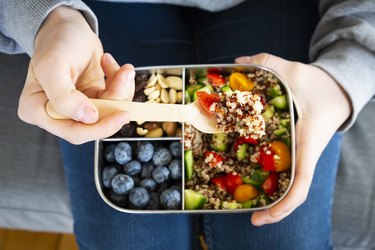
If you feel like gut health rules the wellness world these days, you're not wrong. The makeup of your gut microbiome matters since the bacteria that reside in the large intestine play an important role in your health, according to a July 2019 article in Nutrients.
"Meat, particularly red meat and processed meats, can promote inflammation in the gut, which, in turn, alters good bacteria and can lead to digestive problems such as constipation and bloating."
While we're all on board with our own individualized microbiomes, lifestyle factors — including what we eat — have the power to alter our microbiome for better or for worse.
"Meat, particularly red meat and processed meats, can promote inflammation in the gut, which, in turn, alters good bacteria and can lead to digestive problems such as constipation and bloating," says Dr. Pena.
Loading up on veggies tends to have the opposite effect. Vegetarian diets (as well as Mediterranean-style diets) have been found to positively alter the gut microbiome, a September 2018 study in The Journal of Nutrition suggests.
Researchers speculate that when you remove meat and fish from your diet, you'll likely increase your intake of anti-inflammatory plant foods, many of which contain gut-healthy prebiotics and probiotics.
A quick refresher: Prebiotics are non-digestible carbohydrates that help the good bacteria in our gut thrive, Fraga says. You can find prebiotics in certain fruits (like bananas and apples), vegetables and whole grains. Probiotics are live microbes that are found in fermented foods like kefir, yogurt and sauerkraut, as well as supplements.
You may notice some more immediate effects in your digestion within weeks after switching to a vegetarian diet, Dr. Pena adds.
Your Sleep (and Mood)
Eating more plants might just bring you better zzzs. "The high isoflavone content of a plant-rich diet may be responsible for enhancing sleep quality," DJ Blatner, RDN, dietitian and author of The Flexitarian Diet, tells LIVESTRONG.com.
Isoflavones are plant compounds predominantly found in soybeans, and people who ate a diet rich in isoflavones were observed to enjoy better sleep quality and even reduced depressive symptoms, per a December 2015 study in Nutrition Journal.
What's more, researchers deemed isoflavones a well-tolerated option to help manage depression in a December 2017 Menopause study.
Filling your plate with fruits and veggies beyond soy may also boost your mood. There are a handful of potential mechanisms behind this association, but one has to do with the fact that diets comprised mostly of meat, poultry and fish can be high in arachidonic acid, an inflammatory polyunsaturated omega-6 fat.
"Research shows that a high intake of arachidonic acid promotes changes in the brain that can actually disturb your mood," says Blatner.
And compared to omnivorous diets, vegetarian diets tend to have a higher carbohydrate to protein ratio, which enables more tryptophan (an amino acid) to enter the brain where it gets converted to mood-boosting serotonin, research in the book Vegetarian and Plant-Based Diets in Health and Disease Prevention notes. Talk about a happy meal (plan)!
Your Weight
Before you switch to a plant-based diet to shed pounds, know this: "A change in your meal plan of any kind can lead to mild to moderate weight loss depending on how long you follow the plan for," Fraga says.
In other words, there's no need to ditch animal products for the sole purpose of slimming down.
However, you might see a favorable change on the scale once you switch to a plant-filled diet. Compared to omnivores, vegetarians were observed to have significantly reduced body mass index (BMI), according to a June 2017 meta-analysis in Critical Reviews in Food Science and Nutrition.
"A person following a plant-based meal plan may also experience weight loss because of the lower caloric content of their lean protein and plant-based food choices," explains Fraga. "Meats and animal-based foods can be more caloric due to their fat content."
Tip
To maintain lean body mass when you ditch animal foods, load up on foods like spinach, Greek yogurt, wheat germ and quinoa, Fraga suggests.
“Spinach is a good source of glutamine and is important for muscle growth, while Greek yogurt is higher in protein than regular yogurt. Wheat germ is rich in zinc, iron, selenium, potassium, B vitamins, fiber and protein, but you'll want to avoid it if you're gluten-free. Quinoa is one of the only plant foods that's a complete protein, meaning it contains all nine essential amino acids to help build and maintain muscle."
Your Heart Health
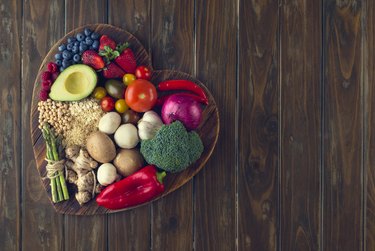
"Some of the pros of cutting out meat and other sources of animal fat is a decrease in cholesterol levels and less inflammation in the body," Dr. Pena says.
"This, in turn, can lead to less plaque buildup and a reduction in heart-related issues." You can expect to see your cholesterol levels improve at around the two- to three-month mark, she adds.
In fact, following a vegetarian meal plan is associated with a 40-percent decreased risk of heart disease, according to a May 2018 study in the journal Progress in Cardiovascular Diseases.
And a vegetarian diet full of nuts, vegetables and soy is linked to a lowered risk of total, ischemic and hemorrhagic strokes in people over 50, according to a February 2020 study in Neurology.
What's more, plant protein is associated with a lower risk of all-cause and heart disease mortality — meanwhile, replacing foods high in animal protein with plant protein sources is tied to longevity, a July 2020 BMJ meta-analysis found.
Another study highlights TMAO, a metabolite that's produced when gut bacteria digest nutrients in animal foods such as red meat, which is linked to an increased risk of heart disease.
Researchers observed that following either a vegetarian or vegan diet helped lower TMAO produced in the body, which suggests going veg might be able to reduce the risk of heart disease, according to the February 2020 study in the Journal of the American College of Cardiology.
It bears noting that nixing fish from your diet is another story, largely because of omega-3 fatty acids. According to Dr. Pena, omega-3s may benefit heart health by decreasing triglycerides, lowering blood pressure slightly, reducing blood clotting and irregular heartbeats and lowering one's risk of stroke and heart failure.
"Eating at least two servings a week of fish, particularly fish that's rich in omega-3 fatty acids, appears to reduce the risk of heart disease, particularly sudden cardiac death," adds Dr. Pena.
While there are concerns surrounding the mercury and antibiotic content of certain types of fish, seafood certainly isn't the enemy when it comes to your heart wellness. In fact, you may actually miss out on critical heart-healthy nutrients when you swipe seafood from your plate.
Your Nutrition Status
While nutrients like iron occur in both plant and animal foods, some critical vitamins are present only in animal products.
As a result, cutting meat, poultry and fish out of the diet can result in deficiencies if you aren't committed to eating a varied diet and taking appropriate supplements.
"Vitamin B12 is one of the most common deficiencies that can occur from eating a vegan or vegetarian diet," says Fraga. That's because B12 naturally occurs exclusively in animal foods like clams, trout, beef, salmon and tuna. Of course, some veggie-friendly items like nutritional yeast are often fortified with the vitamin.
Omega-3s and zinc are two other nutrients that you might be missing on a plant-based meal plan. "Omega-3 fatty acids are very important for maintaining heart health," says Fraga.
The good news: "While fish and eggs are commonly thought of as rich sources [of omega-3s], you can also find these essential fats in chia seeds, flaxseeds, walnuts and hemp seeds."
Tip
If you’re newly vegetarian, focus first and foremost on including a wide variety of different foods in your diet. “You may also want to consider taking certain supplements to ensure that you are getting the right amount of essential nutrients,” Fraga recommends.
“Look for a vegan or vegetarian multivitamin that contains B12, iodine and zinc, and don’t take any iron supplements unless your doctor recommends it.”
The Takeaway
Removing animal products like meat, poultry and fish from your diet can come with some pretty impressive health (and environmental) benefits, from better heart health to improved sleep quality.
But there are also potential drawbacks to switching to a vegetarian diet. In particular, if you aren't careful about eating well-balanced meals, you could fall short on critical vitamins and minerals.
When it comes to how long it'll take for these changes to occur, "It depends," says Dr. Pena.
"You may notice some more immediate effects in your digestion within weeks, while iron deficiencies can arise within several months if there is no adequate replacement. Changes in weight and cholesterol levels can take at least two to three months to appear."
If you're considering switching to a vegetarian diet, talk to your doctor or registered dietitian to learn more about how to modify your meal plan in a safe and sustainable way.
Related Reading
- Critical Reviews in Food Science and Nutrition: “The Effect of Vegetarian Diets on Iron Status in Adults: A Systematic Review and Meta-Analysis”
- Progress in Cardiovascular Diseases: “Vegetarian Dietary Patterns and Cardiovascular Disease”
- The Journal of Nutrition: “Dietary Patterns Affect the Gut Microbiome—The Link to Risk of Cardiometabolic Diseases”
- Academic Press: Vegetarian and Plant-Based Diets in Health and Disease Prevention
- Nutrition Journal: "Relationship between daily isoflavone intake and sleep in Japanese adults: a cross-sectional study"
- Menopause: "Evaluation of the Potential Antidepressant Effects of Soybean Isoflavones"
- National Institutes of Health: "Iron"
- Journal of the American College of Cardiology: "Long-Term Changes in Gut Microbial Metabolite Trimethylamine N-Oxide and Coronary Heart Disease Risk"
- Neurology: "Vegetarian diet and incidence of total, ischemic, and hemorrhagic stroke in 2 cohorts in Taiwan"
- BMJ: "Dietary intake of total, animal, and plant proteins and risk of all cause, cardiovascular, and cancer mortality: systematic review and dose-response meta-analysis of prospective cohort studies"
- U.S. National Library of Medicine: "Biochemistry, Iron Absorption"
- Nutrients: "Gut Microbiome: Profound Implications for Diet and Disease"