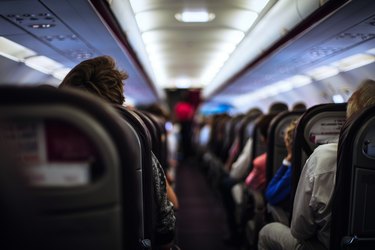
Nobody likes long airline flights. Unless you're flying first class, the limited leg room in coach class can lead to stiff and cramped legs. For many people, this won't result in long-term consequences; however, for certain populations, it can be life-threatening if blood clots form in the legs.
If you're at high-risk for clotting, your doctor can prescribe medication. However, moving about the cabin frequently and doing DVT prevention exercises on an airplane can also help prevent a miles-high catastrophe.
Video of the Day
Video of the Day
What Is DVT?
The National Heart, Lung, and Blood Institute states that deep vein thrombosis, or DVT, is a condition in which blood clots form in the body's deep veins, especially in those of the legs. In some cases, DVT can lead to a pulmonary embolism — and sudden death — if a blood clot breaks off and gets lodged in a lung.
Dehydration from the dry air of a plane cabin can cause the blood to thicken. Combine that with the immobility created by cramped seats and low cabin pressure, and you have a recipe for blood clotting in the legs.
Not everyone is at risk. According to the American Council on Exercise, those predisposed to clotting include:
- Individuals with cancer, or those who have chronic heart or respiratory failure
- People with a predisposition to clotting, obesity or varicose veins
- People who have recently had major surgery, been bed ridden or endured a leg injury
- Women who are pregnant or who have recently given birth; women who take contraceptives or those undergoing hormone replacement therapy
- People who are 40 years old and older
Exercises in Flight
A frequently cited review published in 2011 by the Cleveland Clinic Journal of Medicine suggests getting up and walking around for about five minutes every hour on long flights of four hours or more. While you're seated, promote circulation with these exercises:
Ankle circles: Raise your feet off the floor. Point your toes and move them around in a circle, moving one foot clockwise and the other counter clockwise.
Foot lifts: Start with your feet flat on the floor. Keeping your heels on the floor, lift your toes up as high as they can go. Return both feet flat on the floor; then keeping your toes on the floor, lift your heels up as high as you can. Continue to alternate back and forth.
Knee lifts: Bend one knee and raise that leg off the seat. Contract the thigh muscles. Lower the leg and switch sides. Alternate back and forth for 20 to 30 repetitions.
Knee-to-chest: Bend forward slightly. Interlace your hands around the top of your shin, just below your knee. Pull the knee into your chest. Hold the position for 15 seconds; then slowly lower the leg back down. Switch sides. Repeat several times.
Standing Plane Exercises
When you're safely able to move about the cabin, get up and walk around. If that is discouraged, you can often stand in the aisle by your seat or in the areas near the bathrooms. Take these opportunities to do some standing DVT prevention exercises on the plane to promote circulation.
Calf raises: Hold on to a seat back or other sturdy object for support. Stand with your feet hip-distance apart and slowly rise up onto your toes. Hold for a second or two; then slowly lower down. Repeat 10 to 20 times.
Marching in place: Bend one knee, bringing it up as high as you can. Return to standing and switch sides. Repeat 10 to 20 times.
Quadriceps stretch: Bend one knee bringing the foot up toward your butt. Keep your knees in line and take hold of the ankle of your lifted foot with the same-side hand. Pull the foot into your butt. Hold for 15 seconds, Release and switch sides.
Forward fold: Separate your feet and fold forward at your hips. Keep a slight bend in your knees. Reach your fingers to your shins or the floor. Hold for 15 seconds. Slowly roll up to standing vertebra by vertebra to avoid lightheadedness.
- American Council on Exercise: "How to Avoid Deep Vein Thrombosis on Long Plane Flights"
- National Institutes of Health: "What Is Deep Vein Thrombosis?"
- Cleveland Clinic Journal of Medicine: "Air Travel and Venous Thromboemolism: Minimizing the Risk"
- American Council on Exercise: Standing Calf Raises - Wall
- MayoClinic.com: Pulmonary Embolism: Risk Factors