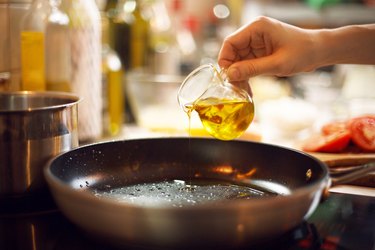
Despite being demonized in the '80s and '90s, fats are actually essential to a balanced diet. Healthy fats help supply energy, support cell growth, protect your organs, produce hormones and absorb certain nutrients, according to the American Heart Association. And the oils you cook with are simply mixtures of fats.
In fact, oils are 100 percent fat. But when it comes to the classification of fats, some offer health benefits and others don't.
Video of the Day
Video of the Day
- Unsaturated fats: These fats include monounsaturated (MUFAs) and polyunsaturated fats (PUFAs) and are primarily found in plants and fatty fish. They help lower your risk of heart disease by improving your cholesterol levels. Both MUFAs and PUFAs are thought to lower total cholesterol, but MUFAs might raise HDL (good cholesterol) while PUFAs might actually lower HDL, Clemson University notes.
- Saturated fats: Found in animal-based foods like meat and dairy, these fats can raise your cholesterol levels. Try to replace some of the saturated fat in your diet with unsaturated fats, per the Harvard T.H. Chan School of Public Health.
- Trans fats: These are associated with higher cholesterol levels, inflammation and insulin resistance, according to the Harvard T.H. Chan School of Public Health. That means diets high in saturated and trans fats can increase your risk of heart disease and stroke, per the AHA. Partially hydrogenated vegetable oils (PHOs) are trans fats and should be avoided. PHOs are the main source of artificial trans fats in processed foods and are linked to heart attacks and death, per the FDA.
Cooking with an oil above its smoke point can also change its health benefits. A smoke point is the temperature at which the oil starts to smoke and break down and therefore lose some of its nutritional value, according to the Mayo Clinic. Different fats have different smoke points, but regardless of what type it is, fat supplies 9 calories per gram, making it the nutrient highest in calories.
Check out this breakdown of healthy cooking oils' smoke point and nutrition facts per tablespoon, according to the USDA. Then keep scrolling to find out about the nutrition info of nine different oils, whether they're OK to cook with and how they may (or may not) benefit your body.
Oil Type | Calories | Total Fat | Saturated Fat | MUFAs | PUFAs | Smoke Point |
|---|---|---|---|---|---|---|
Olive Oil | 119 | 13.5 g | 1.9 g | 9.85 g | 1.42 g | 350 – 468 F |
Grapeseed Oil | 120 | 13.6 g | 1.3 g | 2.19 g | 9.5 g | 390 F |
Avocado Oil | 124 | 14 g | 1.6 g | 9.8 g | 1.8 g | 482 F |
Sesame Oil | 120 | 13.6 g | 1.9 g | 5.3 g | 5.6 g | 350 – 480 F |
Vegetable Oil | 124 | 14 g | 1.9 g | 5.8 g | 5.7 g | 460 F |
Coconut Oil | 121 | 13.5 g | 11.2 g | 0.8 g | 0.2 g | 350 – 400 F |
Black Seed Oil | 105 | 12 g | 3 g | – | – | – |
1. Olive Oil
A staple and main source of fat in the traditional Mediterranean diet, olive oil is made up of monounsaturated fatty acids, per the Mayo Clinic.
A 1-tablespoon serving of olive oil has the following nutrition profile, according to the USDA:
- Calories: 119
- Total fat: 13.5 g, 17% Daily Value (DV)
- Saturated fat: 1.9 g
- Monounsaturated fat: 9.85 g
- Polyunsaturated fat: 1.42 g
- Cholesterol: 0 mg
- Smoke point:
- Extra-virgin olive oil: 350 – 410 F
- Olive oil or light olive oil: 390 – 468 F
Olive oil is associated with lower rates of heart disease by lowering bad cholesterol. And extra-virgin olive oil — which is made by pressing olives until oil is extracted rather than via chemicals and other processes — is rich in polyphenols, plant compounds that act as antioxidants.
Extra-virgin olive oil proved to be the most stable cooking oil under heat, according to a June 2018 study in Acta Scientific Nutritional Health, which means it doesn't lose a lot of its nutritional value when heated. So, it's the best kind of oil for roasting vegetables.
Roasting vegetables in olive oil enriches flavor, lending a smoky sweetness or tender texture, but it also increases the calories. For example, this Roasted Cauliflower dish is around 60 calories per serving. Of course, the number of calories in roasted vegetables with olive oil varies depending on the veggies you use.
Related Reading
2. Grapeseed Oil
Grapeseed oil is a byproduct of the winemaking process, and is made by crushing the seeds to extract their oil. As for grapeseed oil nutrition facts, 1 tablespoon contains:
- Calories: 120
- Total fat: 13.6 g, 17% DV
- Saturated fat: 1.3 g
- Monounsaturated fat: 2.19 g
- Polyunsaturated fat: 9.5 g
- Cholesterol: 0 mg
- Smoke point: 390 F
According to an August 2016 study in Nutrition and Metabolic Insights, grapeseed oil may have anti-inflammatory, heart-protective and anti-cancer properties.
Grapeseed oil has a moderately high smoking point, making it an excellent choice for frying and sautéing, per the Cleveland Clinic. And it's rich in cholesterol-lowering polyunsaturated fats, namely omega-6 fatty acids. Because grapeseed oil is high in calories, however, it may contribute to weight gain if eaten in excess.
As for grapeseed oil's nutritional benefits, it's an excellent source of vitamin E, an antioxidant that helps prevent cell damage in your body and strengthens your immune system, according to the U.S. National Library of Medicine (NLM). One tablespoon of grapeseed oil contains 3.9 milligrams of vitamin E, which is 26 percent of your DV.
3. Avocado Oil
Avocado oil is the natural fat extracted from the fruit of the avocado tree. This oil is similar in texture and taste to olive oil.
Here's avocado oil's nutrition info per 1-tablespoon serving:
- Calories: 124
- Total fat: 14 g, 18% DV
- Saturated fat: 1.6 g
- Monounsaturated fat: 9.8 g
- Polyunsaturated fat: 1.8 g
- Cholesterol: 0 mg
- Smoke point: 482 F
Like olive oil, avocado oil is rich in the monounsaturated fat oleic acid, which is why it's so heart-healthy, according to the U.S. Food and Drug Administration (FDA). You can use it for cooking as it performs well at high temperatures, according to a June 2019 article in Molecules.
Avocado Oil vs. Olive Oil
According to a July 2019 article in Foods, avocado and olive oils are both very potent, functional oils. They’re both associated with lower levels of cholesterol, oxidative stress, inflammation and blood pressure. While avocado oil has slightly higher levels of polyunsaturated fats and higher omega-6 to omega-3 ratios than olive oil, olive oil takes the win for more vitamin E, per the Molecules report.
But regardless of their slight differences, they’re both great oils to cook with and use in dressings and dips.
4. Sesame Oil
Sesame oil is the extracted oil of the sesame seed. Sesame seeds flavor cookies, candy, bread, salads, tahini, sauces and countless meat dishes.
Here's a breakdown of sesame oil nutrition per 1 tablespoon:
- Calories: 120
- Total fat: 13.6 g, 17% DV
- Saturated fat: 1.9 g
- Monounsaturated fat: 5.3 g
- Polyunsaturated fat: 5.6 g
- Cholesterol: 0 mg
- Smoke point: 350 – 480 F
While there are 120 calories in sesame oil, there are 0 grams of carbs in sesame oil.
The oil comes in dark and light varieties. Light sesame oil can be made from either slightly cooked seeds or cold-pressed seeds (unrefined), while dark comes from toasted seeds. The nutrition info doesn't vary much between varieties.
Some recipes just call for a few drops for flavoring. The lower smoke point of the light, cold-pressed oil makes it good for sauces and salads, while the higher smoke point of the dark oil makes it great for sautéing.
Sesame oil's fat content is a combo of mono- and polyunsaturated fats, but because the PUFAs are slightly higher, it's usually considered polyunsaturated.
Remember, MUFAs might raise good cholesterol while the PUFAs might actually lower it — so if your cholesterol levels are a concern, speak with your doctor to find out if you need to cut back on sesame oil.
5. Vegetable Oil
Because of its high smoke point and neutral flavor, many folks use vegetable oil for frying and sautéing various dishes. Generally, commercial vegetable oil is made from soybeans, according to the North American Olive Oil Association. Canola, corn and cottonseed are also common in vegetable oil.
Here's a breakdown of vegetable oil nutrition facts per 1-tablespoon serving:
- Calories: 124
- Total fat: 14 g, 18% DV
- Saturated fat: 1.9 g
- Monounsaturated fat: 5.8 g
- Polyunsaturated fat: 5.7 g
- Cholesterol: 0 mg
- Smoke point: 460 F
Among the vegetable oils containing polyunsaturated fats are safflower, corn, sunflower, soy and cottonseed oils. When it comes to vegetable oils' fat content, those with monounsaturated fats include olive oil, certain seed oils like canola and sesame and nut oils like peanut oil. Coconut and other tropical oils contain primarily saturated fat.
Vegetable oil contains around 124 calories per tablespoon, so if you're watching your calorie intake, use vegetable oils sparingly. Talk to a doctor or registered dietitian before taking any vegetable oil for specific health benefits.
6. Coconut Oil
Despite its high saturated fat content, coconut oil is popular for its rich flavor and mild coconut aroma. A 1-tablespoon serving of coconut oil has the following according to the USDA:
- Calories: 121
- Total fat: 13.5 g, 17% DV
- Saturated fat: 11.2 g
- Monounsaturated fat: 0.8 g
- Polyunsaturated fat: 0.2 g
- Cholesterol: 0 mg
- Smoke point:
- Unrefined: 350 F
- Refined: 400 F
When it comes to the nutritional value of coconut oil, most of the fat in coconut oil is saturated; therefore, it's solid at room temperature. The fats in coconut oil have been shown to raise LDL cholesterol, according to the Harvard T.H. Chan School of Public Health, but more research is needed.
Coconut oil is known for bumping up good cholesterol levels. Your body uses medium-chain triglycerides (MCTs) — the type of fat found in specially formulated coconut oil — as they're processed more efficiently for energy, rather than being stored. But this doesn't apply to commercial coconut oil found on supermarket shelves and, again, more research is needed.
Although coconut oil may have potential benefits, it is still high in saturated fat as well as calories, so enjoy it in moderation.
Can You Microwave Coconut Oil?
Some people may think that microwaving coconut oil ruins it, but that's simply not true. Melting coconut oil above its smoke point breaks it down, but microwaved foods don't usually reach such high temps.
7. Black Seed Oil
Black seed oil refers to the oil of Nigella sativa, a flowering plant native to southwestern Asia and parts of Europe. Black seed is also known as black cumin or black caraway.
Here's a rundown of the known black seed oil nutrition facts per tablespoon:
- Calories: 105
- Total fat: 12 g, 18% DV
- Saturated fat: 3 g
Traditionally, the oil is used to treat respiratory and inflammatory disorders, according to a May 2013 article in the Asian Pacific Journal of Tropical Biomedicine, but there's limited research in humans supporting those uses.
The oil is an abundant source of fatty acids and a substance called thymoquinone, which is being studied as a potential anti-cancer agent, according to Memorial Sloan Kettering Cancer Center. Another potential health benefit of black seed oil is that it's associated with lower blood pressure as well as treatment for asthma, rheumatoid arthritis and diabetes.
Among its active ingredients are several antioxidants. Black seed oil also contains iron, copper, zinc, phosphorus, calcium, thiamin, niacin, pyridoxine, and folic acid as well as high levels of linoleic acid (a polyunsaturated fat), according to a May 2019 article in Evidence-Based Complementary and Alternative Medicine.
Warning
Black seed oil might increase the risk of side effects of drugs that contain cytochrome P450 substrate enzymes, such as certain antidepressants. Topical use of the oil could cause an allergic reaction, and high doses were shown to cause kidney and liver damage in rats, but human studies are needed, per Memorial Sloan Kettering Cancer Center.
Oils to Avoid
1. Castor Oil
Castor oil use dates back to ancient times, when Egyptians used the oil from the castor seeds as a fuel for lamps, according to the Marion Institute. Over the years, people have used castor oil topically to try to heal lymphatic tissue and cure skin cancer, among other ailments.
However, there's no scientific evidence that castor oil boasts these benefits.
According to CosmeticsInfo.org, 90 percent of the fatty acids in castor oil are ricinoleic acid, which is a monounsaturated fatty acid.
While castor oil calories come from fat, you shouldn't use castor oil for cooking, as it is a yellowish liquid mostly used as a lubricant or grease as well as a laxative, per the NLM.
Talk to a medical professional before taking castor oil, especially if you're pregnant. Large doses of castor oil can also be poisonous, as it contains the toxin ricin, according to the NLM.
2. Mustard Oil
Mustard oil comes from mustard seeds. Compared to other popular cooking oils, mustard oil has less monounsaturated fat than olive, flaxseed, grapeseed and peanut oil. Check out the mustard oil nutrition facts per 1-tablespoon serving:
- Calories: 124
- Total fat: 14 g, 18% DV
- Saturated fat: 1.6 g
- Monounsaturated fat: 8.2 g
- Polyunsaturated fat: 2.9 g
- Smoke point: 480 F
Pure or expressed mustard oil is banned for cooking use in the United States and other parts of the world, per the FDA. Mustard seeds contain erucic acid (a type of monounsaturated fat) that may pose risks.
The European Food Safety Authority reports that erucic acid has adverse health effects in animals, such as heart, liver and kidney issues, and may have the same effect on humans. While you shouldn't use mustard oil for cooking, essential oil of mustard is allowed, per the FDA. Essential oil of mustard is typically used externally but can be used for flavoring, too.
- American Heart Association: "Dietary Fats"
- Harvard T.H. Chan School of Public Health: "Types of Fat"
- Mayo Clinic: "Which Type of Oil Should I Use for Cooking With High Heat?"
- Mayo Clinic: "Why Should I Choose Olive Oil Over Other Types of Fat?"
- Ardmore Institute of Health: "Health Benefits of Olive Oil"
- Acta Scientific Nutritional Health: "Evaluation of Chemical and Physical Changes in Different Commercial Oils During Heating"
- Nutrition and Metabolic Insights: "Grape Seed Oil Compounds: Biological and Chemical Actions for Health"
- Cleveland Clinic: "How to Choose and Use Healthy Cooking Oils"
- MedlinePlus: "Vitamin E"
- Office of Dietary Supplements: "Vitamin E"
- Marion Institute: "Castor Oil: "An Essential for Health"
- CosmeticsInfo.org: "Ricinoleic Acid"
- MedlinePlus: "Castor Oil Overdose"
- American Association of the Advancement of Science: "Just a Spoonful of Castor Oil"
- Molecules: "Avocado Oil: Characteristics, Properties, and Applications"
- U.S. Food and Drug Administration: "FDA Completes Review of Qualified Health Claim Petition for Oleic Acid and the Risk of Coronary Heart Disease"
- Foods: "Determining the Arrhenius Kinetics of Avocado Oil: Oxidative Stability under Rancimat Test Conditions"
- Kendall College at National Louis University: "he Complete Beginner’s Guide to Indian Spices"
- International Journal of Science and Research: "Ultrasonic Studies on Mustard Oil: A Critical Review"
- FDA: "Import Alert 26-04"
- European Food Safety Authority: "Erucic Acid a Possible Healh Risk for Highly Exposed Children"
- Center for New Crops & Plant Products: "Sesame:
- Clemson Cooperative Extension: "Fat in Your Diet"
- Food & Function: "Sesamol: A Powerful Functional Food Ingredient From Sesame Oil for Cardioprotection"
- North American Olive Oil Association: "Olive Oil vs Vegetable Oil"
- Los Angeles County Department of Public Health: "Partially-Hydrogenated Oils"
- Harvard T.H. Chan School of Public Health: "Coconut Oil"
- Asian Pacific Journal of Tropical Biomedicine: "A Review on Therapeutic Potential Nigella sativa: A Miracle Herb"
- Memorial Sloan Kettering Cancer Center: "Nigella sativa"
- Evidence-Based Complementary and Alternative Medicine: "Nigella sativa L. (Black Cumin): A Promising Natural Remedy for Wide Range of Illnesses"
- Food Chemistry: "Various Concentrations of Erucic Acid in Mustard Oil and Mustard"
- SFGate: "Toasted Sesame Oil Vs. Sesame Oil"
- Serious Eats: The Truth About Mustard Oil: Behind the 'For External Use Only' Label"
- North American Olive Oil Association: "Understanding Cooking Oil Smoke Points"
- MasterClass: "Cooking Oils and Smoke Points: What to Know and How to Choose the Right Cooking Oil"
- The Vegetarian Health Institute: "Smoke Point of Oils"
- Cleveland Clinic: How to Choose and Use Healthy Cooking Oils