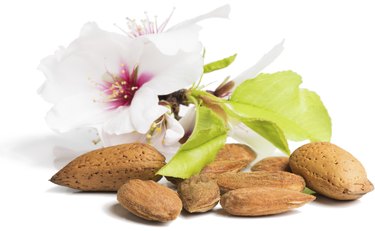
Since losing their undeserved status as a nutritional outcast, nuts have secured a more accurate reputation as a nutrient-dense food that promotes cardiovascular health and helps protect against weight gain and Type 2 diabetes. Among other attributes, most nuts are rich in L-arginine, an amino acid essential to growth, immunity and hormone secretion. The body also uses L-arginine to manufacture nitric oxide, a compound that makes arteries more flexible and less susceptible to blood clots.
Best Sources
Video of the Day
Black walnuts and almonds contain more L-arginine than most other nuts. One ounce of chopped black walnuts -- or about a one-quarter-cup serving -- delivers about 1,130 milligrams of L-arginine, according to the U.S. Department of Agriculture. The same amount of oil-roasted almonds supplies close to 970 milligrams of the nutrient, while raw almonds provide about 880 milligrams per serving. Mixed nuts are another top source -- one-quarter cup of oil-roasted mix nuts with peanuts contains about as much L-arginine as a serving of oil-roasted almonds. You'll get about 815 milligrams of the amino acid from one-quarter cup of pine nuts.
Video of the Day
Good Sources
Most kinds of nuts provides less than 800 milligrams of L-arginine per ounce, and roasted nuts generally contain more than the raw variety. A one-quarter-cup serving of whole Brazil nuts contains just over 710 milligrams, while you'll get right around 680 milligrams from the same amount of dry-roasted pistachios. English walnuts, hazelnuts and oil-roasted cashews are only slightly lower in L-arginine, supplying an average of about 645 milligrams per serving. With 470 milligrams per serving, macadamia nuts are about 50 percent lower in L-arginine than almonds. Pecans contain even less – one-quarter cup of the oil-roasted variety has about 325 milligrams of L-arginine.
Daily Intake
L-arginine is a conditionally essential amino acid, meaning that certain people can't synthesize it or may need more for a short time. Most healthy people, however, make enough L-arginine from the amino acids supplied by a varied diet. There are no specific dietary guidelines for L-arginine because getting enough protein more or less ensures a sufficient supply of amino acids. While it's generally recommended that protein accounts for 10 to 35 percent of your daily calories, men and women are advised to aim for about 56 grams and 46 grams of protein a day, respectively. Most Americans get more than enough protein, according to the Centers for Disease Control and Prevention.
Some Considerations
Nuts -- along with meat, poultry, fish, dairy products and chocolate -- are among the top sources of L-arginine, but legumes and whole grains also contain moderate amounts. Because L-arginine is critical to immunity and wound healing, boosting the amount in your diet can be especially beneficial when you're recovering from illness or injury. If you experience recurrent cold sores, however, you may want to curb your intake of L-arginine-rich foods leading up to and during an outbreak. According to the "Encyclopedia of Healing Foods," L-arginine promotes the replication of herpes simplex, the virus that causes cold sores.