
What does fact checked mean?
At SportsRec, we strive to deliver objective content that is accurate and up-to-date. Our team periodically reviews articles in order to ensure content quality. The sources cited below consist of evidence from peer-reviewed journals, prominent medical organizations, academic associations, and government data.
- American College of Sports Medicine: ACSM Issues New Recommendations on Quantity and Quality of Exercise
- American College of Sports Medicine: ACSM Issues New Recommendations on Quantity and Quality of Exercise
The information contained on this site is for informational purposes only, and should not be used as a substitute for the advice of a professional health care provider. Please check with the appropriate physician regarding health questions and concerns. Although we strive to deliver accurate and up-to-date information, no guarantee to that effect is made.
What Are the ACSM Guidelines for Strength Training?
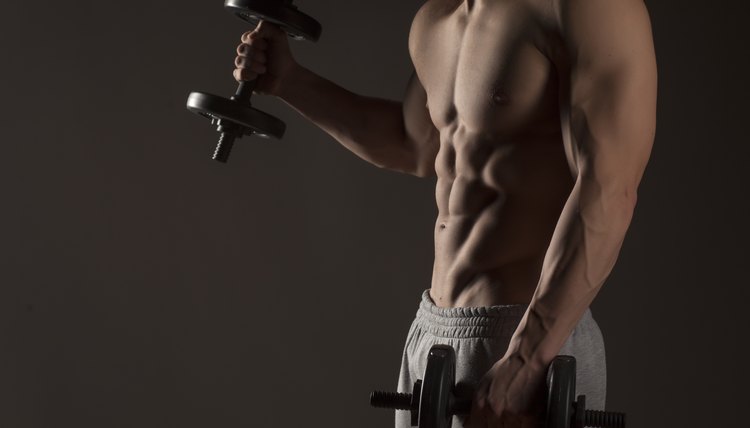
The American College of Sports Medicine, founded in 1954, publishes physical activity guidelines for the public to take into consideration. ACSM's most recent strength-training guidelines were established in 2011. Their position statement provides basic guidelines and principles to help you establish a strength training program.
Finding Your Frequency
ACSM recommends that healthy adults train two to three times per week. If you are an older adult or have been sedentary, start with two times per week and choose light intensity exercises. Spread your resistance training sessions out throughout the week. ACSM suggests a 48 hour break between sessions.
Deciding on Sets and Reps
ACSM recommends eight to 10 different exercises. Start by doing eight to 12 repetitions of each exercise to improve strength and power. To improve muscular endurance, increase to 10 to 15 repetitions. Select a weight that you reach fatigue within the given repetition range -- that's the point when you don't think you can lift one more repetition with proper form. When you can complete one to two repetitions more than the recommended range, increase the weight by 2 to 10 percent.
Choosing Exercises
Choose exercises that target all of the major muscle groups. Include compound and isolation exercises, but focus most of your training around compound exercises. Isolation exercises are single-joint movements that target only one muscle group. Triceps pressdowns and biceps curls are isolation exercises. Compound exercises are multijoint movements that work more than one muscle group. Squats, chest presses, overhead presses and deadlifts are compound exercises.
Learning Technique
Learn the proper technique for each exercise. Do not use momentum or jerky motions to move a weight. Start with light weights and increase the resistance over time as you become stronger. Do not hold your breath. Exhale during the exertion phase of the movement and inhale during the lowering phase. These are basic guidelines for those seeking general health and fitness benefits. If you are training for a specific goal, such as muscle growth or strength, you will need to adjust your program.
References
- American College of Sports Medicine: ACSM Issues New Recommendations on Quantity and Quality of Exercise
- Community Colleges of Spokane: ACSM Resistance Weight Training Guidelines
- Medicine & Science in Sports & Exercise: Progression Models in Resistance Training for Healthy Adults
- Gentil P, Soares S, Bottaro M. Single vs. Multi-Joint Resistance Exercises: Effects on Muscle Strength and Hypertrophy. Asian J Sports Med. 2015;6(2):e24057. doi:10.5812/asjsm.24057
- American College of Sports Medicine. Amercian College of Sports Medicine Position Stand: Progression Models in Resistance Training for Healthy Adults. Medicine & Science in Sports & Exercise. 2009;41(3):687-708. doi:10.1249/mss.0b013e3181915670.
Writer Bio
Based in Austin, Texas, Jolie Johnson has been in the fitness industry for over 12 years and has been writing fitness-related articles since 2008 for various websites. She received her Bachelor of Arts in English and philosophy from the University of Illinois.