
What Is the Role of Sports in Socialization?
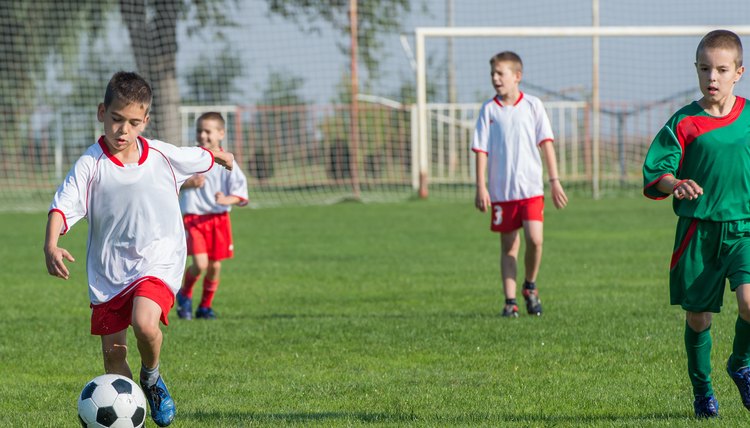
Socialization is “the process by which a human being beginning at infancy acquires the habits, beliefs, and accumulated knowledge of society through education and training for adult status,” according to Merriam-Webster. Research suggests sports play both a positive and negative role in socialization, not only between young athletes and their peer group, but also between children and adults. Research also indicates that sports play differing roles in socialization for boys and girls.
Part of a Team
Sports foster identity and friendship. “Sports participation helps create a social identity,” Ann Rosewater wrote in a 2009 study published by Team-Up for Youth. She cited previous research where “high school youth participating in organized sports activities viewed sports as providing a place to meet other young people ‘who had at least one shared interest.’” Indeed, a Wheelock/Boston Youth Sports Initiative 2010 study said “that quality sport programs can help to develop and maintain healthy relationships amongst youth.”
Boys and Girls
Sports may help boys and girls socialize in different ways, and this may be either a positive or a negative. Rosewater writes, “Sports participation socializes boys into traditional gender roles, while similar participation socializes girls into nontraditional gender roles.” She says sports have an additional social benefit for female high school student-athletes, who “find participation in sports to be a way to break gender stereotypes, enhancing their sense of possibility.”
Kids and Adults
Youth sports can also help children learn to interact with adults such as parents and their teachers. The Wheelock/BYSI study reports that the same “quality sport programs” that can benefit interactions between children may also benefit exchanges between “youth and adults.” Rosewater’s research suggests a ripple effect. “Parents promote children’s social development and social skills by enrolling them in programs,” she wrote. “(These) skills can improve children’s relationships with their teachers.”
Warning Signs
Athletes might participate in unhealthy social activities: “skipping school, cutting classes, having someone from home called to the school for disciplinary purposes, and being sent to the principal’s office,” Rosewater reported. She also noted, “Abuse of alcohol by adolescents who participate in competitive sports is a social phenomenon — that is, a function of the peer group with which the students are associated.” But she said, “Some studies also show that teens participating in sports report lower use of alcohol than those who are not involved in sports activities.”
References
Writer Bio
Based in Massachusetts, Richard Tenorio has been a full-time sports writer and editor since 2002. His sports articles have appeared in the "Daily Item" of Lynn, Mass. Tenorio holds a B.A. in history from Harvard University and an M.S. in journalism from Columbia University.