
Gluteus Medius Spasms and Cycling
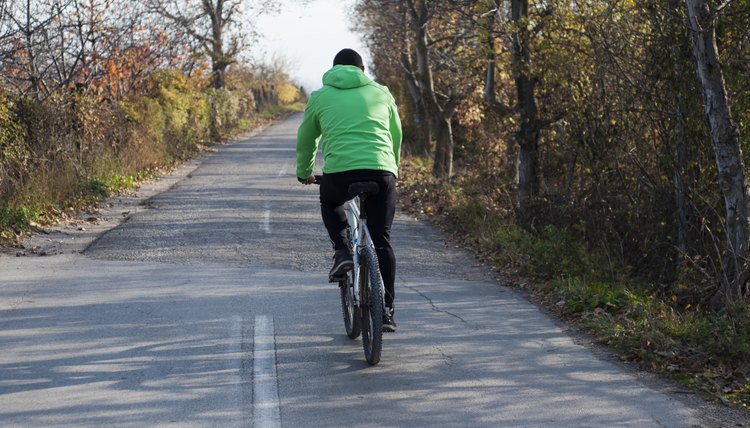
Cycling is considered a low-impact activity, meaning it places little impact on the joints, particularly the knees. While cycling isn't a weight-bearing exercise, it's still possible to sustain an injury or pull a muscle while riding a bike. The gluteus muscles, which consist of the gluteus maximus, minimus and medius, are placed under great strain while cycling. They form part of the powerhouse in the pedal stroke, especially during a seated climb or while pushing a hard gear. It's possible to overwork the gluteus, including the gluteus medius, causing a muscle spasm.
Gluteus Medius
The gluteus medius inserts at the outer surface of the ilium, below the crest, and attaches at the greater trochanter of the femur. It plays a major role in the support of your pelvis. When you pedal, the gluteus medius is responsible for keeping your hips stable. It also abducts and partially flexes the hip. If weakness in the muscle occurs, the cyclist will generally show a rocking in the hips, and the pelvis moves out and upward in the saddle. This disrupts the power transfer from the glutes to the pedals, forcing other muscles to compensate and causing the athlete to use more energy in the process.
Muscle Spasm
When a cyclist continues to push the weakened gluteus medius, a muscle strain or pulled muscle can result. This is the first step in the injury. If left untreated or if the athlete continues to strain the muscle, it can develop into a spasm. A spasm results from the inflammation that occurs around a strained or overstretched muscle. Tightness occurs and, unless treated, the muscle will develop knots or trigger points, which can be very painful.
Treatment
When a gluteus medius muscle spasm progresses into a trigger point, the pain is often felt along the iliac crest, which is the backside of the top of the pelvic bone. The pain may feel like lower back pain, but it's instead caused by the gluteus medius. Find a good sports massage therapist to work on the muscle, and treat the pain with over-the-counter anti-inflammatory pain relievers and ice. You can also sit and roll on a tennis ball to try to loosen the muscle. It's important to decrease your exercise until the pain diminishes and the muscle loosens.
Other Considerations
To avoid future problems, first consider your bike fit. Have a professional fitter assess your position and make any necessary changes. Your pedals may be incorrectly positioned or you might be placing your feet too far to the back of the pedals, both of which can lead to spasms in the gluteus medius. You might also be pedaling with your hips slightly abducted, which can also lead to overuse and spasms of the gluteus minimus. You may need to consult a physical therapist to work on a muscle imbalance or an instability inside the pelvis. Also, be sure to stretch the gluteals after a ride, but be careful not to overstretch them. Slowly build up your miles and the intensity of your rides to reduce the chance of overstraining the gluteus medius again.
References
- ABC News: What Causes Muscle Spasms and What Is the Best Way to Treat Muscle Spasms?
- Sportsinjuryclinic.net: Gluteus Medius
- Cycling Anatomy: Shannon Sovndal
- Sources:
- Moore, Keith, L. and Dalley, Arthur, F. Clinically Oriented Anatomy. 5th Edition. Lippincott, Williams and Wilkins, A Wolters Klower Company.
- Tortera, Gerard J. Principles of Human Anatomy. 6th Edition. Biological Sciences Textbooks, Inc. New York. 1996. Baltimore. 2006.
Writer Bio
A professional writer since 2004, Abby Roberts holds a Bachelor of Arts in writing and has worked as a magazine editor, a staff writer and as a freelance writer for "Muscle and Fitness Hers" magazine. Roberts also produces a blog for female cyclists. She has experience working with cyclists in different facets of training and performance enhancement.