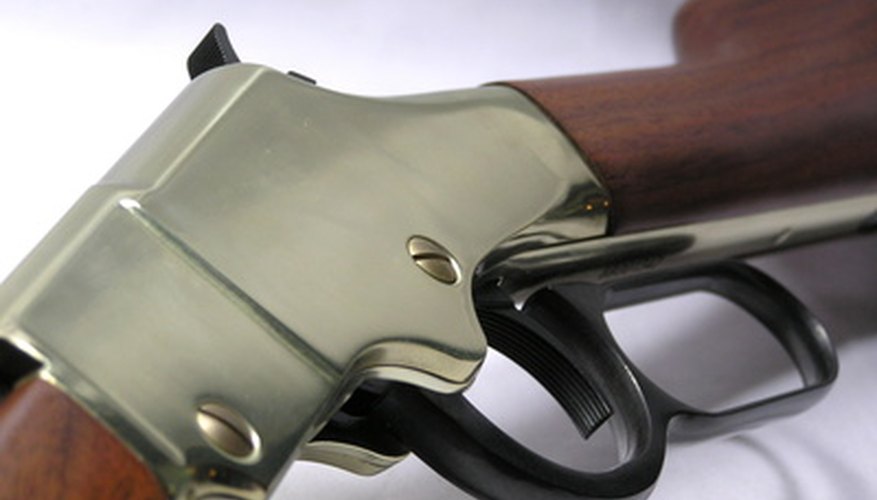


Although open sights are often perceived as old-fashioned and lacking in pinpoint accuracy, they offer numerous advantages over telescopic sights. Open sights, also known as iron sights, are not affected by adverse weather conditions. They're also inexpensive, lightweight and incredibly durable. In very thick cover, open sights make it easier to aim at a target otherwise obscured by brambles or foliage. Of course, properly sighting in your rifle's open sights is essential before you head out to the field.
Items you will need
Paper targets
Ammunition
Sandbag rest or tripod (optional)
Set your target up at a distance of 100 yards. Ensure that the area behind the target is clear, meaning that there are no structures or roads in the background. It's good practice to set your target in front of a small hill or rise in the landscape, as this will serve to stop any stray bullets.
Move to your shooting area. If you wish to sight-in your rifle with greater accuracy, use a sandbag and shooting bench or tripod to help you steady the firearm. Load three cartridges into the weapon.
Position the front post on the end of the rifle in the center of the rear notch or "V" sight. The post should be aligned perfectly within the "V" as well as the bull's eye of the target.
Fire three to five shots at the target, gently squeezing the trigger for each shot. Do not jerk or pull the trigger, as this will affect your accuracy. Also, it's important that you attempt to keep the rifle in the same position for each of the three shots.
Examine your target to see where the bullets struck. If you did not hit the bull's eye, don't worry. Go back to your shooting area and adjust the sights. If you missed to the left, move your sight slightly to the right. If you missed right, move it left. For shots that were too high, move the sight down. Conversely, for shots that were too low, move the sights higher Make only very slight adjustments.
Set up a new target and fire another three to five shots from 100 yards. Once again, examine the target and make the proper adjustments.
Fine tune your open sights until you're firing a group of three to five shots within 1 to 2 inches of each other. The group should be centered on the target, lined up exactly with where you're aiming.
Tips
- If you have a bolt-action rifle with open sights, you can help sight it in more quickly through what's known as bore-sighting. Simply position your rifle firmly on a sandbag and remove the bolt. Look through the open barrel from the rear and center it on your target. Then, while making sure you do not move the rifle, adjust your open sights so that they are centered on the target as well. Replace the bolt and fire three shots at the target. You should find that you're already hitting the target fairly close to center. Afterward, continue to fine-tune your sights by firing successive groups of three to five shots.
References
Tips
- If you have a bolt-action rifle with open sights, you can help sight it in more quickly through what's known as bore-sighting. Simply position your rifle firmly on a sandbag and remove the bolt. Look through the open barrel from the rear and center it on your target. Then, while making sure you do not move the rifle, adjust your open sights so that they are centered on the target as well. Replace the bolt and fire three shots at the target. You should find that you're already hitting the target fairly close to center. Afterward, continue to fine-tune your sights by firing successive groups of three to five shots.
Writer Bio
Arthur Barnhouse has written numerous short stories, contributed content to various websites and was an invited speaker at a university symposium on creative writing. He began writing in 2002 and holds a Bachelor of Arts in English literature from the University of Pittsburgh. Barnhouse has driven across the United States numerous times and draws upon his travel experiences in his writing.