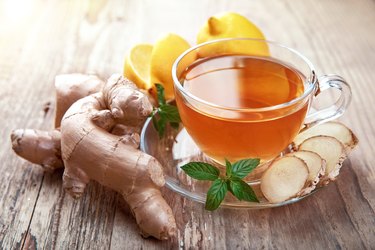
For thousands of years, ginger (Zingiber officinale) has been prized for its medicinal effects, according to the National Institute of Health (NIH).
Native to Asia, ginger is readily available as a candy, capsule or tea, per Johns Hopkins Medicine. Ginger tea has been well-studied and may offer benefits, according to the NIH. Take a look at some potential health benefits of ginger tea.
Video of the Day
Video of the Day
How to Make Ginger Tea
To brew your own ginger tea, simmer a 1-inch piece of the root in 4 cups of water, then strain and drink, according to OncoLink. You can also find packaged ginger teas. Make sure to opt for teas with ginger as the main ingredient, rather than those containing traditional tea with some ginger flavor.
1. Ginger Tea Is Good for Digestion and Nausea
One of ginger's greatest claims to fame is its ability to relieve nausea. Researchers have long studied ginger's potential as a treatment for conditions such as pregnancy- or chemotherapy-induced nausea and vomiting.
And although larger and well-controlled studies are still needed, a March 2016 review in Integrative Medicine Insights suggests ginger could have some benefits when it comes to fighting nausea — but it may not be as effective as medication.
The same review suggests that ginger tea may also help relieve stomachaches caused by bloating and indigestion, although more research is needed to confirm.
Warning
The American Pregnancy Association states that fresh ginger tea is possibly safe during pregnancy, but talk to your doctor before drinking it to be sure. Do not exceed 4 grams of ginger in one day, including ginger found in cookies, bread and ginger ale, according to OncoLink.
Ginger tea made from dried root is not advisable during pregnancy. Read labels carefully, and if you buy a tea marketed to pregnant people that has ginger, be sure that it does not contain other herbs that are unsafe during pregnancy, like nettles, alfalfa and yellow dock, per the American Pregnancy Association.
2. Ginger Tea May Treat Uncomfortable Gas
Ginger is reputed to act as a carminative — a compound that helps to break apart pockets of gas in the digestive tract.
Ginger tea may ease the pain associated with digestive gas and help the body release it, according to an April 2015 review in European Review for Medical and Pharmacological Studies,
One particular April 2015 study in the Journal of Evidence-Based Complementary and Alternative Medicine found that a combination of ginger and artichoke extract stimulated gastric emptying in people with functional dyspepsia, a condition marked by chronic pain in the upper abdomen.
Although it could cause belching and heartburn, no scientific evidence suggests that ginger makes gas worse.
Warning
Side effects from ginger are rare, according to PeaceHealth. Still, drinking too much ginger tea may cause unpleasant reactions such as a stomachache, heartburn or diarrhea.
Check with your doctor before drinking ginger tea if you have gallstones or are taking blood-thinning medication, per the NIH.
3. Ginger Tea Could Help Relieve Pain
Ginger may help relieve pain, per a November 2020 review in Phytotherapy Research. The review looked at 10 years of randomized clinical trials and found that ginger may lower inflammation due to delayed-onset muscle soreness (DOMS) as well as potentially ease pain in people with knee arthritis.
That means drinking ginger tea after tough workouts may help you cope with exercise-related muscle pain.
4. Ginger Tea May Soothe Menstrual Cramps
The same Phytotherapy Research review noted that "six eligible studies suggest a promising effect of oral ginger" when it comes to dysmenorrhea (aka painful menstrual cramps).
Ginger also is used for nausea and an upset stomach — symptoms that sometimes accompany menstruation.
5. Ginger Tea Might Help Skin Inflammation
Ginger's anti-inflammation benefits may extend to your skin, the largest organ in your body. Ginger contains antioxidants called gingerols, which tame inflammation, per a July 2014 review in Natural Product Communications. That matters because inflammation is one of the causes of acne, per the Mayo Clinic.
In one small September 2014 study in Focus on Alternative and Complementary Therapies, 31 participants who took ginger supplements for six months saw "encouraging results" for acne. More research — with a larger number of participants and a placebo trial design — is needed, per the study authors.
6. Ginger Tea May Relieve a Sore Throat
Ginger tea is one of the most common and effective remedies for a cough, according to the Flushing Hospital Medical Center.
Apart from plenty of rest, any warm liquid, like tea or broth, can help soothe your throat, according to Harvard Health Publishing. Other sore throat remedies include gargling with warm salty water and sucking on throat lozenges.
Most cases of sore throat are caused by bacterial or viral infections and are usually resolved within a week, according to the Mayo Clinic. But a sore throat can sometimes be a sign of other health conditions, like HIV, oral cancer or throat cancer.
While drinking homemade tea for sore throat can help relieve some of your discomfort, it may not be able to address the underlying cause of your illness. You should see your doctor if your sore throat lasts longer than a week.
What About Lemon-Ginger Tea?
You can also combine lemon and ginger together. Lemon-ginger tea is an infusion of lemon juice and ginger root, rather than a true tea made with the leaves of the tea plant.
The Flushing Hospital Medical Center recommends drinking honey and lemon ginger tea three or four times a day to soothe a sore throat, relieve coughing and improve congestion.
- The Journal of Pain: Ginger (Zingiber Officinale) Reduces Muscle Pain Caused by Eccentric Exercise
- McKinley Health Center: Menstrual Cramps (Dysmenorrhea)
- BMC Complementary and Alternative Medicine: Effect of Zingiber Officinale R. Rhizomes (Ginger) on Pain Relief in Primary Dysmenorrhea: A Placebo Randomized Trial
- American Pregnancy Association: Drinking Herbal Teas During Pregnancy
- Natural Product Communications: Biological Properties of 6-Gingerol: A Brief Review
- Mayo Clinic: Acne
- National Psoriasis Foundation: About Psoriasis
- Focus on Alternative and Complementary Therapies: Prospective, non-randomised, open-label study of homeopathic Zingiber officinale (ginger) in the treatment of acne vulgaris
- Flushing Hospital Medical Center: Treating a Cough Naturally
- PeaceHealth: Ginger
- Harvard Health Publishing: Sore Throat
- Mayo Clinic: Sore Throat
- Integrative Medicine Insights: The Effectiveness of Ginger in the Prevention of Nausea and Vomiting during Pregnancy and Chemotherapy
- European Review for Medical and Pharmacological Studies: Can nausea and vomiting be treated with ginger extract?
- Journal of Evidence-Based Complementary and Alternative Medicine: The Effect of Ginger (Zingiber officinalis) and Artichoke (Cynara cardunculus) Extract Supplementation on Functional Dyspepsia
- Phytotherapy Research: Clinical trials on pain lowering effect of ginger: A narrative review