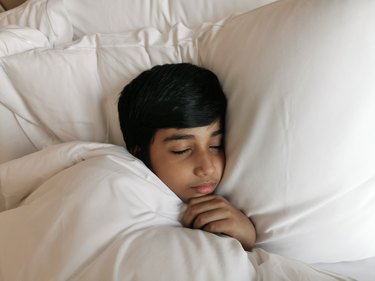
Does your child have difficulty sleeping? Then perhaps you've considered melatonin for kids, a supplement version of a naturally occurring hormone that helps regulate sleep.
But before you give your kid this sleep aid, talk to your doctor. Discussing your child's sleep issues and the best melatonin dosage for your kid will help make sure they receive the help they need to get solid shut-eye.
Video of the Day
Video of the Day
Tip
While more research is needed to understand the long-term effects of melatonin in children, a small 0.5- to 1-milligram dose of the supplement about 30 to 90 minutes before bed may help your child get better sleep. Kids under 3 years old should not take melatonin.
Is Melatonin Safe for Kids?
Melatonin is a hormone that helps regulate your body's wake-sleep cycle, or circadian rhythm, per the Sleep Foundation. Natural melatonin secretion is low during daylight hours and increases at night — largely in response to darkness — to help you fall and stay asleep.
You can also take melatonin as a gummy, capsule or powder supplement to potentially improve your snoozes. And these supplements show promise as a short-term strategy (meaning days or weeks) to help kids develop healthy sleep habits, per the American Academy of Pediatrics (AAP).
For instance, melatonin supplements could help kids with sleeping problems fall asleep faster, per a March 2019 analysis in Sleep Medicine. It may also help children stay asleep longer, according to an April 2019 review in the Journal of Child Neurology. This may be particularly true for kids with neurodevelopmental conditions like autism spectrum disorder or attention-deficit/hyperactivity disorder, per the Boston Children's Hospital.
However, most of the research about melatonin supplements focuses on adults, so more studies are needed to better understand the long-term effects of using melatonin for kids' sleep health. That's why the AAP recommends always talking to your child's doctor before giving them melatonin to make sure the supplement is the best solution for their sleep issues.
Can You Give Infants Melatonin?
Melatonin supplements are not recommended for babies because it could mess with their still-developing circadian rhythms, according to the Sleep Foundation. If your infant is having trouble sleeping, work with your pediatrician to determine the source of their problems and treatment options.
Melatonin Dosage for Kids
There isn't enough research to recommend one specific amount of melatonin for kids, per the Sleep Foundation, so it's best to work with your pediatrician to calculate the best melatonin dosage for your child.
That said, in general, the AAP advises starting small with a 0.5- or 1-milligram dose of melatonin about 30 to 90 minutes before bed. It's not recommended to exceed 6-milligram doses.
Melatonin dosage may also vary based on your child's weight — for instance, an 80-pound kid may be able to have more melatonin than a 50-pound child.
Age matters, too: The Boston Children's Hospital recommends against using melatonin for kids under 3 years old, as sleeping problems in kids that are 2 years old or younger are typically behavioral in nature and can be addressed without the help of a supplement.
How to Address Sleep Problems Without Melatonin
Per the AAP, most sleep difficulties in children are behavioral and typically respond well to non-medicinal sleep hygiene measures, including:
- Following a consistent sleep schedule
- Establishing a regular bedtime routine
- Avoiding stimulating activities before bed, like video games
- Powering down blue-light devices like tablets and phones at least an hour before bed
- Sleeping in a dark, quiet, cool and comfortable space
According to the Sleep Foundation, visiting your doctor before giving your child melatonin also provides an opportunity to check for medical problems that might interfere with sleep, such as:
- Teething
- Allergies
- Colds
- Ear infections
- Swollen tonsils or adenoids
- Restless legs syndrome
- Stress
Safety Considerations
Children typically take low doses of melatonin, so side effects — if there are any — are usually mild. Per the Boston Children's Hospital, possible side effects include:
- Morning sleepiness
- Drowsiness
- Increased bedwetting
- Headaches
- Dizziness
- Agitation
- Nightmares
In addition to its role in sleep, melatonin may also influence puberty and reproductive function, per a January 2019 review in the Nature and Science of Sleep. For this reason, there is concern that long-term use of melatonin supplements in young children might delay or negatively affect sexual development.
However, there's little research on the topic and studies are needed to determine the relationship between melatonin and puberty, according to the review.
It's also worth noting that the FDA does not require melatonin supplements to be proven safe or effective before they are sold, so there's no guarantee that what you take is safe, contains the ingredients it says it does or produces the effects it claims.
Warning
Melatonin supplements are not recommended for anyone with an autoimmune disease, per the Mayo Clinic.
- Sleep Foundation: "Melatonin and Sleep"
- Sleep Medicine: "Efficacy and safety of melatonin for sleep onset insomnia in children and adolescents: a meta-analysis of randomized controlled trials"
- Journal of Child Neurology: "Pharmacologic Treatments for Sleep Disorders in Children: A Systematic Review"
- American Academy of Pediatrics: "Melatonin and Children’s Sleep"
- Sleep Foundation: "Should You Give Melatonin To Children?"
- Mayo Clinic: "Melatonin"
- Sleep Foundation: "Melatonin Dosage: How Much Melatonin Should You Take"
- Sleep Foundation: "Children and Sleep"
- Boston Children's Hospital: "Five things to know about melatonin for kids"
- Nature and Science of Sleep: "Could long-term administration of melatonin to prepubertal children affect timing of puberty? A clinician’s perspective"
- FDA: “FDA 101: Dietary Supplements”
- AHRQ; Melatonin for Treatment of Sleep Disorders; N. Buscemi, et al.; November 2004