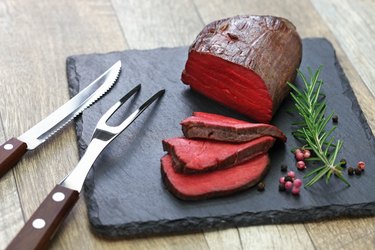
Swapping out venison in favor of other meats may be a beneficial health choice if you have high levels of LDL ("bad") cholesterol. That's because a 3.5-ounce serving of venison (100 grams) contains between 79 and 113 milligrams of cholesterol. That's more than the cholesterol in most other meats, both red and white.
What Is Cholesterol?
Video of the Day
Dietary cholesterol — which is listed on most nutrition labels — is different from blood cholesterol. There are two main types of cholesterol in your body:
Video of the Day
- Low-density lipoprotein (LDL) cholesterol is commonly referred to as "bad" cholesterol.
- High-density lipoprotein (HDL) cholesterol is commonly referred to as "good" cholesterol.
Dietary and blood cholesterol are related, and eating foods that contain significant amounts of dietary cholesterol can contribute to elevated levels of the bad LDL cholesterol in some people.
Recommended Cholesterol Intake
Your blood cholesterol levels are not solely dependent on your diet; Harvard School of Public Health notes that in most cases, your body creates more cholesterol than it processes from your diet. Some people respond more strongly to dietary cholesterol intake.
According to the Dietary Guidelines for Americans, 2020 to 2025, healthy individuals should limit their daily dietary cholesterol intake to no more than 300 milligrams per day.
Cholesterol in Other Meats
A 3-ounce serving of broiled beef sirloin steak contains 75 milligrams of cholesterol, less than in the same serving of broiled venison. The same sized serving of broiled pork chops contains 66 milligrams of cholesterol, slightly less than in beef.
A serving of roasted skinless chicken breast contains 85 milligrams of cholesterol; a serving of roasted skinless turkey contains 68 milligrams of cholesterol; and a 3-ounce serving of bison contains 60 milligrams of cholesterol.
Fat Content
The fat content — particularly the saturated fat content — of your food also has a significant impact on your blood cholesterol. Venison can be beneficial in this regard, because it's naturally one of the leaner meats, with between 2 to 4 grams of total fat and 1 to 2 grams of saturated fat per serving.
Beef contains 8.22 grams of total fat and 3.19 grams of saturated fat; pork contains 12.20 grams of total fat and 3.69 grams of saturated fat; chicken contains 3.57 grams of total fat and 1.01 grams of saturated fat; turkey contains 1.77 grams of total fat and 0.504 grams of saturated fat; and bison contains 7.33 grams of total fat and 2.97 grams of saturated fat.
- Centers for Disease Control and Prevention: "High Cholesterol: Understand Your Risks"
- Harvard School of Public Health: "Fat and Cholesterol"
- USDA National Nutrient Database: "Deer, Venison"
- USDA National Nutrient Database: "Beef Sirloin Steak, Broiled"
- USDA National Nutrient Database: "Pork Chops, Broiled"
- USDA National Nutrient Database: "Chicken, Breast, Meat Only, Roasted"
- USDA National Nutrient Database: "Turkey, Skinless, Roasted"
- USDA National Nutrient Database: "Bison, Ground, Grass-fed, Cooked"
- US Department of Agriculture: "Dietary Guidelines for Americans, 2020 to 2025"
Was this article helpful?
150 Characters Max
0/150
Thank you for sharing!
Thank you for your feedback!
Is this an emergency? If you are experiencing serious medical symptoms, please see the National Library of Medicine’s list of signs you need emergency medical attention or call 911.