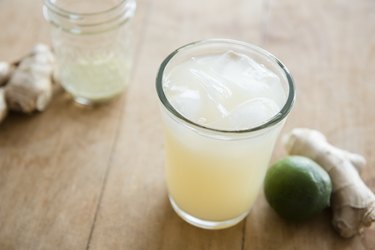
Many of us were taught growing up that drinking ginger ale can help with gastrointestinal issues like nausea. But is ginger ale good for you, or is it one of those health myths people continue to pass down through generations?
First off, what is ginger ale? It's a fizzy drink that contains ginger root or artificial flavoring to mimic the taste, according to the Cleveland Clinic.
Video of the Day
Video of the Day
You may also be wondering why ginger ale is good for you, potentially. Well, ginger has anti-inflammatory, anti-ulcer and antioxidant effects that may help relieve digestive distress, per the Cleveland Clinic.
However, the bubbly beverage may not be the best way to get ginger: "Not all ginger ale actually contains ginger," says Will Bulsiewicz, MD, a gastroenterologist and gut health expert in Mount Pleasant, South Carolina, and author of Fiber Fueled. "Obviously, if it doesn't contain ginger, what's the point? And if it does contain ginger, it generally isn't highly concentrated."
Dr. Bulsiewicz says there are some additional concerns in regards to drinking ginger ale for stomach issues, including the possibility that carbonation and sweeteners (whether sugar or an artificial sweetener) can actually worsen gas, bloating and diarrhea. It may be like taking one step forward and two steps back, he says.
So if you're looking to reap the benefits of drinking ginger ale, Dr. Bulsiewicz recommends instead opting for ginger tea, which is a more concentrated form of ginger without the carbonation or sugar.
At the very least, make sure the ginger ale that you select contains the actual root. Even better, opt for ginger beer: It typically has less sugar and more vitamins than ginger ale, according to the USDA.
Still, ginger ale has some health benefits. Below, explore what ginger ale is good for and why.
Tip
You can make your own tea with ginger root (which you can find at the grocery store) by peeling it and adding it to hot water or tea, per the Cleveland Clinic.
It Can Help With Nausea and Vomiting
Perhaps you've been told to drink warm or cold ginger ale for an upset stomach. As it turns out, there may be some truth to this: It's possible that ginger ale is good for nausea, stomachache and stomach flu symptoms.
For one, it can be good to drink ginger ale after throwing up, as it can help you hydrate if you're experiencing nausea and vomiting, according to the Mayo Clinic.
And here's why ginger is good when you're sick: According to a March 2014 review of the Nutrition Journal, it can significantly reduce nausea, including from morning sickness while you're pregnant.
A March 2016 study in Integrative Medicine Insights likewise found that ginger is an effective (and inexpensive) way to help prevent nausea and/or vomiting, especially if the cause is pregnancy or chemotherapy.
"It's particularly helpful with nausea," Dr. Bulsiewicz says. "My wife was scarfing it down when she had first trimester morning sickness during pregnancy."
That said, these studies only looked at the root and not ginger ale, so you're likely better off sticking to the natural ingredient.
It's also worth noting that flat ginger ale is better for an upset stomach than carbonated, as the bubbles can further irritate digestive distress, per Lehigh University. Heating up ginger ale to room or a warm temperature may also be more soothing while you're sick, according to the Mayo Clinic.
But it may be best to skip this beverage if your kid is sick — it's not likely that ginger ale will help a toddler or child with stomach flu. In other words, if you're wondering what to give a toddler with gastro, ginger ale isn't it, as it may worsen symptoms like diarrhea, per Kaiser Permanente. Instead, stick to children's oral electrolyte solutions or plain water.
Tip
If you're still curious about what not to give your three-year-old (or other child) for an upset stomach or a tummy virus in toddlers, it's also wise to skip Pepto. Per the Mayo Clinic, kids under age 12 shouldn't take it, so using Pepto-Bismol on a two-year-old, for example, isn't safe. Talk to your doctor about if children's Pepto could help with symptoms like diarrhea, nausea and vomiting, per the Cleveland Clinic.
It Can Support Your Immune System
Another ginger ale benefit is that the ginger root may help support your immune function.
A November 2016 meta-analysis in Food & Nutrition Research looked at nine different studies and observed that supplementing with ginger significantly reduced C-reactive protein levels, a marker for inflammation from conditions like heart disease, diabetes and arthritis.
A more recent study shows that ginger may also attack some common bacteria and pathogens, according to a June 2017 article in the International Journal of Molecular Science.
That said, these studies focused on ginger supplements and the root itself, not ginger ale, so more research is needed to determine whether ginger ale is good for you in the same ways.
Tip
There's also a long-standing belief that ginger ale helps with colds. But drinking excess added sugar on the daily won't help relieve your cold and congestion symptoms, according to Johns Hopkins Medicine.
Other Potential Ginger Ale Benefits
You may be wondering if there are any other upsides to sipping this fizzy drink. For instance, does ginger ale help with period cramps? Or is ginger ale good for high blood pressure or IBS?
When it comes to these purported perks, some hold true. Dr. Bulsiewicz says that ginger ale may help with painful period symptoms, arthritis pain, blood sugar regulation and weight loss.
"But that is all contingent on bioactive ingredients from ginger," he says. "The question is, what is the best way to deliver the ginger in an adequate amount and without any unnecessary ingredients?"
Does Ginger Ale Help With Gas and Bloating?
Perhaps you've heard that ginger ale is good for gas or for trapped gas while you're pregnant. But because the drink is carbonated, it may actually have the opposite effect, per the Cleveland Clinic.
Still, drinking ginger ale for gas that comes with other symptoms like nausea may be OK. "It's not as helpful for gas, bloating and diarrhea, although as something soothing for the gut with very little downside, it can be worth a try," Dr. Bulsiewicz says.
And again, your best bet is to drink warm, flat ginger ale or ginger beer when you have the stomach flu or are otherwise sick.
What to Try Instead
If it's ginger you're after, it's typically best to put down the fizzy can — there are more effective ways to go about it. Jackie Newgent, RDN, culinary dietitian and author of The Clean & Simple Diabetes Cookbook, tells us how.
1. Blend It in a Smoothie
Make a ginger ale-inspired smoothie by whirling the root into your favorite recipe. You can even juice it to add it to your go-to beverage.
Not into smoothies? Make a refreshing drink by adding ginger to sparkling water along with a squirt of lime juice and a sprig of fresh mint, Newgent says.
The general rule of thumb is to use about 1/2 teaspoon of grated fresh ginger root per serving of nearly anything, Newgent says. Of course, use a little less if you're unsure or go for more if you can't detect any of it in your food or beverage.
Tip
Try this delicious Ginger-Berry Smoothie that sneaks in spinach for some iron.
2. Create a S.A.S.S. Sauce or Dressing
Add ginger to an Asian sauce based on S.A.S.S — salty, acidic, sweet and spicy, Newgent says. For instance, whisk together soy sauce, rice vinegar, honey or coconut nectar and chili-pepper sauce and then finish it off with ginger. Toss the sauce with soba or udon noodles, scallions or cilantro and veggies of choice.
Add ginger into a fruity salad dressing made by blending together berries or other fruit, avocado oil and apple cider vinegar, then enjoy over salad greens.
Or whisk ginger into a sesame vinaigrette made with toasted sesame oil, rice vinegar, and a little honey or coconut nectar, then drizzle over salad greens with grilled shrimp, salmon or asparagus, Newgent says.
3. Add It to Soups
Simmer ginger into soups, like sweet potato, carrot, chicken noodle or tomato soup. It's OK to use soup from a carton or can — you don't need to make your own, Newgent says.
Tip
Whip up this tasty Carrot Ginger Soup With Mascarpone Cheese and Pomegranates.
4. Sip It in Tea
Simmer ginger into green or peppermint tea, then sip on it warm or iced, Newgent says. Plop in a lemon wedge, if you like. For a no-fuss alternative, buy and steep ginger herbal tea.
- Nutrition Journal: "A Systematic Review and Meta-Analysis of the Effect and Safety of Ginger in the Treatment of Pregnancy-Associated Nausea and Vomiting"
- USDA FoodData Central: "Ginger Beer"
- Food & Nutrition Research: "The effect of ginger supplementation on serum C-reactive protein, lipid profile and glycaemia: a systematic review and meta-analysis"
- Integrative Medicine Insights: "The Effectiveness of Ginger in the Prevention of Nausea and Vomiting during Pregnancy and Chemotherapy"
- International Journal of Molecular Science: "Antibacterial and Antifungal Activities of Spices"
- Cleveland Clinic: "Ginger Ale and Saltine Crackers? 5 Ways to Ease Stomach Pain and Nausea"
- Mayo Clinic: "Nausea and vomiting"
- Kaiser Permanente: "Vomiting and Diarrhea in Children"
- Mayo Clinic: "Bismuth Subsalicylate (Oral Route)"
- Cleveland Clinic: "Bismuth Subsalicylate tablets"
- Lehigh University: "Gastroenteritis Advice"
- Mayo Clinic: "7 ways to combat coughs and colds"
- Johns Hopkins Medicine: "The Do’s and Don’ts of Easing Cold Symptoms"