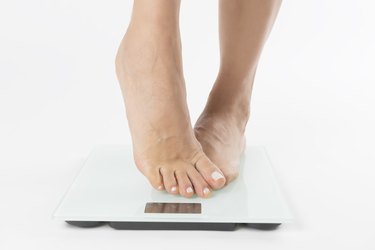
Oh, the tyranny of the bathroom scale. You've been eating right and exercising, but those numbers keep going in the wrong direction. Before you throw in the diet towel, consider trading in your old school scale for a more high-tech body composition monitor, like the Tanita scale.
These scales provide a wide range of measurements designed to give concrete information about health, instead of just focusing on weight. Tanita, a Tokyo-based international company, is considered a leader in precision electronic scales and monitors. Tanita scale measurements include:
Video of the Day
Video of the Day
- Body mass index (BMI).
- Weight.
- Body fat percentage.
- Visceral fat percentage.
- Muscle mass.
- Bone mass.
- Water mass.
- Burning calorie rate.
- Metabolic age.
For many doctors, including obesity specialist Jaime Harper, MD, of Sharper Plastic Surgery in Avon, Indiana, the body fat percentage measurement provided is highly beneficial when designing treatment plans for patients. "I have some patients with a BMI of 27 and others with a BMI of 37, but they may have the same percentage of body fat," Dr. Harper says.
"Body fat percentage correlates with heart and vascular disease. These measurements give me an overall, better idea of the patient's health," she says. "We can then focus on exercise along with diet in certain patients, whereas in other patients I can see by their percentage of body fat and muscle mass that their current exercise regimen is working, and we need to focus more on dietary intake."
Dr. Harper says she does these weight measurements monthly in her patients. "As with any weight measurement, there is going to be some day-to-day variability, so assessing these parameters may be cumbersome on a daily basis."
Read more: What's a Healthy Body Fat Percentage?
What to Know About These Scales
Thanu Jey, DC, a chiropractor and clinical director of the Yorkville Sports Medicine Clinic in Toronto, Canada, calls Tanita scales the gold standard of body composition scales. He cautions, however, that these types of scales must be used properly or they won't provide precise information.
For instance, your hydration level can skew the results of a Tanita scale reading. For that reason, it's not advised that you use the scale first thing upon awakening, after vigorous exercise or after eating.
"In order to calculate body composition numbers using a Tanita scale, you must enter your exact height, age and gender," Dr. Jey says. "To use the scale, stand barefoot on the four electrodes. Don't worry if your toes hang off the scale but do make sure your feet aren't damp. Depending on the model, you may also use a hand-held device that has electrodes, to measure impedance."
Impedance, also referred to as bioelectric impedance analysis (BIA), is at the heart of how Tanita scales work. An analysis of 55 studies, published in January 2013 in the European Journal of Clinical Nutrition, determined that BIA is a simple and inexpensive way to be able to readily and accurately determine body composition criteria as it relates to cardiovascular disease risk, as well as all-cause mortality risk.
To measure impedance, a low electrical signal enters your feet (and in some instances your hands) through metal electrodes. The signal travels through your body, quickly passing through the water in hydrated muscle tissue, until it hits fat tissue, which impedes its progress. Your impedance level is measured and used to calculate multiple body composition criteria, which takes about 20 seconds.
One of the health criteria measured is visceral fat content — the fat that accumulates around the abdomen, near internal organs. Numerous studies, including one published in September 2017 in PloS One that involved nearly 3,000 people with obesity, found that visceral fat is a significant cardiometabolic risk factor, likely to increase heart and blood vessel damage.
"Understanding your body composition is far more beneficial than simply knowing your weight, especially if you're hoping to achieve a goal," says Jey. "Muscle mass weighs more than fat mass, so people often will see their regular weight stay the same or even go up after exercising. The BIA scales are able to determine if that is because muscle mass has increased, without the fat mass/percentage increasing, which is a great sign for weight loss."
Read more: What Are the Benefits of Gaining Muscle Mass?
Important Warnings
Body composition scales are not for everyone. People who have pacemakers or other types of electronic medical implants should not use them. According to Tanita, the scale's electrical signal, which travels through the body, may interfere with the medical implant's operation.
Tanita further cautions pregnant women to use the scales for weighing themselves and nothing more. While there are no known health risks, the company lacks extensive research on women who are pregnant and acknowledges that, given the physiological changes that occur with pregnancy, they cannot expect an accurate body fat reading.
- Jaime Harper, MD, board-certified obesity specialist, Sharper Plastic Surgery, Avon, Indiana
- Thanu Jey, DC, chiropractor, clinical director, Yorkville Sports Medicine Clinic, Toronto, Ontario, Canada
- PloS One: Body Fat Distribution, in Particular Visceral Fat, Is Associated With Cardiometabolic Risk Factors in Obese Women”
- Tanita: "Tanita"
- European Journal of Clinical Nutrition: "The Use of Bioelectrical Impedance Analysis for Body Composition in Epidemiological Studies"
- Tanita: "How BIA Works"
- Tanita: "FAQ"