
What does fact checked mean?
At SportsRec, we strive to deliver objective content that is accurate and up-to-date. Our team periodically reviews articles in order to ensure content quality. The sources cited below consist of evidence from peer-reviewed journals, prominent medical organizations, academic associations, and government data.
- Asian Spine Journal: Lumbar Stenosis: A Recent Update by Review of Literature
- Asian Spine Journal: Lumbar Stenosis: A Recent Update by Review of Literature
The information contained on this site is for informational purposes only, and should not be used as a substitute for the advice of a professional health care provider. Please check with the appropriate physician regarding health questions and concerns. Although we strive to deliver accurate and up-to-date information, no guarantee to that effect is made.
Lower Back Bone Spur Exercises
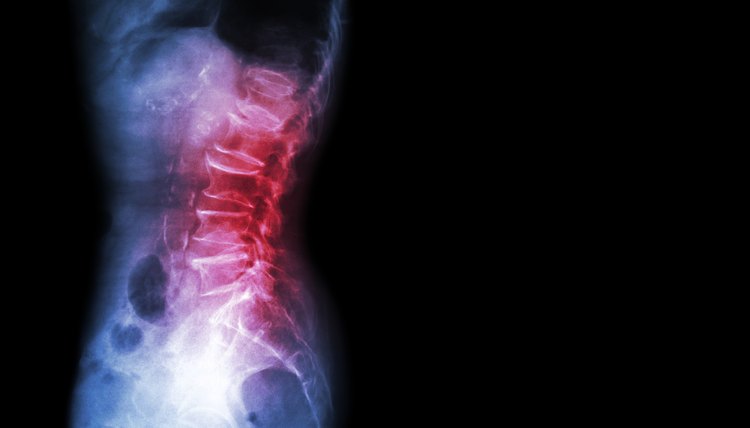
Low back pain is common. In fact, according to a study published by Journal of Orthopaedic & Sports Physical Therapy, it is the most common cause of difficulty with daily activities and missed work in the United States. Bone spurs are growths that can develop over time in any joint of the body. They aren't always problematic — unless they pinch nerves or other structures around them. In the lower back, bone spurs can pinch nerves that travel to your legs. Bone spurs are one cause of low back pain, but exercises can help relieve pain caused by this condition.
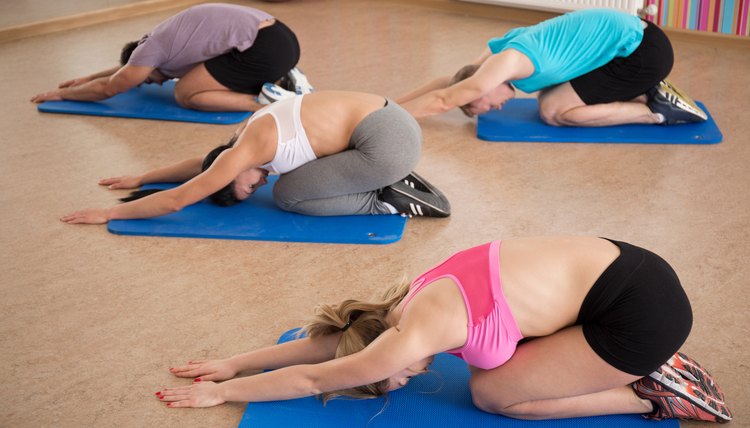
Bone spurs can put pressure on nerves in your lower back.
Prayer Stretch/Child's Pose
The prayer stretch — also called the child's pose — helps open up space around your bone spurs, relieving pain and pressure.
Kneel on a firm but padded surface and sit back on your heels. Reach both arms straight over your head.
Bend forward and rest your chest on your thighs. Let your chin drop down toward your chest.
Slowly walk your fingers forward until you feel a stretch in your low back. Hold for 20 to 30 seconds, then relax. Repeat three times.
Tips
If you can't kneel, lie on your back and pull one knee in to your chest. Hold for 20 to 30 seconds, and repeat three times on each side.
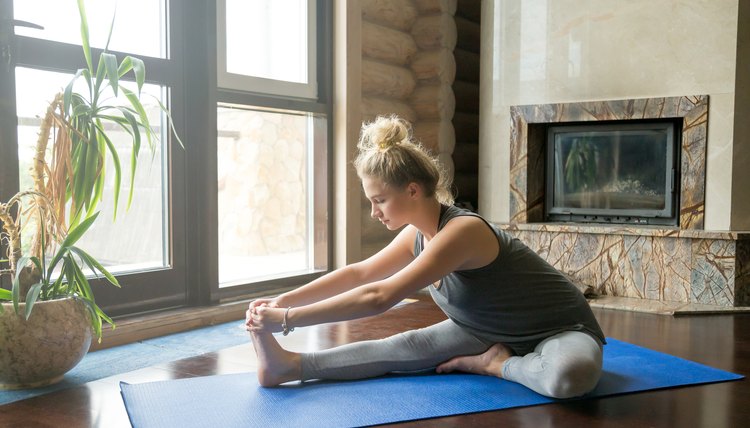
Bone spurs can put pressure on nerves in your lower back.
Hamstring Stretch
Tight hamstring muscles can pull on your low back, increasing pain if you have bone spurs.
Sit with your legs straight out in front of you. Bend one knee and pull your heel in toward the opposite inner thigh.
Bend forward at your hips and reach both hands toward your toes. Stop when you feel a stretch along the back of your thigh.
Hold for 20 to 30 seconds, then relax. Perform three times on each leg.
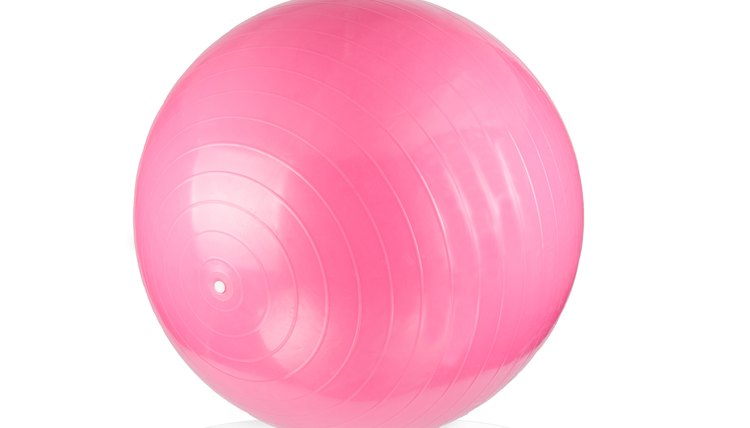
Bone spurs can put pressure on nerves in your lower back.
Hip Twists
Strong abdominal muscles help support your low back to help decrease pain.
Lie on your back and prop your bent legs up on the exercise ball. Press down through your heels to hold the ball securely in place.
Tighten your abdominal muscles and flatten your low back against the ground. Rotate your knees to one side as far as possible while keeping your hips on the floor. Hold for three seconds, then return to the center.
Rotate to each side 10 to 20 times.
Butt Lift
The butt lift exercise — also called bridging — strengthens muscles that support your low back.
Lie on your back and bend your knees. Rest your feet flat on the ground. Cross your arms over your chest.
Squeeze your buttocks together and lift your hips straight up toward the ceiling. Lift as high as possible while keeping your shoulder blades on the ground.
Hold for 2 to 3 seconds, then slowly lower back down. Repeat 10 times.
Dead Bugs
Dead bugs are named for the position the exercise is performed in — on your back with your arms and legs sticking up.
Lie on your back. Tighten your abdominal muscles and press your low back into the floor. Raise both arms up toward the ceiling with your elbows straight. Bend your knees and bring them up as if you are sitting in a chair.
Keeping your abs tight and back pressed against the ground, slowly reach one arm overhead. At the same time, slowly lower the opposite leg down toward the floor.
Bring your arm and leg back to the starting position, and repeat on the opposite side. Alternate sides and repeat 10 to 20 times.
References
- American Academy of Orthopaedic Surgeons: Lumbar Spinal Stenosis
- North American Spine Society: Evidence-Based Clinical Guidelines for Multidisciplinary Spine Care
- American Academy of Orthopaedic Surgeons: Spine Conditioning Program
- Asian Spine Journal: Lumbar Stenosis: A Recent Update by Review of Literature
- American Medical Association: Osteoarthritis of the Lumbar Spine
Writer Bio
Dr. Bailey is a physical therapist with an additionaldegree in psychology and board certification in hand therapy. She is a Level 1CrossFit Coach and former ACSM certified personal trainer. Dr. Bailey is alsoan Anatomy and Physiology professor and has been writing health and fitnessarticles for over 10 years.