
What does fact checked mean?
At SportsRec, we strive to deliver objective content that is accurate and up-to-date. Our team periodically reviews articles in order to ensure content quality. The sources cited below consist of evidence from peer-reviewed journals, prominent medical organizations, academic associations, and government data.
The information contained on this site is for informational purposes only, and should not be used as a substitute for the advice of a professional health care provider. Please check with the appropriate physician regarding health questions and concerns. Although we strive to deliver accurate and up-to-date information, no guarantee to that effect is made.
Do Calf Raises Help You Run Faster?

Calf raises should be part of every runner's workout regimen. Sprinters, middle distance runners and long-distance runners alike, can benefit from strengthening your lower leg muscles to improve your running speed and reduce your risk for injuries. While the glutes and hamstrings do a lot of the heavy lifting for the lower body in cardio exercises, calves and other lower leg muscle groups are important as well. The calves are responsible for the push off during a sprint and help to flex your ankles during a change of direction. This is why many certified personal trainers suggest adding calf raises to a lower body workout
How to do a calf raise?
Stand on the edge of a step with just the balls of your feet. Press up onto your toes as high as you can. Squeeze your calves at the top then lower down slowly, letting your heels come down as far as possible. Repeat for two to four sets of 15 reps. You can add a barbell or other weightlifting equipment to create more of a strength training emphasis.
Lower Leg Muscles
fatchoi/iStock/Getty Images
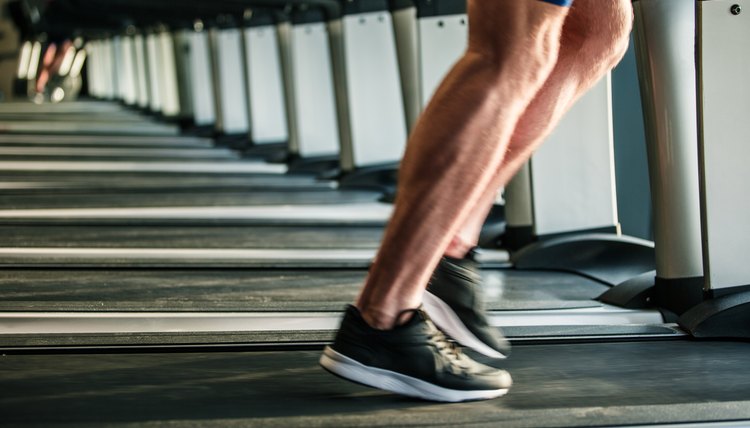
The lower legs consist of three muscles that work to flex the foot and support the ankle: the soleus muscle, gastrocnemius and tibialis anterior. The soleus is the larger and deepest of the calf muscles and is stimulated when the knee is in the flexed position; such as in seated calf raises. The gastrocnemius consists of two heads and both heads of the gastrocnemius lay over the soleus and insert into the Achilles tendon. It becomes active when the knee is extended in exercises such as standing calf raises. The tibialis anterior runs along the front of the lower leg next to the shin bone and is stimulated when the foot is flexed. Strong calves are a huge factor in efforts to run faster, so calf exercises are a must.
Ankle Strength
fatchoi/iStock/Getty Images
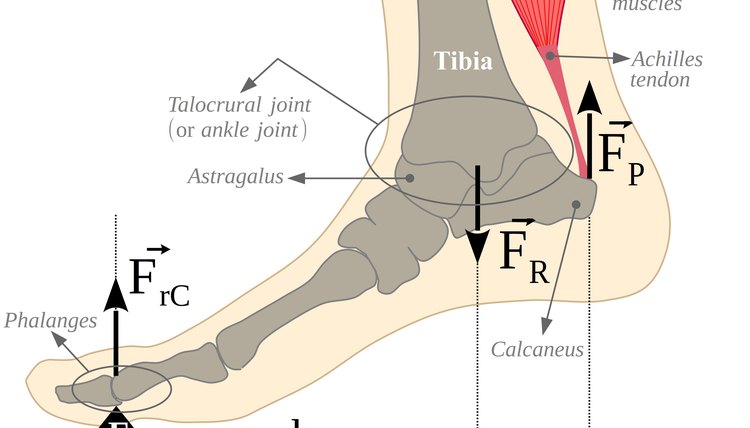
Strong ankles can help prevent ankle strains and help increase stride length and therefore your full range of motion. The soleus and gastrocnemius are the two primary muscles that influence ankle strength. Strengthening these two muscles will make your ankles stronger, allowing you to push harder off the ground, which increases the time you are airborne. As a result, your stride become longer, and your speed will increase, notes BrianMac Sports Coach.
Anterior Tibialis Muscle
fatchoi/iStock/Getty Images
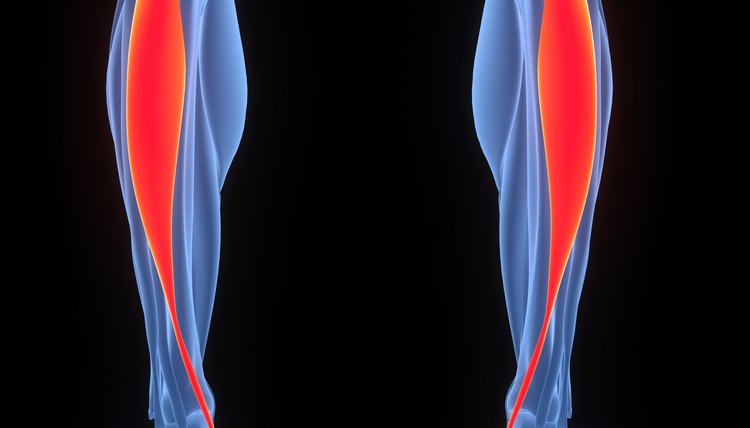
Developing a strong anterior tibialis muscle allows for greater flexion of the foot. The more you are able to flex your foot, the greater the force you exert into the ground when your foot makes contact. This increase in force, allows you to push off the ground harder, thus increasing your speed. Furthermore, strengthening the anterior tibialis is also key for injury prevention. Notably shin splits; a common problem amongst runners.
Lower Leg Workout
Your gastrocnemius responds best to heavier resistance and low repetitions; whereas, the soleus responds to lighter weight and higher repetitions. If you are a beginner trying your first calf routine, perform each exercise with as many reps as it takes to fatigue the muscles. If your legs are in bad shape, that could be as few as eight. Work your way up over time, and as your calf strength improves, to the ideal number of reps and sets for each, which are: standing calf raises -- three to five sets of eight to 10 reps; three sets of 20 to 30 reps of seated calf raises; and three sets of 20 reps of body-weight toe raises.
Considerations
Strength train calves once or twice weekly on nonconsecutive days. Train your calves following your running workout, or on days you are not running to avoid premature fatigue in your lower legs. Furthermore, adding in hill training into your training program to help further strength your lower legs. Running hill sprints can benefit both sprinters and distance runners by strengthening the ankles and encouraging dorsiflexion, which will help strengthen the anterior tibialis. You can also add dumbbells to your calf raises to increase strength or do single-leg calf raises to focus on each leg.
Writer Bio
Heather Hitchcock has been writing professionally since 2010. She has contributed material through various online publications. Hitchcock has worked as a personal trainer and a health screening specialist. She graduated from Indiana University with a Bachelor of Science in exercise science.