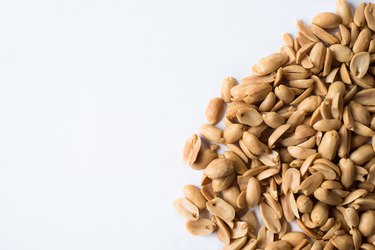
Despite their name, peanuts aren't nuts; they're classified as a type of legume. Peanuts are rich in a various nutrients, including protein, fiber and antioxidants. The fiber in peanuts is particularly beneficial as it can help prevent a variety of gastrointestinal issues, including constipation.
Peanut Nutrition Facts
Video of the Day
Peanuts are seeds — specifically, the seeds of peas — which is why this "nut" is actually part of the legume, or bean, family. They are thought to have originated in Peru or Brazil and have been consumed for thousands of years.
Video of the Day
According to the USDA, an ounce of peanuts (28 grams) has 161 calories and 14 grams of fat, a quarter of which comes from healthy, unsaturated fatty acids. An ounce of peanuts also contains 7.3 grams of protein and 4.6 grams of carbohydrates. A total of 2.4 grams of these carbohydrates come from the fiber in peanuts, which means that each ounce is equivalent to just 2.2 grams of net carbs. Each ounce of peanuts also contains:
- 36 percent of the daily value (DV) for copper
- 7 percent of the DV for iron
- 11 percent of the DV for magnesium
- 24 percent of the DV for manganese
- 9 percent of the DV for phosphorus
- 8 percent of the DV for zinc
- 15 percent of the DV for vitamin B1 (thiamin)
- 21 percent of the DV for vitamin B3 (niacin)
- 10 percent of the DV for vitamin B5
- 6 percent of the DV for vitamin B6
- 17 percent of the DV for vitamin B9 (folate)
- 16 percent of the DV for vitamin E
Peanuts are also rich in antioxidants and other bioactive compounds, including resveratrol, phenolic acids, flavonoids and phytosterols. They also contain a small amount (between 1 and 4 percent) of a variety of other nutrients, including choline, vitamin B2 (riboflavin), selenium, potassium and calcium.
Benefits of Fiber in Peanuts
According to the Food and Drug Administration, the recommended DV for fiber is 25 grams per day. However, the Institute of Medicine gives a more specific recommendation: 14 grams of fiber per 1,000 calories that you consume. This means that the average woman needs about 25 grams of fiber per day, while the average man needs about 34 grams per day.
Unfortunately, only 5 percent of American adults get enough fiber. An April 2017 review in the Journal of the American Association of Nurse Practitioners reported that most American adults consume just 15 grams of fiber per day. People on alternative diets, like the low-carbohydrate or ketogenic diet, typically consume just 10 grams of fiber per day.
Insufficient dietary fiber consumption can result in gastrointestinal problems, like constipation, because insoluble fiber promotes healthy digestion. Soluble fiber is also beneficial, preventing the absorption of fat and cholesterol into your body.
Peanuts provide about 10 percent of the DV per ounce-sized serving, so they're considered a good source of dietary fiber. The fiber in peanuts is primarily insoluble fiber, which can counteract constipation. Peanuts contain small amounts of soluble fiber, too.
According to Chapter 11 of Peanuts: Genetics, Processing and Utilization, published by Elsevier Inc. in 2016, diets rich in fiber are important for a variety of reasons. Diets that contain fiber-rich foods, like peanuts, can help:
- Lower cholesterol
- Lower blood pressure
- Promote weight loss and decrease obesity
- Reduce the risk of cancer, particularly colon cancer
- Improve blood glucose
- Improve cardiovascular health
Peanuts for Constipation Prevention
Peanuts are commonly consumed as a stand-alone snack, but may also be used to make oil, butters, vegan milk and cheese, and a variety of other products. Their nutty flavor and fat content makes them extremely versatile as ingredients and they can be easily integrated into your diet.
You've probably encountered peanut-based candy and cookies, like Reese's pieces, Nutter Butter or peanut brittle. However, peanuts are also used in healthy foods, like savory dishes. They might appear as an ingredient in anything from Mirchi ka salan, a spicy Indian peanut curry, to the Chinese Kung Pao chicken.
If you don't like eating peanuts on their own but are keen on consuming them as a healthy, fiber-rich snack, they can be easily incorporated into a homemade granola or trail mix. You can also incorporate other nuts for constipation prevention too.
Keep an eye out for alternative food products that have incorporated peanuts. For example, pasta on its own is considered to have minimal nutritional value and typically contains no fiber. However, if peanut flour has been added to the dough, this food could be considered a good source of fiber, too.
Nutrition of Other Peanut Products
Many peanut-rich products contain similar nutritional profiles to raw peanuts. However, a large amount of variation still exists.
For example, there is no fiber in peanut oil. In fact, peanut oil lacks virtually all of the nutrients peanuts contain, with the exception of fat and vitamin E. There is 28 percent of the DV for vitamin E in 28 grams (the equivalent of an ounce or 2 tablespoons) of peanut oil.
In contrast, 2 tablespoons (32 grams) of smooth, unsalted peanut butter has a fairly similar nutritional profile to raw peanuts. Two tablespoons of peanut butter contains 191 calories, 16.4 grams of fat, 7.1 grams of protein and 7.1 carbohydrates. However, there is less fiber in peanut butter (just 1.6 grams), despite the higher carbohydrate content.
According to the USDA, each serving of peanut butter also has:
- 13 percent of the DV for magnesium
- 9 percent of the DV for phosphorus
- 7 percent of the DV for zinc
- 15 percent of the DV for copper
- 23 percent of the DV for manganese
- 5 percent of the DV for vitamin B2 (riboflavin)
- 26 percent of the DV for vitamin B3 (niacin)
- 7 percent of the DV for vitamin B5
- 8 percent of the DV for vitamin B6
- 7 percent of the DV for vitamin B9 (folate)
- 19 percent of the DV for vitamin E
Peanut butter also contains small amounts (between 1 and 4 percent) of a variety of other nutrients, including choline, vitamin B1 (thiamin), selenium, potassium, iron and calcium.
As you can see, peanut products are generally high in fat, and most are good sources of protein and other nutrients. The vast majority of these products still have antioxidants and other beneficial bioactive compounds that can benefit your health.
However, if you're looking for a fiber-rich food that can improve your gut health, you're likely best off eating raw or roasted peanuts. Constipation is often easy to counteract, as long as you're getting the recommended amount of fiber per day.
- Journal of the American Association of Nurse Practitioners: "Fiber Supplements and Clinically Proven Health Benefits: How to Recognize and Recommend an Effective Fiber Therapy"
- Journal of Food Science and Technology: "Optimization of Ingredient Levels for the Development of Peanut Based Fiber Rich Pasta"
- ScienceDirect: "Peanuts: Genetics, Processing and Utilization: Chapter 11 - Peanut Composition, Flavor and Nutrition"
- Journal of Food Science and Technology: "Peanuts as Functional Food: A Review"
- National Peanut Board: "History of Peanuts & Peanut Butter"