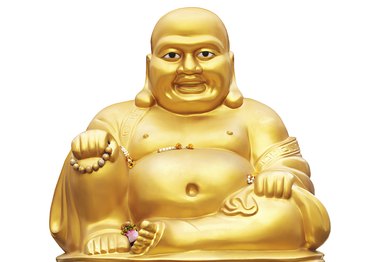
As is the case with many major world religions, Buddhist philosophy implies certain rules that any individual Buddhist may or may not practice. Laws concerning diet are grounded in the Five Precepts, core Buddhist guidelines for living, and the ultimate goal of Buddhist practice: the elimination of suffering by limiting attachment to worldly things. Although dietary laws apply more strictly to Buddhist monks and nuns, even those who live in monasteries can adapt their specific food practices, depending on conditions such as a food's availability and personal need.
Vegetarianism
Video of the Day
The Five Precepts are Buddhist guidelines for increasing good in the world, according to Geoff Teece, lecturer in religious education at the University of Birmingham, England, and author of the book "Buddhism." The First Precept, to avoid harming any living thing, means that many Buddhists regard killing animals for food as wrong. As a result, many Buddhists turn to vegetarianism. In some cultures, however, a reliance on fish or meat as a major food source results in elaborate reinterpretations of the meaning behind the First Precept, notes Ravindra S. Khare, professor of anthropology at the University of Virginia, in his book "The Eternal Food: Gastronomic Ideas and Experiences of Hindus and Buddhists." In Sinhalese fishing villages, practicing Buddhists compensate for the negative karma generated by killing fish by donating part of each catch to the monks and avoiding fishing on holy days.
Video of the Day
Bland Food
The Fifth Precept, to avoid drugs and alcohol, and cultivate a pure and clear mind, lies behind the Buddhist habit of eating plain or bland food. In his book "Humanistic Buddhism," Venerable Master Hsing Yun, founder in 1967 of the Fo Guang Shan Buddhist Order in China, argues that the correct way to view food and drink is as vehicles for nourishment, and nothing else. He recommends vegetables over meat, fruit over sugar and chewing thoroughly over eating more. Overeating causes lethargy, and inhibits the clarity of mind that Buddhist precepts aim to cultivate.
Mixing Food
Another way to adhere to the Fifth Precept is to mix your food. The aim of mixing food is to obliterate the flavor of any individual part of the meal, so everything on your plate or in your bowl becomes simply food. Ravindra Khare notes that mixing food is especially important for monks in Buddhist cultures, who go from door to door in order to take their meals. In mixing the food all together, the monk blends the succulent offerings of the rich with the humble offerings of the poor. Khare further notes that in some cases, mixing food might enhance flavor, and is in some cultures a way of increasing pleasure. So mix at your own discretion.
Giving Food
In many Buddhist cultures, people donate food to monks as a means of building good karma and cultivating generosity. The Second Precept of Buddhism is not to take what hasn't been given, but to give freely, according to Teece. In Thailand, as in many Buddhist cultures, the daily circulation of monks with their bowls affords people an opportunity to offer food and develop the habit of sharing, explain Thai folktale collectors Supaporn Vathanaprida and Margaret Read MacDonald in "Thai Tales." In the West, conscientiously giving to those in need by donating to a food bank or volunteering at a soup kitchen can help you participate in giving food.
- “Buddhism”; Geoff Teece; 2004
- “The Eternal Food: Gastronomic Ideas and Experiences of Hindus and Buddhists;” Ravindra S. Khare; 1992
- “Humanistic Buddhism: A Blueprint for Life”; Hsing Yun, Xingyun, Robin Stevens and Edmond Chang; 2005
- “Thai Tales: Folktales of Thailand;” Supaporn Vathanaprida, Margaret Read MacDonald, and Boonsong Rohitasuke; 1994