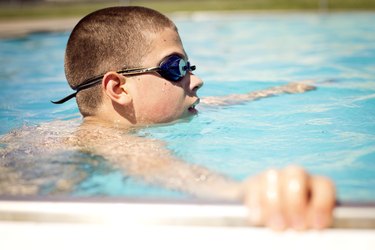
In swimming competition, the 500-yard freestyle event is commonly called "the 500" or "the 500 free." It can be grueling, consisting of 20 lengths of a 25-yard pool. Focusing on a few elements of the 500 can help you improve your performance. Building endurance, watching your form, managing your pace, concentrating on breathing and perfecting your turn can help make this swim successful.
Endurance
Video of the Day
Endurance is a major component of completing an optimal 500-yard freestyle swim. Swimming 500 yards is not an easy task. It requires a lot from your body and you need trained muscles and lungs. While distance training is essential to increase endurance, interval training also helps improve both speed and endurance. To build endurance, throughout a long training swim, include bursts in which you go all out for a certain distance -- such as one lap or a length of the pool -- before returning to your normal pace. Schedule two or three strength-training workouts each week, as well as a day of cross-training: Running and cycling are both ways in which you may build endurance. Incorporate high amounts of lean proteins in your diet and hydrate well throughout the day.
Video of the Day
Technique
An improper freestyle form doesn't just hamper your style. It results in inefficiency and may even cause injury. To help improve your form, ensure you are horizontal in the water. This prevents drag and makes it easier to move through the water. The optimal rotation of your body during a freestyle swim is 30 to 40 degrees. Additionally, rotating your shoulders forward during your stroke will help your arms enter the water about shoulder-width apart, which is best for your joints. As you pull, your arms should follow your body -- not cross over your body or be too far out to the side. Finish your stroke at the hip. Use your pulling arm to drive your entering hand and arm forward into the water.
Breathing
Proper breathing can greatly help your form. Focus on exhaling under water. Hold your head still between breaths and when exhaling. Lifting your head causes your legs to drop, creating drag, and over-rotating your head causes you to over-rotate your body. If you find yourself rotating your head with your body, try looking at one spot at the bottom of the pool. Importantly, avoid excessively rotating your head or lifting it to take a breath. Instead, try to take advantage of the "pocket." The website Swim Smooth explains, "When you move through water you create a 'bow wave' with your head and body, just like a boat does. ... This creates a trough either side of your head and body that is beneath the surface level of the pool -- so there's air lower than you might expect there to be." Rotate your head only enough to find the pocket and inhale.
Pace Yourself
Because of the long distance, it's important to pace yourself. If you start out too fast, you will run out of energy before finishing, but starting too slow can hamper your time. If the beat of a particular song matches your desired pace, mentally singing it may help you stay on pace throughout the swim. Negative splitting can help if you are focusing on bettering your time. With negative splitting, the first and last 100 yards are fastest while the middle of your swim is dedicated to pacing yourself and conserving energy.
Better Your Turn
In a 25-yard pool, you have 19 turns during a 500-yard freestyle. Working on your flip turn can improve your entire swim. Start with your chin tucked and flip your legs straight over using your abs -- not your arms. Plant your feet against the wall with toes pointing up. Push off on your back, then twist during your glide to face the bottom of the pool. Exhale late in your flip and into your glide. Use your bottom arm for your first stroke and wait for the second stroke to take a breath.