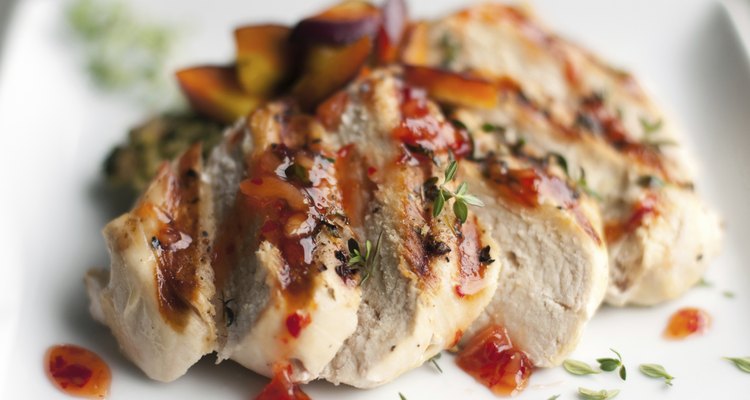
rjgrant/iStock/Getty Images
Over the last several decades, consumption of chicken and turkey has increased substantially. The average amount of meat eaten per year for each person in the United States increased by 66 pounds for chicken and 14 pounds for turkey. These numbers reflect increasing appreciation for the lower calories and fat, together with great nutrition.
Definition
To compare chicken with turkey, nutrition information is provided for equal portion sizes of 100 grams. However, 100 grams does not necessarily represent a typical serving size. The average chicken leg weighs 130 grams, and the average turkey leg weighs 329 grams. One half chicken breast is around 118 grams, while one half turkey breast is about 390 grams.
Calories, Protein and Fat
Chicken and turkey breasts are both low in calories, 110 and 111, very low in fat, 1 to 2 percent daily value, and supply 46 to 49 percent of the daily value of protein. Chicken and turkey legs are slightly higher in fat and provide less protein, 40 percent of the daily value. A turkey leg has 108 calories, while the chicken leg has 120.
Vitamins
Four of the B vitamins are found in almost equal amounts in leg and breast meat from both chicken and turkey. They supply thiamin, vitamin B-12, folate and pantothenic acid.
Minerals
All the essential minerals can be found in the leg and breast meat from chicken and turkey. They’re a good source of phosphorus, 17 to 21 percent of the daily value, and 5 to 10 percent of the daily value of potassium, magnesium and iron. You’ll also receive 1 to 4 percent of the daily value of calcium, sodium and manganese. Turkey provides slightly more copper than chicken.
Differences
One significant difference is the amount of niacin. Chicken and turkey are both great sources of niacin, but chicken has more than turkey, and breast meat provides more than leg meat. A chicken breast has 56 percent DV of niacin compared with turkey’s 31 percent. The leg meat from a chicken has 30 percent DV of niacin, and from a turkey, you’ll get only 13 percent.
Both chicken and turkey are good sources of vitamin B6, but the breast meat is a richer source than leg meat. The same is true for riboflavin, with breast meat from both providing more than the legs -- 12 percent in breasts compared with an average of 6 percent in legs.
Two minerals are supplied in different quantities — selenium and zinc. Turkey is significantly higher in selenium no matter which meat you prefer, providing 35 to 41 percent of the daily value compared with 19 to 25 percent in chicken. Zinc differs depending on the type of meat. It’s roughly the same in both chicken and turkey, but the dark meat provides more than twice the zinc than what is available in white meat.
Finally, there is a difference in the amount of cholesterol. Chicken and turkey have about the same amount of cholesterol, but breast meat is lower compared with the leg meat.
Related Articles

Whole vs. Low-Fat Buttermilk

Does It Take Longer to Cook With the ...

What Is the Average Breast Measurement?

Potato Bread vs. Wheat Bread

Fat in Whole Chicken vs. Chicken Breast

How to Cook Chicken Thighs

The Best Way to Cook Turkey Thighs

How to Cook a Turkey Leg & Breast

Difference in Cook Time Between Bone-in ...

Strontium-Rich Foods

A List of Foods That Contain Choline

Zinc & Copper for Aging Skin

Nutrition of Red Snapper Vs. Tilapia

Vitamin B2 for Hair Growth

Difference Between Roaster & Stewing ...

Food Sources of Phosphatidylcholine

How to Use Turkey Eggs

Can You Substitute Beef Bouillon for ...

How to Cook Turkey Parts

Which Is Healthier, Lima Beans or ...
References
- USDA Nutrient Data: Chicken Breast
- USDA Nutrient Data: Turkey Breast
- USDA Nutrient Data: Chicken Leg
- USDA Nutrient Data: Turkey Leg
- U.S. Per Capita Meat Consumption
Writer Bio
Sandi Busch received a Bachelor of Arts in psychology, then pursued training in nursing and nutrition. She taught families to plan and prepare special diets, worked as a therapeutic support specialist, and now writes about her favorite topics – nutrition, food, families and parenting – for hospitals and trade magazines.
Photo Credits
rjgrant/iStock/Getty Images