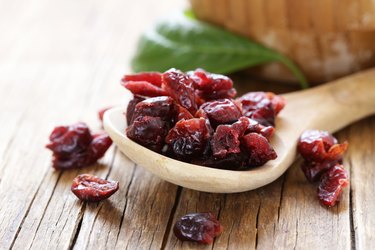
Cranberries are a red, tart berry that can be blended into smoothies, made into juices or turned into baked goods.
Across the United States, people eat 400 million pounds of cranberries each year, mostly over Thanksgiving and Christmas, according to the leading cranberry brand Ocean Spray.
Video of the Day
Video of the Day
Unlike other popular berries (such as blueberries and strawberries), cranberries aren't often eaten fresh.
Dried Cranberries Nutrition Facts
Dried cranberries are literally just cranberries that have had their water content removed. The serving size for dried cranberries — and any dried fruit — is 1/4 cup, per the American Heart Association (AHA).
A 1/4 cup of sweetened dried cranberries contains the following, according to the USDA:
- Calories: 123
- Total Fat: 0.4 g, 1% Daily Value (DV)
- Saturated Fat: 0 g
- Cholesterol: 0 mg
- Sodium: 2 mg, 0% DV
- Total Carbohydrates: 33.1 g; 11% DV
- Dietary Fiber: 2.1 g; 8% DV
- Sugars: 29 g; 58% DV
- Protein: 0.1 g, 0% DV
Dried cranberries are also a source of vitamins and minerals. A 1/4 cup of unsweetened dried cranberries contains:
- Vitamin E: 0.8 mg; 6% DV
- Vitamin K: 3 mcg, 3% DV
Cranberries also contain some essential amino acids as well as the antioxidants lutein and zeaxanthin, according to an October 2018 study in the journal Food Science.
Keep in mind: There are many ways cranberries can be dried, including sun-drying, hot-air drying, freeze-drying, vacuum-drying and more, according to the Food Science study. Each method results in the retention of different amounts of nutrients in the cranberries. In general, freeze-drying seems to retain the most nutrients.
Tip
Dried cranberries are high in antioxidants, according to the Mayo Clinic. But, because dried cranberries also tend to contain a lot of sugar, stick to a single serving size.
Dried Cranberries vs. Fresh Cranberries
Dried fruits are often thought of as condensed fruits. All the beneficial vitamins, minerals and other properties of fruits are in a preserved, snackable form.
But this isn't always the case: Because different ways of making dried cranberries can affect their nutrition, 1 cup of fresh cranberries doesn't have the same nutrients as the equivalent 1/4 cup of dried cranberries.
In general, fresh cranberries have more vitamins and minerals: You'll get more vitamin C, vitamin E and manganese in the fresh fruit, per the USDA. And although dried fruits are known for being good sources of fiber, there's even more fiber (13 percent DV) in a cup of whole, fresh cranberries compared to dried cranberries (8 percent DV per 1/4 cup).
What Are Craisins?
Craisins are dried cranberries with added sugar.
The ideal dried fruit has no added ingredients with no sugars or preservatives — it's just dehydrated fruit. Cranberries often have added sugar because they're naturally very tart. A cup of fresh cranberries supplies about 9 percent of your DV of sugar, according to the USDA. In contrast, dried cranberries with sugar added often contain as much as 58 percent of your DV.
Benefits of Cranberries
There's no question cranberries — dried, fresh or made into sauces or juice — are delicious. Cranberries also offer some health benefits, although many of their perks aren't yet conclusive and require more research.
1. They Contain Antioxidants
Cranberries are known for their bioactive compounds, which are linked to protection against degenerative and chronic diseases, according to a May 2015 study in the Records of Natural Products.
Cranberries are also rich in other antioxidants, like flavonoids, catechins and phenolic acids, according to a May 2018 study in the International Journal of Food Properties.
2. They May Help Your Gut
One of the antioxidants cranberries contain — proanthocyanidins, which are polyphenols part of the flavonoid family — has antimicrobial properties, according to a July 2016 article in Advances in Nutrition.
These antimicrobial properties can, along with other beneficial compounds found in these berries, help make sure that your digestive system is colonized with only good bacteria.
3. They're Linked to a Reduced Risk of UTIs
You'll often hear cranberries mentioned as an option for both treating and preventing urinary tract infections (UTIs). Despite the hype, cranberries aren't an effective treatment for UTIs, according to the National Center for Complementary and Integrative Health (NCCIH).
That said, they do appear to reduce the risk of a UTI in people who are at a high risk of getting one, per the NCCIH. For instance, in one meta-analysis that looked at seven randomized controlled trials, cranberry reduced the occurrence of UTIs by 26 percent, per December 2017 research in the Journal of Nutrition.
4. They May Support Heart Health
Cranberries may help to improve blood pressure and cholesterol, two important factors when it comes to heart health, according to the AHA.
But more research is needed to confirm this. It's still unclear if cranberry juice can cut heart disease risk, per the Memorial Sloan Kettering Cancer Center (MSKCC).
Downsides to Eating Dried Cranberries
There aren't too many downsides to eating dried cranberries, as long as you enjoy them in moderation. Drinking too much cranberry juice (about 3 cups a day) may lead to nausea and diarrhea, per the MSKCC.
Cranberries might also interact with certain medications, such as the following, per the MSKCC:
- Tacrolimus
- Warfarin
- CYP450 substrate drugs
- UGT substrate drugs
If you have a history of kidney stones, try to avoid cranberries because they are high in oxalates, according to the MSKCC.
Related Reading
- Microbiology Insights: Fungal Presence in Selected Tree Nuts and Dried Fruits
- Advances in Nutrition: "Impact of Cranberries on Gut Microbiota and Cardiometabolic Health: Proceedings of the Cranberry Health Research Conference 2015"
- Food Chemistry: "Phytochemical and Physical Properties of Blueberries, Tart Cherries, Strawberries, and Cranberries as Affected by Different Drying Methods"
- Records of Natural Products: "Antioxidant Activity and Polyphenol Content of Cranberries (Vaccinium Macrocarpon)"
- Chemistry Central Journal: "Citrus Fruits as a Treasure Trove of Active Natural Metabolites That Potentially Provide Benefits for Human Health"
- USDA: "Nutrition Comparison of Cranberries and Dried Sweetened Cranberries"
- Ocean Spray: "Cranberry Sauce Stats"
- American Heart Association: "Fruits and Vegetables Serving Sizes Infographic"
- USDA: "American Importing Co. Inc. - Produce Dried Cranberries"
- Mayo Clinic: "Slide show: Add antioxidants to your diet"
- National Cancer Institute: "bioactive compound"
- International Journal of Food Properties: "Cranberry antioxidant power on oxidative stress, inflammation and mitochondrial damage"
- National Center for Complementary and Integrative Health: "Cranberry"
- Journal of Nutrition: "Cranberry Reduces the Risk of Urinary Tract Infection Recurrence in Otherwise Healthy Women: A Systematic Review and Meta-Analysis"
- Memorial Sloan Kettering Cancer Center: "MSKCC"
- AHA: "Be thankful for cranberries' health benefits all year long"