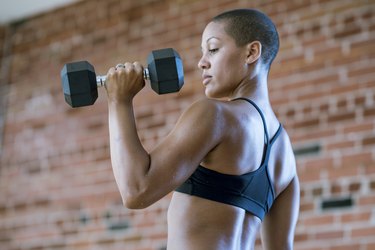
The biceps and triceps are both located in the upper arm, though they are situated in different areas. Because they belong to different muscle groups: one posterior and one anterior, you can perform biceps and triceps same day workouts.
Tip
It's important to vary your exercises, therefore working the triceps and biceps in the same workout is advisable.
Video of the Day
Biceps and Triceps, Same Day
Before learning whether biceps and triceps can be exercised in the same workout, it's important to know those muscles' functions. Despite their proximity in the upper arm, they are part of two different muscle groups, the triceps in the posterior, or back of the upper arm, and the biceps in the anterior of the upper arm.
Video of the Day
While the biceps are more critical for the bending of the elbow, the triceps are key to the extension of the elbow and bringing the upper arm down from an overhead position. The biceps also function to supinate the forearm, or turn it palm-up and lifting the upper arm forward, according to the U.S. Department of Veterans Affairs.
As to whether the muscles can be worked on the same day, or even during the same workout: many signs point to yes. With a resistance training regimen and knowledge of how to avoid injury during workouts, you can get started with your biceps and triceps same day workouts.
Read more: Workouts for Different Parts of the Biceps
Vary the Muscle Groups
The U.S. Department of Veterans Affairs Move program recommends that you don't do strength exercises of the same muscle group on any two days in a row. In fact, variety is essential when beginning a strength training program.
According to Better Health Channel, switching around your workout routine by introducing new exercises, will challenge your muscles and force them to adapt and become stronger.
Resistance training beginners will find that despite their rapid increase in muscle growth, their strength will eventually level out. One way to push past the plateau is to vary your workouts. This way you surprise your muscles with different stresses. The muscles will then be forced to adapt.
Better Health Channel also suggests giving at least 48 hours of recovery time to each muscle before beginning the next workout. Because biceps and triceps are different muscles, you can work both of them within the 48-hour time period.
Order Matters, Not Size
Now that you know you can train the biceps and triceps in one workout, you may want to know which type of exercise to do first. According to a March 2012 study in Sports Medicine, researchers found that in terms of workout order, the size of the muscle group being exercised didn't necessarily matter.
What did matter though was the order of the exercises performed. So, exercises performed at the beginning of the workout were more effective than those performed at the end. Therefore, if you're aiming to focus more on the biceps during one workout, you may want to do the biceps-focused exercises first.
Tricep and Bicep Workouts
If you're looking for exercises you can do to work out the biceps and triceps, the U.S. Department of Veterans Affairs has some suggestions. Examples include:
Standing triceps press-down: Standing straight, grip the bar of a cable machine with both hands, palms face down. Keep the elbows next to the trunk and push the arms down until they're fully extended.
Standing dumbbell triceps curl: Hold a dumbbell with both hands, then raise it above the head until the arms are fully extended. Gradually lower the weight behind the head until forearms and biceps touch.
Reverse curl: Bend at the knees and waist, then hold the barbell, hands about shoulder-width apart. Do a bicep curl, except instead of palms facing upward, palms will be facing downward. Lift up, hinging at the elbows, then lower down.