What does fact checked mean?
At Healthfully, we strive to deliver objective content that is accurate and up-to-date. Our team periodically reviews articles in order to ensure content quality. The sources cited below consist of evidence from peer-reviewed journals, prominent medical organizations, academic associations, and government data.
The information contained on this site is for informational purposes only, and should not be used as a substitute for the advice of a professional health care provider. Please check with the appropriate physician regarding health questions and concerns. Although we strive to deliver accurate and up-to-date information, no guarantee to that effect is made.
The symptoms of bronchitis include wheezing, coughing, difficulty breathing and an ache in your chest 2. While a sauna cannot cure the cause of these symptoms, it can alleviate some of your suffering and improve your attitude and outlook. After these improvements, you can find yourself feeling better while you wait for the infection to pass.
If you are experiencing serious medical symptoms, seek emergency treatment immediately.
The Steam Soothes Your Throat and Lungs
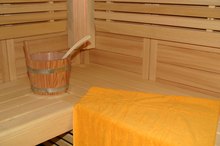
In a wet sauna, water is poured over heated stones to produce steam. This steam soothes your throat and lungs, providing some relief from the irritation caused by chronic coughing. The soreness in your chest due to wheezing and your hindered breathing due to an excess of mucus also diminishes.
Sweat Purges Other Bacteria and Germs
The Effects of Sitting in the Sauna
Learn More
Sweating exfoliates and purges your skin, washing out germs and bacteria that can make you feel worse. The clean feeling you feel after a sauna improves your overall sense of wellness and improves your attitude. This purge also removes other elements that may have taxed your immune system, leaving your body better able to cope with your bronchial infection.
- Sweating exfoliates and purges your skin, washing out germs and bacteria that can make you feel worse.
- This purge also removes other elements that may have taxed your immune system, leaving your body better able to cope with your bronchial infection.
Simulated Fever Boosts Immunity
The heat from a sauna simulates fever conditions. This simulated rise in body temperature boosts the activity of your immune system. Over time and with regular stimulation, your immunity will rise and your ability to fight off bronchitis and other infections will increase.
Relaxation Eases Your Discomfort
Cough Sounds Like Fluid in the Chest After Running
Learn More
As you relax, the fatigue you feel due to bronchitis eases. You may also be experiencing muscle soreness due to lack of oxygen and the general effects of your infection. You will find that these symptoms also become less severe as the heat from the sauna delivers you into a more relaxed state.
Stress Reduction Helps Your Body Recover
Stress inhibits your immune system's ability to fight off an infection, and the relaxation you experience during a sauna reduces physical stress on your body. This reduction in stress helps you recover from your infection more quickly than you would if you did nothing to lower your stress levels.
Related Articles
The Effects of Sitting in the Sauna
Learn More

Cough Sounds Like Fluid in the Chest After Running
Learn More

Can I Exercise With Whooping Cough?
Learn More

Herbs That Clean the Lungs
Learn More

Bacterial Vaginosis Home Remedies
Learn More
Remedy for a Bronchitis Cough
Learn More
Breathing & Phlegm
Learn More
Bronchitis Symptoms With Allergies
Learn More

Do Infrared Saunas Work to Lose Weight?
Learn More

How to Get Rid of Nasal & Throat Congestion
Learn More
References
- Mayo Clinic: Bronchitis Symptoms
- Health911: Cough Remedies
- Crinnion W. Sauna as a valuable clinical tool for cardiovascular, autoimmune, toxicant-induced, and other chronic health problems. Environmental Medicine. 2011;16(3):216-25.
- Sauna Types. The North American Sauna Society. Published 2018.
- Kunutsor SK, Khan H, Laukkanen T, Laukkanen JA. Joint associations of sauna bathing and cardiorespiratory fitness on cardiovascular and all-cause mortality risk: A long-term prospective cohort study. Ann Med. 2018;50(2):139-146. doi:10.1080/07853890.2017.1387927
- Sauna-Induced Sweating Offers Many Health Benefits. UW Health. Published October 16, 2017.
- Imbeault P, Ravanelli N, Chevrier J. Can POPs be substantially popped out through sweat?. Environ Int. 2018;111:131-132. doi:10.1016/j.envint.2017.11.023
- Calories burned in 30 minutes for people of three different weights. Harvard Health Publishing. Updated August 13, 2018.
- Petrofsky J, Berk L, Bains G, et al. Moist heat or dry heat for delayed onset muscle soreness. J Clin Med Res. 2013;5(6):416-25. doi:10.4021/jocmr1521w
- Consolazio CF, Shapiro R, Masterson JE, McKinzie PSL. Energy requirements of men in extreme heat. The Journal of Nutrition. 1961;73(2)126–134. doi:10.1093/jn/73.2.126
Writer Bio
Rob Callahan lives in Minneapolis, where he covers style, culture and the arts for Vita.MN and "l'étoile Magazine." His work has earned awards in the fields of journalism, social media and the arts. Callahan graduated from Saint Cloud State University in 2001 with a Bachelor's degree in philosophy.