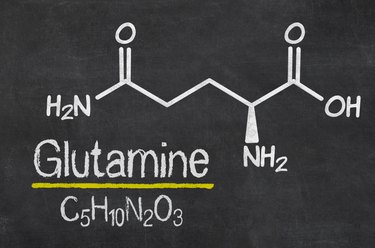
When you hear the word glutamine, you might automatically think about muscle building. Glutamine is one of several amino acids, which are building blocks for protein in your body. But glutamine has other functions as well, including the ability to alter blood sugar levels. The effects are complicated, however, as glutamine can act in various ways to both increase and decrease blood sugar levels. Nevertheless, the few research studies that have been conducted so far in people with type 2 diabetes (T2DM) suggest that the overall effect of glutamine supplements may be a slight lowering of blood sugar levels.
How Glutamine May Increase Blood Sugar
Video of the Day
Glutamine is produced naturally in your body, especially within your muscles. While some glutamine combines with other amino acids to form muscle proteins, most is released into the bloodstream. It travels in the blood to other parts of your body and exerts numerous effects. One of these effects is to increase the production of glucose -- also known as blood sugar -- in your liver and kidneys. Cells in these organs can directly transform glutamine into glucose through a series of chemical reactions. When this glucose is then released into the blood, your blood sugar level rises.
Video of the Day
Glutamine can also stimulate specialized cells in your pancreas to release a hormone called glucagon into the bloodstream. When glucagon reaches the liver, it stimulates the liver cells to produce more glucose. This is another way in which glutamine may increase blood sugar levels.
How Glutamine May Decrease Blood Sugar
Glutamine may also lower your blood sugar. The primary way this occurs is by glutamine increasing the amount of glucagonlike peptide-1 (GLP-1) released into your blood from cells in your intestines. GLP-1 is a protein that can lower blood sugar by: -- Increasing the release of insulin from insulin-producing cells in your pancreas. Insulin is the main hormone that helps body cells take up glucose, thus lowering blood sugar levels. -- Reducing the release of glucagon from your pancreas, which reduces the amount of glucose produced in the liver.
-- Reducing the speed at which food leaves the stomach after you eat. Because food is absorbed into your body only when it reaches the intestines, slower stomach emptying slows the speed of food absorption. This in turn reduces the peak increase in blood sugar level that occurs when you eat.
Glutamine Supplements for Type 2 Diabetes
Because glutamine can have opposing effects on blood sugar levels, the question arises about what will happen when a person with T2DM takes glutamine supplements. Researchers have only recently started to study this issue, so there are few studies to help answer this question. A study published in the May 2011 issue of "The Journal of Nutrition" evaluated the effects of a single dose of glutamine powder before a breakfastlike meal of cereal and milk in 15 adults with T2DM. All study participants received glutamine on one day, and on another day, they received water instead of glutamine for comparison. The peak blood sugar increase after the meal was less after glutamine than after water.
Regular Glutamine Consumption in Type 2 Diabetes
Having determined that a single dose of glutamine may lower blood sugar levels in people with T2DM, the next question is whether regular glutamine use will also do this. In a study published in the November 2014 issue of "PLoS One," 13 adults with T2DM received glutamine before every breakfast and dinner for 4 weeks. At the end of this period, fasting blood sugar levels were generally similar to those before the study, but the participants' average A1C levels -- a marker of long-term blood sugar control -- were improved. The improvement in A1C, however, was small, falling on average from 7.0 percent before the study to 6.9 percent at the end.
More Evidence Regarding Regular Glutamine
In a larger study published in the January 2015 issue of "Nutrition," 53 adults with T2DM consumed glutamine supplements or a lookalike inactive substance before every breakfast, lunch and dinner for 6 weeks. At the end of this period, people who consumed glutamine had lower fasting blood glucose and A1C values, compared to those taking the inactive substance, or placebo. However, the differences were small. The average A1C was 7.0 percent with placebo vs. 6.7 percent with glutamine. The average blood sugar was approximately 142 mg/dL with placebo vs. 128 mg/dL with glutamine.
Indirect Effects of Fat Loss
In addition to their effects on blood sugar levels, glutamine supplements may also reduce body fat. In the 2015 "Nutrition" study previously mentioned, body fat mass, body fat percentage and waist circumference all decreased, on average, after 6 weeks of glutamine. Similarly, a reduction in waist circumference and body weight were observed after 4 weeks of glutamine supplements in a small study of 6 women with obesity and without T2DM, as reported in the "European Journal of Clinical Nutrition" in November 2014. Because excessive fat, particularly in the waist area, is one of the main reasons for the insulin resistance that causes high blood sugar levels in T2DM, glutamine supplements may indirectly reduce blood sugar by affecting the amount and distribution of body fat.
Moving Forward
Although the discussed studies suggest that glutamine may help lower blood sugar levels in people with T2DM, the effect was small. This may be at least partly because of the opposing effects of glutamine on various aspects of glucose metabolism. It should also be noted that the participants in the studies had generally well-controlled diabetes, so the effects of glutamine in people with poorly controlled T2DM are unknown. Clearly, more research is necessary. Even if glutamine is proved to be helpful, the benefit will likely be small, and other strategies, such as diet, lifestyle changes and medications, will remain the mainstay of treatment for T2DM.
Precautions and Warnings
If you have T2DM and are considering taking glutamine supplements, you should do so only under the direction of your doctor. Consuming extra glutamine in the form of supplements can produce side effects and interact with medications. Particular caution is required for people with kidney or liver disease, and pregnant women should only take glutamine supplements if a doctor determines that they are definitely necessary. The safety of using glutamine supplements long-term -- over several months to years -- has not been adequately studied in humans.
- Nutrition and Exercise Immunology; David C. Nieman and Bente Klarlund Pedersen
- European Journal of Clinical Nutrition: Glutamine Supplementation Favors Weight Loss in Nondieting Obese Female Patients: A Pilot Study
- Glutamine: Metabolism, Enzymology, and Regulation; Jaime Mora and Rafael Palacios
- The Journal of Nutrition: Nonnutritive Effects of Glutamine
- The Journal of Nutrition: Glutamine Reduces Postprandial Glycemia and Augments the Glucagon-Like Peptide-1 Response in Type 2 Diabetes Patients
- PLoS One: Glycemic Effects and Safety of L-Glutamine Supplementation With or Without Sitagliptin in Type 2 Diabetes Patients -- A Randomized Study
- Nutrition: Effect of Glutamine Supplementation on Cardiovascular Risk Factors in Patients With Type 2 Diabetes
- Diabetes Care: Relationships Between Gastric Emptying, Postprandial Glycemia, and Incretin Hormones
- DailyMed: NutreStore -- Glutamine Powder, for Solution
Is this an emergency? If you are experiencing serious medical symptoms, please see the National Library of Medicine’s list of signs you need emergency medical attention or call 911.