
What does fact checked mean?
At SportsRec, we strive to deliver objective content that is accurate and up-to-date. Our team periodically reviews articles in order to ensure content quality. The sources cited below consist of evidence from peer-reviewed journals, prominent medical organizations, academic associations, and government data.
The information contained on this site is for informational purposes only, and should not be used as a substitute for the advice of a professional health care provider. Please check with the appropriate physician regarding health questions and concerns. Although we strive to deliver accurate and up-to-date information, no guarantee to that effect is made.
Differences Between Plyometrics & Isometrics
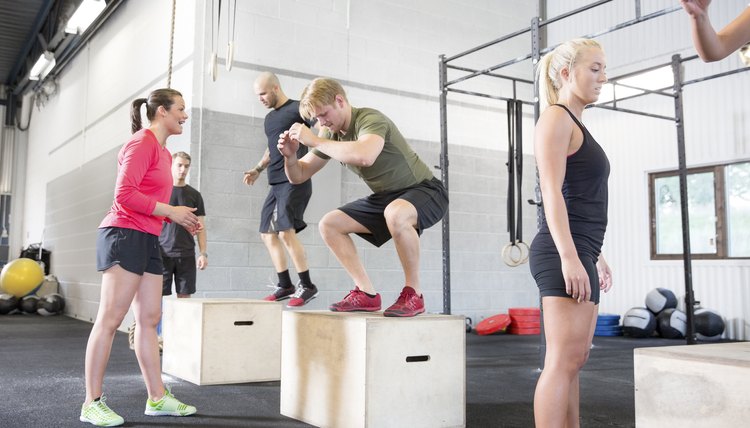
Isometrics and plyometrics are bodyweight strength training exercises that sound similar but their meaning is very different. Isometrics is a type of exercise that causes muscle contraction without a change in the length of the muscle during reps. Plyometrics involve large, fast movements such as jumping and hopping. The muscles shorten and lengthen as the joints move during plyometric training. These types of exercises achieve different results but may overlap in your training program depending on goals and physical capabilities.
Isometric is Static and Plyometric is Explosive
Plyometric exercises include explosive movements such as jumping rope, squat jumps and plyometric pushups. This is known as rate of force development – and you will see rate of force development shortened to RFD.
In a prior article, we looked at the physics to determine why volleyball players are able to react faster than most people. Volleyball players develop fast twitch muscles that accomplish a rate of force development (RFD) that matches the time allowed to respond to the speed of a spiked volleyball. That these physical properties, the time allowed to defend a volleyball spike or the physical time allowed to respond to a baseball, are achievable by athletic training is one of the keys of good game design and why we should enjoy the athletic training to excel at sports.
Isometric exercises include static exercises like plank bridges, side bridges and static yoga poses.
Both iso and plyo exercises may target the upper and lower body, including the core. But the way you do the exercises makes all the difference.
For example, to perform an isometric push up simply begin in a push up position and then lower your body halfway to the floor. Hold the position for 10 to 30 seconds, using your body weight is a form of resistance training.
To perform plyometric pushups, also known as clap pushups, begin in a pushup position, lower your body all the way down toward the floor and then quickly push your arms straight as you press your body off the floor and clap your hands.
Joint Stress
Plyometric exercises require movement at the joints whereas isometric exercises require no movement at all. Isometrics therefore place no additional stress on the joints whereas plyometrics are typically high-impact.
Landing places great stress on your joints, though supportive shoes can lessen the strain. Even catching yourself after a clap pushup stresses your wrists, elbows and shoulders, which doesn't happen when holding an isometric pushup. This can mean tendon stiffness for you if you are not careful.
Strong, Fast Muscles
Isometrics create muscle activation, increase muscle tissue size and isometric strength. Stabilization training like isometrics helps to protect and support the joints. And due to the lack of stress on the joints, isometric exercises are often part of rehabilitation programs for patients with weak joints and muscles.
Athletes also benefit from isometric training because it improves their ability to hold positions. However, plyometrics improve athletic performance because workouts make the muscles, joints and connective tissue that hold the two together stronger. Plyometrics improve speed and power, which holding static isometric contractions does not.
Play It Safe when Plyometric Training and Isometric Training
Plyometric and isometric exercises come with different dangers. Isometric exercises cause your blood pressure to elevate at maximal effort. This is due to the high amount of tension in the muscles while contracting during the exercises. Plyometrics are hard on the body, from the above average stress on the musculoskeletal system to the intensity of exercises.
You should have a foundation in weight training before doing plyometrics to reduce the potential for injury. Also, rest for one minute between repetitions and take three days off between plyometric workouts for recovery.
Go deeper Plyometrics versus Isometric Training:
Academic Kinesiology is a discipline that helps study the differences between Plyometric versus Isometric training. A resistance training book you can find on Amazon or your local library is Designing Resistance Training Programs, Fourth Edition.
Our opinion, know your sport. When I played basketball and football, plyometrics was part of every practice. And the effects of plyometric training were easy to see in my on field performance. Charles Barkley explained a lot of his youth training was basically doing plyometric jumping exercises. I read this in high school, and spent my summer focused on high intensity jump performance training. The muscle strength performance improved, especially to my calf and hamstring muscle groups, and I added three to four inches to my vertical jump. You can see this in the NBA today, Ja Morant is not only quick, but what separates him from top NBA players is his vertical jump.
Barbell Bench Press: Isometric and Plyometric variations.
Years ago the son of my head football coach came to our weight room after a year playing football for the Nebraska Cornhuskers. He warmed up using an isometric variation of a bench press, bringing the barbells down half way and holding. Then, he switched to a heavier weight and focused on plyometric training, almost equivalent to what you’d see in the NFL draft combine test of how many 225 pound bench presses you can do. You could tell he was focused on speed and power – he played Tight End and explained how difficult blocking NFL bound defensive players were. Quickly activating upper body force production separates NFL lineman and D-1 College athletes. For example, notice how quickly the Detroit Lions #2 overall draft pick defensive lineman Aidan Hutchinson moves out of his stance in the HBO 'Hard Knocks: Training Camp with the Detroit Lions' documentary.
References
Writer Bio
Sarka-Jonae Miller has been a freelance writer and editor since 2003. She was a personal trainer for four years with certifications from AFAA and NASM. Miller also worked at 24 Hour Fitness, LA Fitness and as a mobile trainer. Her career in the fitness industry begin in 2000 as a martial arts, yoga and group exercise instructor. She graduated cum laude from Syracuse University.