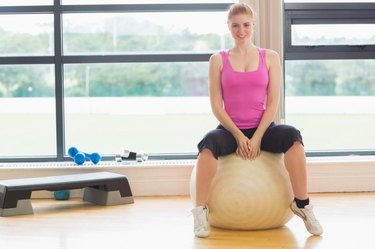
Whether you call it a stability ball, Swiss ball or balance ball, you can use it to train your core. Specific moves, such as ball crunches, ball passes and roll outs, target your ab muscles directly, but doing something as simple as bouncing on the ball challenges your entire core, which includes your back and hip muscles, to be stronger and healthier.
Evidence for Core Strength
Video of the Day
One of the primary roles of your core is to help with stability of your pelvis. Just sitting on a stability ball, as opposed to a static chair, challenges your balance and stability, and thus requires activation of your core. A study published in a 2015 issue of Human Factors showed that doing pelvic rotation exercises, such as moving front to back or side to side, while sitting on a stability ball is also an effective way to initiate core muscle activation. Bouncing is a variation of these rotations as it requires you to use your core to stay upright and balanced on the ball, just as if you were rolling your pelvis around while seated.
Video of the Day
How to Bounce
To effectively work you core, use proper form and technique when bouncing.
Step 1
Sit on a fitness ball. Plant your feet hip-distance apart.
Step 2
Draw your belly button in toward your spine as you begin to bounce. Focus on the upward action, keeping the action small at first. As you feel more comfortable, bounce a little higher. You can even lift your feet off the floor as you go up.
Step 3
Vary your arm movements as you bounce, reaching up and down or front to back. If you feel unstable, feel free to rest your hands on the ball alongside your hips to keep you from rolling onto the floor.
Step 4
Bounce for several minutes as a warmup for a full-body ab routine.
Choosing the Right Size
Bouncing will be most comfortable, safe and effective when you use the right size stability ball. Use these tips to determine if your ball is right for you:
- When you sit on the ball, your feet should easily rest flat on the floor.
- Your knees align with your pelvis, making a 90-degree angle, when seated. Your thighs should be parallel to the floor.
- Your head, shoulders and hips all line up when you sit up straight. You don't find it necessary to lean forward or back to create the 90-degree knee angle.
Balls come in multiple sizes, ranging from 45 to 85 centimeters. Most people who are between 5'1" and 5' 8" will need a 55-centimeter ball. Those who are taller -- 5'9" to 6'3" -- should go for 65 centimeters; even taller should reach for the largest sizes. People shorter than 5'1" will likely need a 45-centimeter ball.
Read More: What Size Stability Ball Should I Buy?
Round Out Your Workout
Bouncing does strengthen your core, but it doesn't give you a comprehensive workout. Use the ball to do other moves that will give you a functional, healthy powerhouse:
Crunches off the ball: Lie with your low back on the ball, place your hands behind your head and curl your upper body toward your thighs.
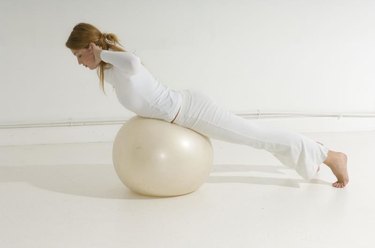
Back extensions: Lie belly first on the ball, legs extended straight behind you. Place your hands by your ears and lift your chest up and away from the ball.
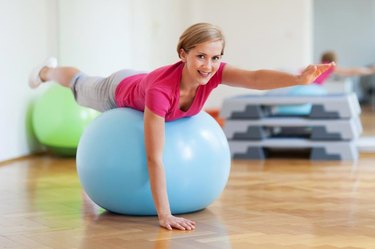
Bird dogs: Put your abdomen on the ball with your hands and feet on the floor. Alternate extending the right arm/left leg and left arm/right leg to opposite sides of the room.
Side crunches: Lie your right side waist on a stability ball and prop your feet against a wall for balance. Place your hands behind your head and squeeze upwards to work the left side. Flip directions.
Read More: Total-Body Blast Stability Ball Workout