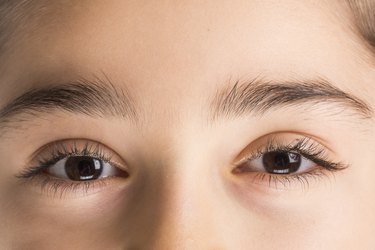
Uncontrollable eyebrow twitching is not only random, but awkward. Not fun on a first date or a job interview. It's often caused by stress, lack of sleep or even excess caffeine, but low magnesium levels may also be a trigger.
Video of the Day
Video of the Day
Whether it's around the eyebrow, lips, forehead or eyelids, "in adults, a facial spasm rarely indicates an underlying medical condition," says Ali Samii, MD, a neurologist at University of Washington Medicine who specializes in movement disorders and spasticity. Instead, a twitch usually resolves on its own and people forget they ever had one." Eyebrow twitching often happens along with eyelid twitching because an eyelid twitch can pull the eyebrow down.
Normally, nerve impulses from the brain tell muscles what to do, but according to the Ohio State University Wexner Medical Center, illness or stress can disrupt that process, resulting in muscle twitching.
What is eyelid twitching a sign of? According to the American Academy of Ophthalmology, eyelid twitching can result from lack of sleep, too much stress or too much caffeine. The Kellogg Eye Center at Michigan Medicine has a similar message: "Ophthalmologists often are asked what causes the twitching and what can be done to stop it. Lack of sleep, too much caffeine or increased stress seem to be root causes."
The Mayo Clinic lists additional possible triggers, including bright light, smoking, drugs or medications, alcohol and air pollution.
Can Magnesium Deficiency Cause Twitching?
The National Institutes of Health Office of Dietary Supplements explains that magnesium is a mineral involved in metabolism, protein-building and blood pressure. With a healthy diet, you get enough minerals just from what you eat, so magnesium supplements are not usually necessary.
Spinach and other green leafy vegetables, nuts, seeds and whole grains are good sources, notes the U.S. Department of Agriculture. Black beans and kidney beans, edamame, avocado, baked potatoes, rice, unprocessed cereals, raisins, yogurt, oatmeal, salmon, halibut, milk, chicken and beef also contain magnesium.
Chronic alcoholism can cause magnesium deficiency, according to the Cleveland Clinic.
"Low magnesium levels can lead to muscle twitches in skeletal muscle and rhythm abnormalities in heart rate," says Matthew C. Kostek, PhD, an associate professor of physical therapy at Duquesne University in Pittsburgh.
"If a person is experiencing lip or forehead twitches, they most likely notice them because they are on the face and are thus noticeably observed visually, and also felt more easily due to increased sensory input of nerves from the face, compared with other parts of the body," he says. Twitches on the heel, elbow or any place that's covered by hair might go unnoticed.
"The density of neurons innervating the facial muscles is slightly greater than other areas of the body, so symptoms might occur there first and they will be noticed there first," Dr. Kostek says.
How Overexertion Affects Magnesium
An August 2017 review in the journal Nutrients suggests that taking magnesium supplements may alleviate soreness after a workout. But evidence is sparse because magnesium levels are hard to detect. Typical blood, saliva or urine tests are not as useful as they are for measuring other health factors. Therefore, it has been difficult to confirm that overexertion causes magnesium depletion because depletion is hard to measure.
"According to previous research, the best indicator of magnesium status in an individual is through the magnesium load test," says Alyssum Reno, MS, a clinical instructor in kinesiology at the University of Alabama in Huntsville. "However, this test is expensive, and most laboratories do not have the capacity to conduct this test, so serum magnesium (a blood test) is often utilized." But only a small amount of the body's total magnesium is accounted for in the blood.
"There have been multiple studies in which magnesium has been shown to alleviate muscle cramps in deficient individuals," Reno says. "However, magnesium deficiency was assessed using serum magnesium (blood test) or dietary recalls." She is co-author of research presented a recent American College of Sports Medicine conference that suggested, albeit with just 22 subjects, that magnesium supplementation may benefit people starting an exercise regimen as well as active exercisers who experience chronic muscle soreness.
"In our recent study," Reno says, "magnesium supplementation of 350 milligrams a day for 10 days significantly reduced feelings of muscle soreness and improved feelings of perceived recovery [from exercise] in individuals with low magnesium intake — about 52 percent of the U.S. Department of Agriculture's Recommended Dietary Allowances."
"The mechanism for how magnesium may alleviate muscle soreness is not well understood," she says, "and more research is needed on this topic."
- Ali Samii, MD, neurologist, professor, University of Washington Medical Center, Seattle
- Ohio State University Wexner Medical Center: “Why Do My Muscles Twitch?”
- American Academy of Ophthalmology: “What Is an Eyelid Spasm or Twitching Eyelid?”
- Mayo Clinic: “Eye Twitching”
- National Institutes of Health Office of Dietary Supplements: “Magnesium Fact Sheet for Health Professionals”
- U.S. Department of Agriculture: “National Nutrient Database for Standard Reference Release 28: Nutrients: Magnesium, Mg (mg)”
- Cleveland Clinic: “Magnesium Rich Food”
- Matthew Kostek, PhD, associate professor, physical therapy, Rangos School of Health Sciences, Duquesne University, Pittsburgh
- Nutrients: “Can Magnesium Enhance Exercise Performance?”
- Alyssum Reno, MS, clinical instructor, kinesiology, University of Alabama in Huntsville
- American College of Sports Medicine, 2020 SEACSM Abstracts: “Abstract P222: Effects of Magnesium Supplementation on Muscle Soreness and Performance”
- Kellogg Eye Center, Michigan Medicine: "Frequently Asked Questions About Vision and Vision Care"
Is this an emergency? If you are experiencing serious medical symptoms, please see the National Library of Medicine’s list of signs you need emergency medical attention or call 911.