What does fact checked mean?
At Healthfully, we strive to deliver objective content that is accurate and up-to-date. Our team periodically reviews articles in order to ensure content quality. The sources cited below consist of evidence from peer-reviewed journals, prominent medical organizations, academic associations, and government data.
The information contained on this site is for informational purposes only, and should not be used as a substitute for the advice of a professional health care provider. Please check with the appropriate physician regarding health questions and concerns. Although we strive to deliver accurate and up-to-date information, no guarantee to that effect is made.
What Is Sodium Metasilicate?
Sodium metasilicate is a member of the sodium compound family, according to the International Programme on Chemical Safety 12. A very basic compound, sodium metasilicate is used in a variety of industrial and household settings 2. While it is a cleaning and de-rusting solution, it is highly corrosive and should be handled with care.
Identification
Sodium metasilicate is produced by fusing sand with sodium carbonate at very high temperatures, notes the International Programme on Chemical Safety 12. This produces a clear, white or grayish-white crystal solution. Sodium is a base, and therefore has a high pH level. When interacting with acid, sodium metasilicate will often neutralize that acid 12.
Uses
What Are the Dangers of Sodium Silicate?
Learn More
Sodium metasilicate is a highly corrosive substance, particularly when water is added 2. For this reason, it is used in a variety of settings. The compound is found as an ingredient in fireproofing mixtures, household cleaning, insecticides, fungicides and as a bleaching aid. The United States Food and Drug Administration has approved one form of sodium metasilicate, the pentahydrate form, for use in washing vegetables and fruits 2.
Green-Friendly
Sodium metasilicate’s corrosive properties come in handy when used as a cleaning powder, according to the Housekeeping Channel 2. For those who wish to purchase environmentally friendly “phosphate-free” cleaning powders, sodium metasilicate is frequently used as a substitute 2. It is available for purchase at many home stores and hardware centers.
Safety Precautions
The Effects of Inhalation of Clorox Fumes
Learn More
Because sodium metasilicate is a highly corrosive material, it can be highly irritating when it comes in contact with the skin, eyes or respiratory tract, according to the International Programme on Chemical Safety 12. If using as a cleaner, take precautions such as wearing a protective mask and gloves. If your skin does come in contact with the metasilicate, wash your skin and remove any clothing contaminated by the compound. If the compound comes in contact with your eyes, flush them thoroughly with saline solution.
- Because sodium metasilicate is a highly corrosive material, it can be highly irritating when it comes in contact with the skin, eyes or respiratory tract, according to the International Programme on Chemical Safety 1.
- If your skin does come in contact with the metasilicate, wash your skin and remove any clothing contaminated by the compound.
Storage
Sodium metasilicate should be stored in a dry location 123. Do not remove the compound from its original container because if stored in an improperly labeled container, this could create confusion as to its contents and increase the risk of injury. Because it is corrosive, store out of reach of children and pets.
Related Articles
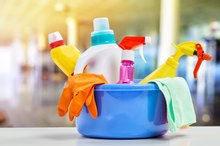
What Are the Dangers of Sodium Silicate?
Learn More
The Effects of Inhalation of Clorox Fumes
Learn More

Sodium & Calcium Hydroxide
Learn More

What Are the Dangers of Ethylene Vinyl Acetate?
Learn More
Side Effects of Sodium Carbonate
Learn More

Uses of Phenyl Benzoate
Learn More
Uses for Sodium Acetate
Learn More
What Are the Dangers of Sodium Acetate?
Learn More

What Is Ammonium Lactate Lotion?
Learn More

Types of Citric Acid
Learn More
References
Writer Bio
Rachel Nall began writing in 2003. She is a former managing editor for custom health publications, including physician journals. She has written for The Associated Press and "Jezebel," "Charleston," "Chatter" and "Reach" magazines. Nall is currently pursuing her Bachelor of Science in Nursing at the University of Tennessee.