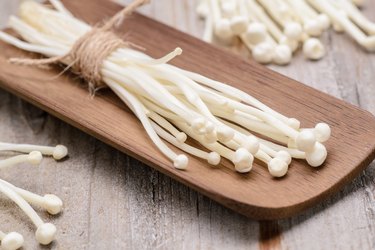
With their long, slender stems, ultra-small caps and creamy white color, enoki mushrooms are more elegant than the average fungus. These crisp, mildly sweet mushrooms -- known as "snow puffs" in their native Japan -- grow in bouquetlike clusters and are traditionally eaten raw or lightly cooked.
Major Nutrients
Video of the Day
Like other fresh mushrooms, enokis are a low-calorie source of protein and complex carbohydrates. A 1-cup serving of the raw variety -- or right around 2.3 ounces, according to the U.S. Department of Agriculture -- provides about 24 calories, 1.7 grams of protein and 5 grams of carbohydrates. Enokis are virtually fat- and sugar-free.
Video of the Day
Vitamins and Minerals
Mushrooms are generally high in B vitamins, and enokis are no exception. They're especially rich in niacin, offering 23 percent of the recommended daily value per 1-cup serving of raw mushrooms. You'll also get about 10 percent each of the daily values for thiamine, pantothenic acid, riboflavin and folate, according to the USDA. Although they're lower in minerals, fresh enokis still provide about 7 percent each of the recommended daily values for potassium and phosphorus per serving, plus trace amounts of iron, copper, zinc and selenium.
Beneficial Phytochemicals
The nutritional value of enoki mushrooms is further increased by their beneficial phytochemicals, including several potent antioxidant compounds. Dietary fiber also falls into this category -- a cup of raw enokis provides nearly 2 grams, or 7 percent of the recommended daily value. Enokis contain substantial amounts of beta-glucan, a soluble fiber that's particularly effective in reducing high cholesterol.