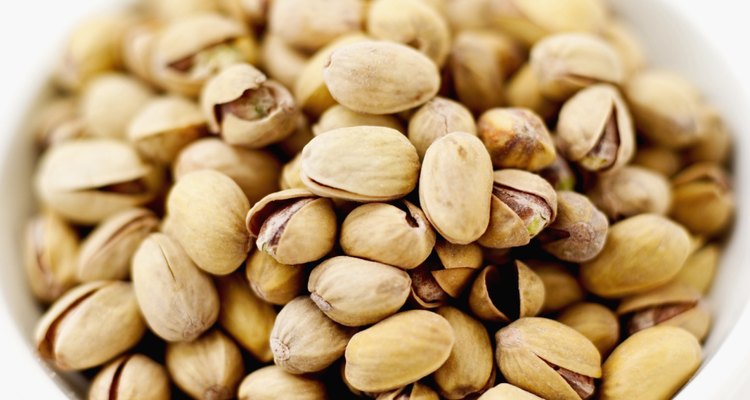
You'll be less likely to die of cancer or heart disease if you get less of your protein from red meat and more from plant foods, say researchers at the Harvard School of Public Health. This includes nuts like peanuts or pistachios. Peanuts and pistachios are cholesterol-free and rich in heart-healthy fats. Use them as a quick snack or as an unusual breading for poultry, or add them to salads and noodle dishes. Avoid oil-roasted and salted nuts that are high in sodium; also, be sure to keep your portion size under control. A single serving of nuts is only about 0.5 ounce.
Fat
Most of the calories in a serving of either peanuts or pistachios is supplied by fat. Peanuts have 83 calories in each 0.5 ounce, with 63 -- or about 72 percent of the total -- contributed by fat. Pistachios have 81 calories, though only 66 percent are from fat. Both contain a similar amount of saturated fat, at around 0.8 or 0.9 gram per serving. In addition, both contain over 3 grams of monounsaturated fats in 0.5 ounce. A diet rich in monounsaturated fats may lower your risk of stroke, heart disease and high blood cholesterol.
Carbohydrates
Nuts like peanuts and pistachios aren't good sources of carbohydrates. A half ounce of pistachios has just 4.1 grams of carbohydrates, while the same amount of peanuts has approximately 3 grams. Over 1 gram of the carbohydrate total in 0.5 ounce of both pistachios and peanuts is supplied by dietary fiber. Nuts are a source of both soluble and insoluble fiber. Eating plenty of both types of fiber can help you avoid diabetes, high blood cholesterol and digestive disorders like hemorrhoids.
Protein
Peanuts contain 3.4 grams of protein in every 0.5-ounce serving, while pistachios have about 3 grams in each serving. The Centers for Disease Control and Prevention says that healthy adult women should have about 46 grams of protein daily, while children between 4 and 18 years old need 19 to 52 grams each day, depending on their age, activity level and gender. A serving of pistachios or peanuts would fulfill about 7 percent of a woman's daily protein requirement; for an elementary school-aged child, it would fulfill almost 10 percent of a day's protein needs.
Vitamins
Peanuts and pistachios are both a source of B vitamins such as niacin, pantothenic acid, vitamin B-6, riboflavin and folate, though they contain slightly different concentrations of each. Peanuts have more niacin, with 1.9 milligrams in every 0.5-ounce serving, or 13 percent of a woman's recommended daily allowance. Pistachios are a better source of vitamin B-6: Each 0.5-ounce serving has 12 percent of the RDA for a woman.
Minerals
Peanuts are rich in manganese, a mineral that helps regulate your blood sugar and aids in the production of sex hormones. A 0.5-ounce serving of peanuts fulfills 17 percent of your requirement of manganese as an adult woman. Pistachios also contain manganese, but are an especially good way for you to increase your copper intake. Adults need 900 micrograms of copper each day, and pistachios contain 183 micrograms in every 0.5 ounce. Pistachios and peanuts also contain iron, magnesium and potassium.
Related Articles
Which Is Healthier, Lima Beans or ...
A Low-Cholesterol Diet Plan Menu
Nutrition Information on Blueberries
Calories in Candied Walnuts
The Nutritional Value of Edamame Beans

A List of Foods That Contain Choline
How Many Calories Are in an 8-Ounce ...
How to Store Raw Peanuts
Difference in Sugar Content of Sweet ...
List of High Protein Vegetables
Which Nuts Are Alkaline Forming?
Nutrition in Swiss Vs. American Cheese

2500 Calorie Menu
How to Salt and Dry Pistachios
Fat Grams in Cheese
The Nutritional Value of Anasazi Beans ...
High Fiber & Protein Diet Menus

Vitamin B6 Dosing for Children
Foods High in Fiber & Calcium
Fruits High in Zinc
References
- Archives of Internal Medicine: Red Meat Consumption and Mortality - Results from 2 Prospective Cohort Studies
- ChooseMyPlate.gov: What Counts as an Ounce Equivalent in the Protein Foods Group?
- USDA National Nutrient Database for Standard Reference: Nutrient Data for 16390, Peanuts, All Types, Dry-Roasted, Without Salt
- USDA National Nutrient Database for Standard Reference: Nutrient Data for 12152, Nuts, Pistachio Nuts, Dry Roasted, Without Salt Added
- American Heart Association: Know Your Fats
- Harvard University Health Services: Fiber Content of Foods in Common Portions
- Centers for Disease Control and Prevention: Protein
- University of Maryland Medical Center: Vitamin B-3 (Niacin)
- University of Maryland Medical Center: Vitamin B-6 (Pyridoxine)
- University of Maryland Medical Center: Manganese
Resources
Writer Bio
Michelle Kerns writes for a variety of print and online publications and specializes in literature and science topics. She has served as a book columnist since 2008 and is a member of the National Book Critics Circle. Kerns studied English literature and neurology at UC Davis.
Photo Credits
Stockbyte/Stockbyte/Getty Images