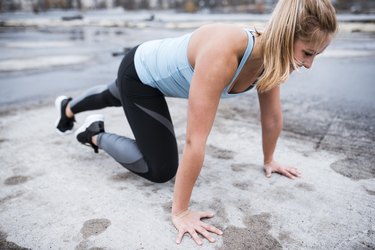
Like sit-ups, push-ups or planks, the mountain climber exercise can be done anywhere, any time and at no cost, and you certainly don't need a mountain to do them. What's more, mountain climbers exercise benefits are numerous: working key muscles from the triceps to the glutes to the abdominals.
Tip
Mountain climbers work the abdominals, glutes, legs, triceps, shoulders and more, while getting your heart rate up.
Video of the Day
Mountain Climbers: Exercise Benefits
Mountain climbing, or as it's known to some, "running planks," comes with a laundry list of benefits, from hamstrings to heart. According to Mark Briant, a personal trainer who runs wellness consultancy MobFit, in an interview with HuffPost in January 2018, mountain climbers work the abs, legs and shoulders, while getting your heart rate pumping.
Video of the Day
In an April 2017 article for the New York Times, Jordan D. Metzl, MD, writes that exercise mountain climbers mimic the movement of real climbers as they scale steep peaks, and they build strength in the back, arms and legs as well as the core. In fact, a March 2012 study published in the International Journal of Sports Medicine found that climbing builds core strength and trunk mobility in adults.
Certified trainer and author of Turbulence Training Craig Ballantyne in an April 2014 interview with Women's Health Magazine emphasizes the upper body benefits of mountain climbers, noting that they build holding endurance in the triceps and shoulders.
In sum, mountain climbers work a number of different muscles, including:
- Glutes
- Quads
- Abdominals
- Hamstrings
- Triceps
- Shoulder muscles
Read more: 5 No-Equipment Upper Body Exercises
Proper Mountain Climber Form
Whether you want to work up to 100 mountain climbers a day or just a dozen, it's crucial to maintain the proper form to avoid injury and ensure you're working the correct muscles. The American Council on Exercise (ACE) breaks down the correct positioning:
Get into plank position, with your knees and feet hip-width apart, your hands on the mat with your fingers facing forward and knees lifted off the ground. Keeping your abdominal muscles in place, bring your left thigh to your chest, driving your knee toward your elbow. Repeat this movement with the opposite leg.
Mountain Climber Do's and Don’ts
Briant has a few suggestions of what to do and what not to do when trying to maintain proper mountain climber form. He recommends beginning with 10 to 15 mountain climbing exercises in a row. For maximum ab work, he suggests bringing your knees to your chest with a slight pause. He also advises keeping your back straight and not going into "downward dog" position.
Physical trainer and founder of personal training/fitness company BoddiBoo.co.uk Danielle Smith, who was also interviewed by HuffPost in January 2018, advises actively engaging your core by drawing your navel in toward your spine. This way your abdominal muscles will get a workout each time you switch knees. Moreover, she recommends keeping your shoulders right above your wrists to engage your shoulder muscles.
Mountain Climber Variations
There are several variations on the traditional mountain climber exercise, none of which require the assistance of a mountain climber exercise machine. Other variations, according to Ballantyne, include:
- Cross-Mountain Body Climber: Begin in push-up position. Keeping your abs in place, pick your leg up and bring your right knee to the left shoulder. Alternate sides.
- Stability Ball Mountain Climber: Position your hands on a stability ball, 18 to 24 inches apart. Extend your legs behind you in push-up position. Bring your right knee toward your chest; then lower it. Alternate sides.
- Slow Motion Mountain Climber: In push-up position with your abs braced, do the mountain climber exercise, but hold each leg up to your chest for two seconds before alternating.
- ACE: "Mountain Climbers"
- New York Times: "The 9-Minute Strength Workout"
- HuffPost: "Mountain Climbers Are The Full Body Exercise You Can Do Anywhere"
- Women's Health Magazine: "5 Variations on Mountain Climbers You Have to Try"
- Thieme: International Journal of Sports Medicine: "Effects of Climbing on Core Strength and Mobility in Adults"