
What does fact checked mean?
At SportsRec, we strive to deliver objective content that is accurate and up-to-date. Our team periodically reviews articles in order to ensure content quality. The sources cited below consist of evidence from peer-reviewed journals, prominent medical organizations, academic associations, and government data.
- ExRx.net: Muscle Directory: Tibialis Anterior
- ExRx.net: Exercise Directory: Lever Seated Tibia Raise
- ExRx.net: Smith Reverse Calf Raise
- ExRx.net: Exercise Directory: Lever 45-Degree Reverse Calf Press
The information contained on this site is for informational purposes only, and should not be used as a substitute for the advice of a professional health care provider. Please check with the appropriate physician regarding health questions and concerns. Although we strive to deliver accurate and up-to-date information, no guarantee to that effect is made.
What Exercise Machine Works the Tibialis Anterior?
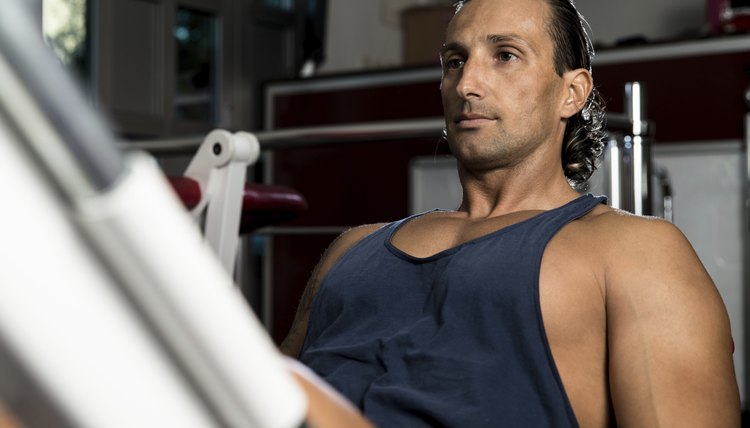
The tibialis anterior is an oft-overlooked muscle. It is your shin muscle, the muscle on the front of your lower leg. The tibialis anterior is responsible for dorsal flexion of your ankle joint -- pulling the top of your foot toward your shin. To work this muscle, perform a reverse calf raise. Although not many exercise machines target the tibialis anterior specifically, certain ones do work this muscle while targeting others. Consult your doctor before beginning any new exercise routine.
Dorsiflexion Machine
You aren't likely to find this strength machine in many gyms -- but it does exist, and its only function is to work the tibialis anterior muscle. It is a small device with handles that hold weight plates. Sit on a bench and set the dorsiflexion machine at your feet. Place your heels on the pedal and slide the top of your feet under the padded bar. Lift the front of your feet up as far as you can, keeping your heels on the pedal. Slowly lower until your toes point downward and repeat.
Smith Machine
The Smith machine is one of the most versatile pieces of fitness equipment in the gym. To work your tibialis anterior on the Smith machine, place an aerobic step under the bar. Position the bar across your shoulders and stand on the aerobic step with your heels on the platform and the balls of your feet hanging off. Raise your toes as high as you can off the ground, lifting up onto your heels. Slowly lower and repeat.
Leg Press
The leg press machine is commonly used to work the calf muscles, and it can be used in a similar manner to target the tibialis anterior muscle. Sit in the leg press machine and place your feet at the top of the foot plate with your toes extended past the edge. Keep your legs straight; do not bend your knees. Push through your heels, pulling the front of your foot back toward your body. Slowly lower and repeat.
Standing Calf Machine
With a slight adjustment of your body position, you can use a standing calf raise machine to target the tibialis anterior muscle. Instead of facing forward in the machine, turn around and face away from it. Place your heels on the platform with your toes hanging off. Position the pads on your shoulders. Lift your toes into the air as high as you can. Slowly lower and repeat.
References
- ExRx.net: Muscle Directory: Tibialis Anterior
- ExRx.net: Exercise Directory: Lever Seated Tibia Raise
- ExRx.net: Smith Reverse Calf Raise
- ExRx.net: Exercise Directory: Lever 45-Degree Reverse Calf Press
- American Academy of Orthopaedic Surgeons. Shin Splints. Updated August 2019.
- Donec V, Kubilius R. The effectiveness of Kinesio Taping® for pain management in knee osteoarthritis: a randomized, double-blind, controlled clinical trial. Ther Adv Musculoskelet Dis. 2019;11:1759720X1986913. doi:10.1177/1759720x19869135
- Pieber K, Herceg M, Paternostro-Sluga T, Schuhfried O. Optimizing stimulation parameters in functional electrical stimulation of denervated muscles: a cross-sectional study. J Neuroeng Rehabil. 2015;12:51. doi:10.1186/s12984-015-0046-0
- American Academy of Orthopaedic Surgeons. Foot and Ankle Conditioning Program. Updated October 2012.
Writer Bio
Based in Austin, Texas, Jolie Johnson has been in the fitness industry for over 12 years and has been writing fitness-related articles since 2008 for various websites. She received her Bachelor of Arts in English and philosophy from the University of Illinois.