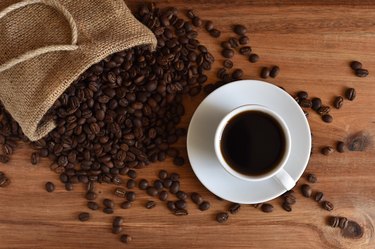
With countless tasks to manage on a daily basis, it can be challenging to get everything done, especially when your energy level is low. This is why many people turn to coffee. Whether you are drinking a cup o' joe or eating chocolate-covered coffee beans, caffeine always seems to provide a boost.
Tip
Eating coffee beans can have the same effect on your mood and focus as drinking coffee. It’s a much more concentrated way to consume caffeine For this reason, it's best you consume them in moderation.
Video of the Day
Does Coffee Give You Energy?
Keeping your energy level high has to do with a healthy lifestyle, first and foremost. The American Heart Association zeroes in on several energy-boosting factors including adequate exercise, restful sleep, stress reduction and at the top of the list — a healthy diet. Eating a balanced diet that includes a variety of proteins, fats, vegetables, whole grains, healthy oils and unrefined carbohydrates is the best way to maintain energy throughout the day.
Video of the Day
Read more: Side Effects of Switching to a Healthy Diet
While coffee alone cannot provide the caloric energy we need to survive, it can be used to our advantage. According to Harvard Health Publishing, caffeine is a stimulant that we can consume to sharpen our minds and increase alertness.
A February 2017 study published in the Journal of Psychopharmacology shows that a 60-milligram shot of caffeine — or the equivalent of one espresso or eating five coffee beans — improves contentment, mood and attention span. Coffee has also been shown to improve endurance performance in long-duration physical activities like swimming and bicycling.
Even more compelling, however, is a November 2015 study in the journal Circulation. Researchers found that coffee consumption is linked to an eight to 15 percent reduction in the risk of death. Perhaps this is because coffee consumption has also been associated with a reduced risk of cardiovascular disease, type 2 diabetes, Parkinson's disease, uterine and liver cancer, cirrhosis and gout.
Is Caffeine Consumption Safe?
It's common knowledge that coffee contains caffeine, but how much is in each cup? According to the National Coffee Association, an 8-ounce cup can vary between 75 and 165 milligrams, with the average being about 95 milligrams. And if you think decaf is completely free from caffeine — think again. Even decaf coffee has an average of 2 milligrams per cup.
Read more: Is Decaf Coffee Bad for Your Health?
Knowing that, is there a limit on how much coffee we should be drinking in a day? The U.S. Food and Drug Administration (FDA) cites that healthy adults can safely consume about 400 milligrams of caffeine or the equivalent of about four or five cups of filtered coffee per day. More than that may lead to symptoms such as migraine headaches, insomnia, nervousness, bloated belly, irritability and stomach upset.
While consuming 400 milligrams of caffeine may come as fantastic news for coffee lovers, be mindful — a 16-ounce "Grande Blonde Roast" at Starbucks has 360 milligrams of caffeine. Compared to the average cup, this contains a higher percentage of caffeine in coffee. And remember, coffee may not be your only source of caffeine for the day.
Eating Coffee Beans
Some people prefer to eat coffee beans as a snack, instead, and this is completely safe as long as it's done in moderation. This is because there is much more caffeine in coffee beans per gram. By comparison, the average cup of coffee, which may take 70 coffee beans to produce, has 95 milligrams of caffeine, while eating just 10 chocolate-covered espresso beans has 134 milligrams of caffeine.
By FDA standards for caffeine intake, this means you would want to limit yourself to eating less than 30 chocolate-covered espresso beans per day, tops. And while eating 30 coffee beans may seem like a lot to some, it can be quite easy to overdo it if they are coated in delicious dark chocolate.
Dark chocolate has some rewarding health benefits, of course, but the calories and sugar content should also be taken into consideration when mapping out your caloric intake for the day. According to the USDA, a 40-gram serving of dark chocolate coated coffee beans (28 pieces) has roughly 216 calories and 17 grams of sugar.
- Integrative Medicine Research: “Coffee and Health”
- U.S. Food and Drug Administration: “Spilling the Beans: How Much Caffeine Is Too Much?”
- Harvard Health Publishing: “Eating to Boost Energy”
- American Heart Association: “5 Simple Heart-Healthy Energy Boosters”
- Harvard Health Publishing: “The Latest Scoop on the Health Benefits of Coffee”
- Mayo Clinic: “Caffeine: How Much Is Too Much?”
- Circulation: “Association of Coffee Consumption With Total and Cause-Specific Mortality in 3 Large Prospective Cohorts”
- Center for Science in the Public Interest: “Caffeine Chart”
- National Coffee Association: “Coffee, Caffeine & Health”
- USDA: “Nutrition Facts for Dark Chocolate Coated Coffee Beans”
- USDA FoodData Central: “Espresso Coffee Beans, Chocolate-Covered”
- Journal of Psychopharmacology: “Effects of a Single, Oral 60 Mg Caffeine Dose on Attention in Healthy Adult Subjects”