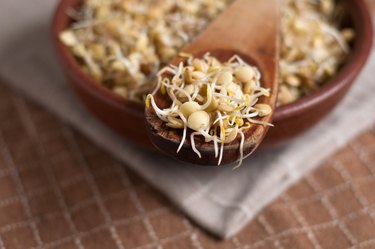
Adding legumes, such as lentils, to your diet offers health benefits. The Linus Pauling Institute notes that legume consumption correlates with a lower risk of type 2 diabetes. Both dried and sprouted lentils boost your legume intake. Sprouted lentils offer more caloric bang for your buck, because each cup contains just 82 calories, while a calorie-matched serving of dried lentils is just 2 tablespoons, which expands to roughly one-third cup when cooked. Both types of lentils fit nicely into a healthful diet, but sprouted and dried lentils differ in their mineral and vitamin content.
The Similarities
Video of the Day
Sprouted and dried lentils offer similar amounts of manganese and zinc. Both foods contain 1.2 milligrams of zinc, which contributes 15 per toward the daily zinc intake recommended for women and 11 percent for men. Zinc controls nerve function, which is important for your senses of taste and smell, and it maintains the health of your immune system. Dried and sprouted lentils also provide a significant amount of manganese. This is 0.32 milligram per serving for dried lentils or 0.39 milligram for sprouted lentils. This manganese contributes toward your daily recommended intake, with 2.3 milligrams for men and 1.8 milligrams for women, and benefits your health by promoting brain function and helping to control your blood sugar.
Video of the Day
Iron Content
Look to sprouted lentils over dried lentils as a source of beneficial iron. Your body needs iron to perform the electron-transport chain, which is a series of chemical reactions that generate useable energy for your tissues. Iron also helps your white blood cells function, which helps keep your body free of infection and also contributes to heme, a chemical needed for oxygen transport. A serving of sprouted lentils contains 2.5 milligrams of iron, which is 31 percent of the recommended daily intake for men and 14 percent for women, while a calorie-matched portion of dried lentils contains 1.8 milligrams of iron.
Copper Content
Sprouted lentils also provide significantly more copper per serving than their dried counter parts. Each serving of sprouted lentils offers 271 micrograms of copper, which is 30 percent of the recommended daily intake, while a calorie-matched portion of dried lentils contains just 125 micrograms, or 14 percent of your daily needs. Copper activates cytochrome c oxidase, which is a protein your body uses to make energy, and also helps produce melanin, a pigment protein found in your eyes, hair and skin.
Folate Content
Opt for dried lentils over sprouted and you'll consume more folate. Each portion of dried lentils offers an impressive 115 micrograms of folate, which makes up 29 percent of the recommended daily intake. A calorie-matcher portion of sprouted lentils, in contrast, contains 77 micrograms of folate. The folate in lentils helps you make S-adenosylmethionine, which is a chemical your cells use to control gene activity. The ability to turn genes on and off, as needed, proves essential to tissue health, because gene dysregulation contributes to cancer growth. Folate also plays a key role in healthy fetal development, and helps support a healthy pregnancy.
- Linus Pauling Institute: Legumes
- USDA National Nutrient Database: Lentils, Raw
- USDA National Nutrient Database: Lentils, Sprouted, Raw
- University of Maryland Medical Center: Zinc
- University of Maryland Medical Center: Manganese
- Linus Pauling Institute: Iron
- Linus Pauling Institute: Copper
- Linus Pauling Institute: Folate
- USDA National Nutrient Database: Lentils, Mature Seeds, Cooked, Boiled, Without Salt