
Gymnastics Drills for Beginners
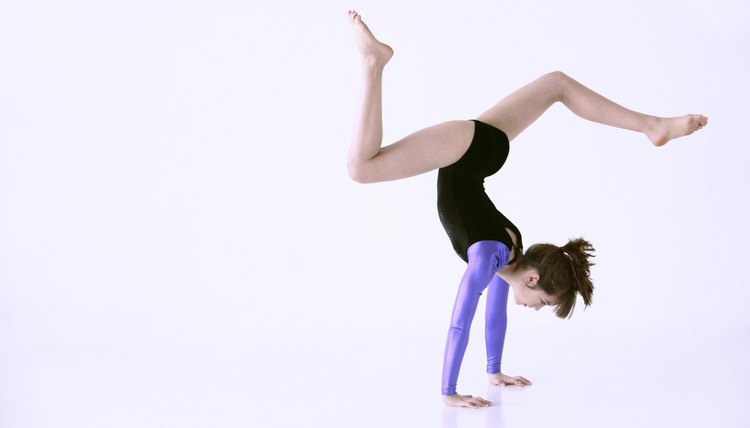
Gymnastics requires a great deal of strength, balance, coordination, agility and body awareness to perform the various moves and avoid injury. Beginners will greatly benefit from certain gymnastics drills that help to improve all areas of fitness, as well as get their bodies ready for more advanced moves. These are drills that anyone can perform, and it is necessary to do them regularly in order to get the greatest benefit.
Basic Pushups
All aspects of gymnastics requires strength, particularly upper-body strength, to properly perform the different moves, and most moves simply cannot be performed without the right amount of strength. One of the simplest and most effective ways to build upper-body strength is traditional pushups, which require no equipment so they can be done at any time. Those who are new to pushups should start with three sets of five repetitions, perhaps from their knees, instead of their toes, and then work up by adding to the amount of pushups and repetitions done each week.
Frog Stand For Beginners
The frog stand works to develop hand-balancing skills, stabilizes core muscles, improves balance and helps gymnasts work toward being able to perform an unsupported handstand. This beginner exercise requires gymnasts to get into a squat position, put the hands on the floor, lean forward, lift the legs and then put knees to elbows. This position should be maintained for 20 seconds, and the gymnast should build up to holding this position for a full minute by adding three to five seconds to the hold each week to improve strength, balance and stamina.
The Handstand Drill
The handstand is one of the most important moves that a gymnast will use for all levels of gymnastics performance and competition. Gymnasts should perform handstand drills to perfect this move and ensure a solid, tight handstand at all times. Start by doing handstands against a wall to get comfortable with the move and once in position, hold it for 30 to 60 seconds. Increase the difficulty by eventually putting a gap between your body and the wall.
Forward Rolls or Somersault
The forward roll -- or somersault -- is used to train for more complex tumbling and flipping. To begin, put both hands flat on the floor and squat with your knees together. While tucking the head, push with the legs and use the arms to support some of the weight and roll forward. Finish by rocking onto the back and then rolling to the feet. When finished, stand tall with your arms straight out to the sides, which is the stance taken when any gymnastics move is completed.
References
Writer Bio
Suzy Kerr graduated from Grady School of Journalism and Mass Communications at the University of Georgia. She completed her Master's degree in Nutrition Sciences, also at the University of Georgia. Suzy has been a successful health, fitness and nutrition writer for more than 10 years, and has been published in various print and online publications.