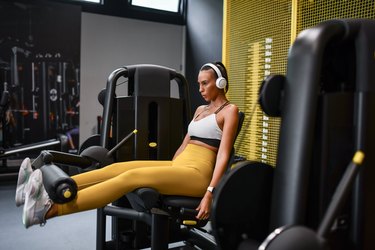
The leg extension and leg curl machines do to your upper-leg what brisket does to stew or what burgers do to a BBQ: Beef 'em up.
Two different machines, both the leg extension and leg curl machine are popular amongst those looking to build lower-body muscle and those rehabbing knee injuries.
Video of the Day
The two leg strength machines work opposing sides of your thighs — while the leg extension machine isolates your hamstrings, the leg curl machine targets your quads. Typically, if you incorporate one of these machines, you'll also want to incorporate the other (or, another exercise that works the muscles not yet targeted), according to exercise physiologist Pete McCall, CSCS, CPT, host of the All About Fitness Podcast.
"If muscles at the front of the thigh become stronger, or vice versa, it can create an imbalance that increases risk of injury to the knee joint," he tells LIVESTRONG.com.
But how do you use each machine, exactly? Let's get into it. Ahead, everything you need to know about the leg curl and leg extension machines — including how to use them with proper form, the strength gains you'll be able to make by incorporating each machine, as well how many reps and sets to do at each station.
How to Do a Leg Curl on a Machine With Proper Form
The leg curl machine is an excellent way to isolate your hamstrings. But doing so requires setting up the machine just right.
"The most common form mistake people make when using the lying leg curl machine is using momentum, rather than their muscles, to move through each rep," Jake Harcoff, CSCS, head coach and owner of AIM Athletic, tells LIVESTRONG.com. "Instead of letting the weight stack slam down or bounce during the second portion of each rep, keep your core and hamstrings engaged to stay in control and maintain a consistent range of motion."
Without further ado, here's how to do leg curls correctly.
- The circular pad detached from the table is designed to rest along the backside of your feet when you are face down, knees in-line with the pivot-point of the pad. Adjust the tube so it sits between your ankle and your heel when you’re laying face-down on the pad.
- Adjust the weight to something you can move comfortably for 10 to 15 reps.
- Crawl into the machine so the padded roller rests against the back of your foot and your knees are at the tail end of the bench.
- Grip the handles, palms facing inward.
- Maintain contact between your upper legs, hips and the bench throughout the entire movement. Use your hamstrings to pull your heels towards your butt bending your knees as you do. Draw your heels as close to your butt as you can without arching your lower back.
- When returning to the start position, slowly push the weight away from your body with your hamstrings, rather than relying solely on momentum.
Leg Curl Muscles Worked
1. Hamstrings
The leg curl machine loads the muscles along the back of your leg. Also known as the hamstring curl, this machine primarily works — you guessed it — your hamstring muscles.
The opposing muscle to your quadriceps, your hamstrings are among the biggest, most powerful muscles in the body.
By placing you face-down on a bench, the leg curl locks your hips in place, which forces your hamstrings to do the most work to move your lower legs, Harcoff explains.
2. Core
Your core muscles — which span side-to-side, as well as from chest to pelvis — help protect your spine, as well as help transfer power over to your limbs.
You have to lock these muscles in the palace in order to keep from over-extending your lower back while you extend your legs back on the machine, Harcoff says.
By strengthening your midline through exercises like the leg curl machine, you help reduce the risk of lower-back issues, as well as increase your ability to throw and kick with ferocity and speed, he says.
3. Calves
"Your calf muscles assist in providing stability and control throughout the movement," Harcoff says. More specifically, a muscle in the calf known as the gastrocnemius.
The gastrocnemius muscle crosses the back of your knee and helps your hamstrings to bend the knee when using either of the leg curl machines. It also helps keep your foot in a flexed position throughout the movement.
4. Glutes
Do leg curls build glutes? "The leg curl machine also requires the muscles around the hamstring to activate," Harcoff says. Most notably: your glutes.
Your glutes — or more specifically, the gluteus maximus, the biggest glute muscle — help stabilize your hips and pelvis during the exercise, according to Harcoff.
Leg Curl Benefits
The word "hamstring" may sound like the slimy string wrapped around your Christmas morning meat of choice. But actually, it's one of the largest and most powerful muscle groups in the entire body.
Spending time strengthening this muscle with a leg curl machine provides several important benefits, Harcoff says. In particular, for people who work desk jobs. When you sit, you're not actively engaging the muscles on the back side of your body, such as your hamstrings, glutes and lower back. As far as your muscles are concerned, if you don't use 'em, you lose 'em. So, "a sedentary lifestyle can cause these muscles to become inactive and deconditioned over time," he explains.
Incorporating hamstring exercises, like the leg curl machine, into your workout routine can be particularly beneficial for individuals who sit all day because it helps counteract the negative effects of prolonged sitting.
What's more, the leg curl machine offers certain benefits other hamstring exercises don't. Unlike most other hamstring exercises like the deadlift and kettlebell swing, which are multi-joint movements that call on all the surrounding musculature and joints, the leg curl machine is an isolation exercise.
"[The leg curl machine] allows you to achieve knee flexion without making you flex at the hip," Harcoff says. This shifts the majority of the focus to your hamstrings, as opposed to all the surrounding hip, quad, lower-back, and lower-leg muscles.
This isolation is particularly beneficial for those who may have lower back issues or want to prioritize hamstring development without placing excessive stress on the spine, Harcoff explains. No doubt, compound exercises that work your hamstrings, like the standard and Romanian deadlift, are very effective for strengthening your hamstrings. However, those exercises are simply not accessible to people navigating certain injuries, he says.
Plus, compound exercises are more taxing on your body and lead to greater muscle breakdown. While that makes them effective for improving overall strength, it also means that you need to give your body more time to recover before hitting them again, he says.
Leg Curl Variations and Alternatives
Trying to improve hamstring strength, but don't have access to a leg curl machine or wondering if leg curls are even necessary? You have plenty of exercise options, according to McCall. "Any deadlift variation is going to effectively strengthen your hamstring as well," he says.
Actually, deadlift variations may strengthen your hamstring more functionally than leg curls do, according to McCall. "The leg curl machine may make your hamstring bigger and stronger," he says. "But because your foot is not in contact with the ground when you're moving your hamstring, the curl machine doesn't prepare the connective tissues around your hamstring to handle the force placed on the muscle when you run, walk or pivot."
That's why McCall says athletes who aren't currently rehabbing an injury or preparing for the stage can improve hamstring strength with the Romanian deadlift, barbell deadlift or single-leg deadlift, instead. All three of these deadlift variations can be done with a barbell, dumbbell or kettlebell.
How to Do a Leg Extension on a Machine With Proper Form
The seated leg extension machine itself isn't too tricky to use. However, setting it up requires a little savvy, according to Harcoff. Typically, the leg extension machine consists of a padded seat, a lever that locks your knees into the palace and a swiveling arm that sits above your ankle, he says. More on how to set up and use the machine ahead.
- Adjust the padded lever closest to your body so that it rests right above your knee joints, while holding your upper legs down. You want 1 to 2 inches of space between your thigh and the pad when you're at rest so there's space for the muscles to contract. Now, adjust the foot lever so that it sits in your ankle crease.
- Sit in the chair in position. Think about pressing your entire lower back into the seat to engage your midline.
- Adjust the weight stack to a weight you can move for 10 to 15 reps.
- Keeping your core tight, think about pulling your lower legs towards the ceiling while extending your knees.
- Continue extending your knees until your legs are nearly straight. Contract your quads at the top for 1 to 2 seconds.
- Return to the start position by lowering your legs and pulling your heels down toward the ground.
Tip
You actually don’t want to extend your legs totally straight. Straightening your knees completely when using the leg extension machine can create a shearing force on your knees, McCall says. Over time, this can damage the tissue surrounding your knees.
Leg Extension Muscles Worked
1. Quadriceps
"The leg extension machine primarily targets the muscles at the front of your thighs, known as the quadriceps," Harcoff says.
This massive front-body muscle has four main parts: the rectus femoris, the vastus lateralis, the vastus medialis and the vastus intermedius. All four of these are called on during the leg extension — the vastus intermedius, specificially, facilitates knee extension.
As you straighten your legs, your body calls on the rectus femoris and vastus lateralis, which connect your knees to your hips. At the end of the motion, when your knees are almost straight, the vastus medialis contracts.
2. Core
Just as you have to engage your midline to protect your back when you sit in an office chair, you need to engage your midline to protect your back while sitting in a leg extension machine.
Bracing your midline throughout each rep keeps the movement in your quads, rather than forcing your lower back to take over some of the work, Harcoff explains.
3. Calves
When you (almost) straighten your legs, you want your toes pointed "high and to the sky," Harcoff says. This foot flexion activates your calf muscles, which is why the leg extension machine also improves your calf strength.
Failure to flex your feet throughout the movement can put your knees in a wonky position. After all, while your quad muscles surround the upper portion of your knees, your calf muscles surround the lower region.
Your calf muscles are made of two muscles: the gastrocnemius and the soleus. But the one that's used the most during a leg curl is the gastrocnemius, which is most superficial. It crosses the back of your knee and helps your hamstrings to bend your knees when using either of the leg curl machines.
Leg Extension Benefits
Just as the leg curl machine isolates your hamstrings, the leg extension machine isolates your quads. Meaning, the the machine allows you to strengthen and use your quads without putting undue strain on your back.
"The fact that it allows you to move your quads without placing excessive load on your lower back makes it a great training tool for people with specific back-related issues or injury," Harcoff says. Because most leg extension machines allow you to place as little as 5 or 10 pounds worth of load on your quads, it's also a great way for people who are new to resistance training or rehabbing an injury to work the front part of their leg, he says.
As it goes, there are exercises (like squat variations) that work your quads more functionally than the leg extension exercise, McCall says. However, all of these other exercises require the ability to safely put your body weight on your feet, knees and ankles. Plus, because they are compound exercises, there's generally greater room for error amongst people who don't (yet!) have sound movement patterns. The leg extension machine makes it easy for newbie lifters to slow down, move with intent and learn what it feels like to contract and relax their quad muscles, Harcoff says.
Don't read it wrong: The leg extension machine isn't just for newer and injured gym goers. It's for anyone who wants to strengthen their quadriceps. In particular, those who spend the bulk of their days sitting. When you're sitting in a desk chair on your computer or on the couch watching Netflix, your lower-body muscles turn off, Harcoff says. Over time, this causes your quads and all the supportive muscles around your knee to weaken, which increases risk of injury in life and sport.
"Targeting your quadriceps with the leg extension machine can help individuals regain muscle strength around their knee joint, which promotes better alignment and reduces the risk of muscle imbalances," he explains. This, in turn, decreases risk of joint aches and pains.
Leg Extension Variations and Alternatives
No doubt, leg extensions can effectively increase your quad mass and strength, McCall says. But few home, CrossFit, HIIT or bootcamp gyms and fitness studios have them. So what should you do instead? Squat.
Actually, for the majority of the population McCall recommends squats over the leg extension — or at least, squatting in addition to using the machine. The leg extensions machine isolates your quads, he explains. While this makes it great for teaching you how to contact your quads, it does little to improve movement quality, he says.
When you move your legs, your hamstrings, quads, glutes and calf muscles all work together to get you from point A to point B. The squat is a multi-joint movement that primarily works your quads and glutes, but really calls on all the other muscles in your legs to do work, too. The more you squat, the stronger your quads — as well as the connective tissues around your quads and nearby muscles — become, McCall explains.
Exactly which squat variation you opt for will depend on your current equipment options and fitness level. But any weighted squat variation is a good substitution for (or addition to) the leg extension machine. Examples include the front squat, goblet squat, back squat, Bulgarian split squat and overhead squat.