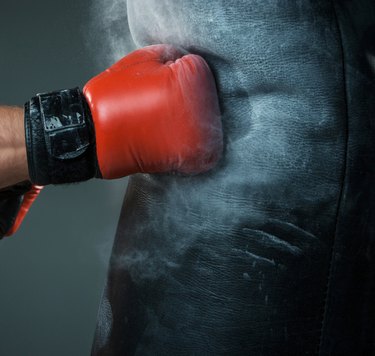
The force of an object is a product of that object's acceleration and mass. English physicist Isaac Newton introduced this fundamental identity of classical mechanics with his second law of motion, F = ma. F represents force; m represents mass; and the variable a represents acceleration. A fighter's fist or a boxer's glove when it reaches a punching bag will have a force dependent on how fast the fist or glove is speeding up and the mass of the fist or glove and arm. The unit of force is typically the Newton (N), which is one kilogram meter per second squared.
Step 1
Weigh the boxer or fighter on a bathroom scale. For example, the boxer weighs 147.7 pounds.
Video of the Day
Step 2
Multiply the boxer or fighter's weight by 0.0345 using a calculator, to determine the mass of the boxer's arm. For example, 0.0345 x 147 = 5.0715. The estimated mass of this boxer's arm is 5.1 kilograms.
Step 3
Station the boxer in front of a punching bag. Place two assistants to the right and left of the boxer. The assistants should be facing each other with a line of vision perpendicular to the direction in which the boxer will punch. Equip one assistant with a digital stopwatch and the other with a velocimeter.
Step 4
Instruct the assistant holding the velocimeter to hold the device immediately to the left of the surface of the punching bag, opposite the boxer. Instruct the assistant holding the stopwatch to time the boxer's punch, starting the stopwatch when the boxer begins his punching movement and stopping the stopwatch when the boxer's fist strikes the punching bag.
Step 5
Instruct the boxer to punch the bag, allowing the two assistants to take their measurements. For example, the assistant holding the stopwatch measures a punch time of 0.1 seconds; the assistant holding the velocimeter measures a velocity of 19.0 mph.
Step 6
Multiply the punch velocity by 1.61 to convert the velocity to kilometers per hour, using a calculator. For example, 19 x 1.61 = 30.59. Multiply your answer by 0.277 to convert the punch velocity to meters per second. For example, 30.59 x 0.2778 = 8.49. The boxer's punch velocity was approximately 8.49 meters per second (m/s).
Step 7
Divide your answer by the measured time of the punch. For example, the measured time of the punch was 0.1 seconds: 8.49 divided by 0.1 = 84.9. The acceleration of the boxer's fist and arm was approximately 84.9 meters per second squared (m/s^2).
Step 8
Multiply your answer by the calculated mass of the boxer's arm in kilograms. For example, 84.9 x 5.1 = 432.99. The force of this boxer's punch when it reaches the punching bag is approximately 433 kilogram meters per second squared, or 433 Newtons (N).
Things You'll Need
Bathroom scale
Assistants
Velocimeter
Stopwatch
Calculator
Video of the Day