
Wrestling Weight Classes: High School Wrestling Weight Class Rules
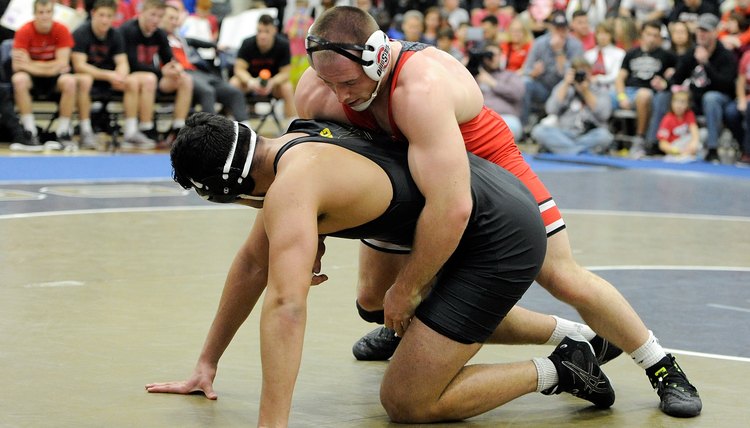
To avoid mismatches in high school wrestling, and for obvious safety reasons, amateur wrestlers only face competitors of comparable sizes based on their actual weight. As a result, wrestling organizations set strict body weight-measurement rules to ensure heavier wrestlers don’t sneak through their initial assessment to face lighter opponents.
At the high school level, each state sets its own standards set by wrestling rules committees, but state associations typically follow the rules established by the National Federation of State High School Associations, or NFHS.

NFHS Wrestling Rules on High School Weight Classifications
High school wrestling student-athletes typically compete in one of 14 weight classes established by the NFHS. In the lowest weight class, a wrestler’s weight can be no more than 106 pounds. The maximum qualifying wrestling weights, in pounds, for the remaining classes are: 113, 120, 126, 132, 138, 145, 152, 160, 170, 182, 195, 220 and 285.
A few states make exceptions to these rules. For example, New York adds a 99-pound weight class to the 14 standard classes. Some states also set lower minimum weight class limits for non-varsity competition. In Ohio, for example, its member schools have weight classes for all-freshman meets that consist of : 98, 103, 112, 119, 125, 130, 135, 140, 145, 152, 160, 171, 189 and 265 pounds.

Establishing a Minimum Weight
Each state develops its own preseason minimum weight certification procedures, which go beyond merely stepping on a scale on the first day of competition.
In New York, for example, wrestling rules call for all wrestlers to be assessed within 14 days of the beginning of the wrestling season to establish the minimum weight at which they may compete during the regular season. Wrestlers may compete in higher weight classes if they gain weight as the season progresses.
During assessments, wrestlers are weighed, take a urine hydration test -- to ensure they aren’t dehydrated in an attempt to lower their weights -- and are subject to a skinfold test to check their body fat. A wrestler’s minimum certified weight can be adjusted if the body fat level is more than 7 percent for boys or 14 percent for girls.
Making the Weight Allowance
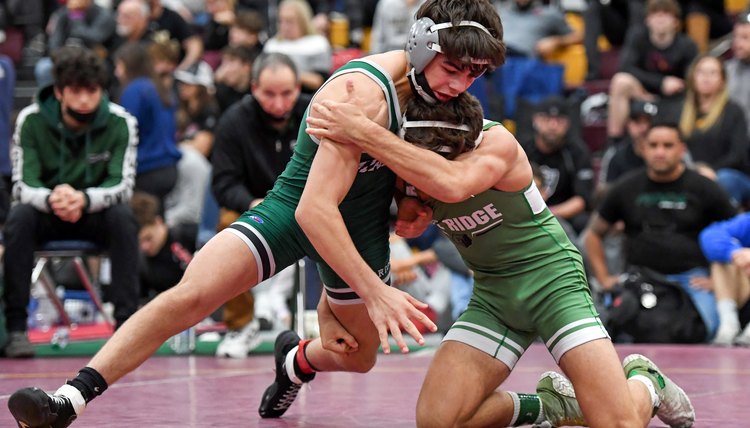
Regardless of a wrestler’s minimum wrestling weight certification, he still cannot wrestle within a weight class if he weighs more than the limit. Each wrestler is weighed on the day of a match to verify his eligibility for a particular weight class.
In Kansas, for example, competitors are weighed between 30 and 90 minutes before a dual meet, or between 30 minutes and two hours prior to a post-season tournament. They can strip down to minimal clothing but must wear a “suitable undergarment” on their “buttocks and groin area.” Wrestlers who are above the weight for their classes may be re-weighed as many times as they wish before the weigh-in period ends to try and lower weight back to their desired wrestling weight classes.
Weighty Differences
The Amateur Athletic Union, or AAU, also holds competitions for high school-age wrestlers. For 15- and 16-year-old competitors, the AAU uses the standard NFHS weight classes, but adds three lower classes, with maximum weights of 84, 91 and 98 pounds.
For 17- through 19-year-olds, the AAU eliminates the two lightest classes and leaves the upper 15 unchanged. High school wrestlers who move on to collegiate competition are sorted into 10 weight classes, with a maximum of 125 pounds in the lightest class and 285 in the heaviest.
References
Writer Bio
M.L. Rose has worked as a print and online journalist for more than 20 years. He has contributed to a variety of national and local publications, specializing in sports writing. Rose holds a B.A. in communications.