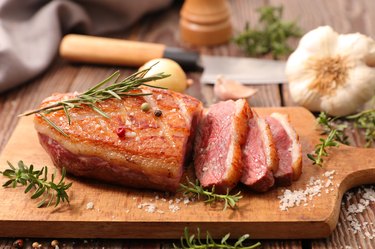
When it comes to poultry, chicken is king — but globally, duck is the third most commonly produced type of poultry, according to a February 2015 article in CyTA Journal of Food.
This flavorful, protein-rich bird is generally considered a healthy food. Just keep in mind, though, that duck's skin is often very fatty.
Video of the Day
Video of the Day
Duck Meat Nutrition Facts
One cup of chopped roast duck contains the following, per the USDA:
- Calories: 281
- Total Fat: 15.7 grams, 20% DV
- Saturated Fat: 5.5 grams, 28% DV
- Cholesterol: 124.6 milligrams, 42% DV
- Sodium: 91 milligrams, 4% DV
- Total Carbohydrates: 0 grams, 0% DV
- Dietary Fiber: 0 g, 0% DV
- Sugar: 0 g
- Protein: 32.9 g, 66% DV
Duck meat is also a rich source of vitamins and minerals, along with healthy essential fats, like omega-3 and omega-6 fatty acids.
If you're concerned about the fat — 15.7 grams per 1 cup of roasted duck breast — try removing the skin. The same-sized portion of duck breast broiled without the skin has just 4.35 grams of fat, according to the USDA.
Duck meat is considered fairly nutritious, with a variety of vitamins, minerals, antioxidants and other nutrients, according to a May 2014 paper in Food Science and Technology Research. Like other foods, these nutrients may change based on the way you cook your duck.
Related Reading
The Fat in Duck Meat
The fat in duck meat has pros and cons.
For someone on a low-carbohydrate or ketogenic diet, the high-fat content of duck might make it a favorite choice of protein. Most of the fats in duck are healthy monounsaturated and polyunsaturated fats, which are healthy, according to the Harvard T.H. Chan School of Public Health.
Despite this, the amount of fat in duck may still feel concerning — where a 1-cup portion of roasted duck meat has nearly 16 grams of fat, a similarly sized portion of roasted chicken has just 5 grams, per the USDA.
And duck has a lot of saturated fat — the American Heart Association (AHA) recommends limiting your saturated fat to 5 to 6 percent of your caloric intake as too much of it can increase cholesterol and your risk of heart issues.
Someone eating a 2,000-calorie diet should eat less than 13 grams of saturated fat a day, according to the AHA. One cup of roasted, skin-on duck meat has 5.5 grams of saturated fat.
Remove the skin, though, and those saturated fats will drop to 1 gram, per the USDA.
Related Reading
How the Duck Is Raised Matters
Like all animals, the nutrition of duck can be influenced by whether it's wild or farmed, or even just the types of foods it has eaten during its life. Farmed ducks commonly eat a variety of foods, including corn, rice bran, soybeans and fish meal, but ducks are, of course, exposed to many more types of food in the wild, according to an April 2018 research published in the Tropical Animal Science Journal.
How they eat matters too: Overfeeding ducks prevents them from absorbing nutrients, which in turn affects the nutritional value of their meat, per a June 2015 study in the Journal of Applied Animal Research. Ducks and geese are often force-fed in order to produce specialty products like foie gras.
Duck species can also impact nutrient content, especially regarding the amount of fat they contain, according to the above-mentioned article in CyTA Journal of Food.
The Health Benefits of Duck Meat
1. It's a Good Source of Protein
As you've seen in the nutrition facts about duck, it's chock-full of protein, with 32.9 grams per cup. That's a lot, but less than chicken, which has 43 grams of protein per cup, according to the USDA.
2. It's High in B Vitamins
B vitamins help your body get energy from the food you eat, according to the U.S. National Library of Medicine (NLM). And duck is a good way to get many of these vitamins — in 1 cup of roasted duck meat, you'll get:
- Thiamin (B1): 0.4 mg, 30% DV
- Riboflavin (B2): 0.7 mg, 51% DV
- Niacin (B3): 7.1 mg, 45% DV
- Vitamin B5: 2.1 mg, 42% DV
- Vitamin B6: 0.4 mg, 21% DV
- Folate (B9): 14 mcg, 4% DV
- Vitamin B12: 0.6 mcg, 23% DV
3. It's a Good Source of Selenium
Not getting enough selenium, which is found in many foods, is linked to a higher risk of heart disease, certain cancers and thyroid disease, according to the National Institutes of Health.
That same 1-cup portion of roasted, skin-on duck provides 31.4 micrograms or 57 percent of your DV of selenium, according to the USDA.
How to Add Duck to Your Diet
If you're not used to cooking duck, you might confuse a whole bird for chicken, goose or pheasant. You'll often find duck breasts or legs butchered in similar ways to chicken and other types of poultry — but because duck meat is darker than that of most other birds, it can actually be easily differentiated from other poultry products.
Despite its color, duck meat is still considered white meat, per the USDA. But in the kitchen, it's sometimes treated more like a steak and cooked to medium or even medium-rare. That said, the USDA advises cooking duck to an internal temperature of 165 degrees, just as you would with chicken.
Duck also has various uses beyond just its meat. Duck bones can be used to make bone broth for soups, like pho, while duck fat can be used as an alternative to butter. As with chicken, you can eat duck offal, turning livers into pâté or pan-frying kidneys. You can even eat duck eggs, which are a rich source of vitamin B12.
From a cooking perspective, anything you'd do to chicken, you can do to duck. Whether it's a pot pie, stir fry, dumplings or stew, duck meat can be used in just about any dish.
- CyTA Journal of Food: "Influence of duck species and cross-breeding on sensory and quality characteristics of Alabio and Cihateup duck meat"
- USDA: "Roast Duck"
- USDA: "Duck, young duckling, domesticated, White Pekin, breast, meat only, boneless, cooked without skin, broiled"
- Food Science and Technology Research: "Evaluation of Antioxidant Activities of Extract from Beijing Roast Duck"
- Harvard T.H. Chan School of Public Health: "Fats and Cholesterol"
- USDA: "Roasted Chicken Breast"
- American Heart Association: "Saturated Fat"
- Tropical Animal Science Journal: "Performance and Intestinal Profiles of Tegal Duck Fed Ration Supplemented with Prebiotics"
- Journal of Applied Animal Research: "The effect of feed consumption levels on growth performance and apparent digestibility of nutrients in White Pekin ducks"
- U.S. National Library of Medicine: "B Vitamins"
- National Institutes of Health Office of Dietary Supplements: "Selenium"
- USDA: "Are duck and goose "red" or "white" meat?"
- USDA: "What are recommended cooking times for duck and goose?"