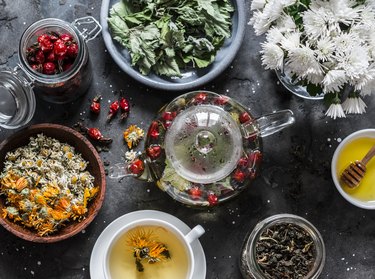
Kidney and bladder function is crucial to your overall health, especially when it comes to flushing away excess toxins. When considering a tea good for kidneys or the bladder, your specific needs should dictate the blend that's right for you.
Tip
There are no "magic bullet" teas for kidney health and bladder function. Some bladder-kidney tea blends may contain ingredients that will benefit your renal system function.
Video of the Day
Evaluating Your Kidney Needs
Because water is still considered the best fluid to ensure proper kidney function, the smartest "tea" option may well be just hot water, perhaps flavored with lemon juice. In terms of traditional and herbal teas, what you choose should depend on whether you currently have any kidney issues. The best tea for kidney disease will be different than one that is a general preventative tea for kidney health.
Video of the Day
Some studies have found that drinking at least one cup of black or green tea may help prevent kidney stones, according to the Linus Pauling Institute (LPI). On the other hand, some black teas may have oxalate concentrations that are high enough to contribute to the problem, for people prone to kidney stones, notes the LPI.
As for the ability of green or black tea's antioxidant content to prevent cancers, including kidney or bladder cancer, human research has not yet tested this theory, according to the LPI. In addition, the caffeine content in green tea, as well as its unpredictable effects on blood sugar, can pose a problem for kidney patients who also have high blood pressure or diabetes.
Read more: The Effect of Black Tea on Weight Loss
Choosing Tea for Kidney Health
So, is there a best tea for kidney disease? Some herbal teas can help target or prevent specific kidney-related problems, but it's important to ask your doctor before drinking them regularly, especially if you have serious kidney issues. Many of the studies related to potential "kidney cleanses" have not been undertaken in large-sample, human trials.
A September 2016 study published in the Asian Journal of Urology found that Blumea balsamifera, or sambong, decreased the size of laboratory-grown calcium crystals, which are formed from urine minerals. The study used a commercially-available tea.
Sambong may also prevent the formation of these crystals. If too many larger crystals stick together, they can form painful stones. Sanbong's crystal-decreasing action potentially lowers the risk of kidney stones. Sambong is derived from a tropical shrub.
One type of hydrangea shrub, Hydrangea paniculata, features cone-shaped flowers. It also boasts medicinal properties. Research published in the December 2017 issue of Frontiers of Pharmacology focused on the high presence of the beneficial compounds in hydrangea that are known as coumarins.
Coumarins have antioxidant and anti-inflammatory properties. According to animal studies, ingesting hydrangea can have protective qualities, at least in the case of kidney injury. Hydrangea paniculata is available in "kidney cleanse" blends. Whether it's the best tea for kidney disease is, of course, a question your doctor can help you solve.
Warning
According to the Centers for Disease Control, herbal supplements, in general, should be avoided if you have kidney disease. For patients with renal function issues, the National Kidney Foundation warns against herbal teas that are high in potassium and phosphorous, such as American ginseng, evening primrose, feverfew, shepherd’s purse and nettle.
Improving Bladder Control
The Mayo Clinic points out that caffeinated teas can irritate bladders. Avoid both black and green teas, which have higher amounts of caffeine. Other potential irritants that you might be adding to your morning "cuppa" include honey, artificial sweetener, sugar and milk. If you're finding that your specialized herbal tea isn't doing the job, try eliminating sweeteners and milk, to see if the teas become more effective.
Beyond what you should avoid when bladder control is an issue, seeking out single-herb or herbal blend teas may prove useful. You'll find teas labeled "bladder control," or you may prefer to use a single-herb tea. Herbs which have been identified as useful by Reviews in Urology (RIU) include:
- Cleavers. A North American herb, cleavers contain tiny, sticky "hooks" that cling to the sides of the bladder. This characteristic potentially protects the bladder from irritants that can contribute to overactive bladder. At this point, results are more anecdotal than well-studied, RIU notes.
- Gosha-jinki-gan. A Chinese herbal blend, gosha-jinki-gan has both tradition and clinical research confirming its use for bladder control. The ten herbs, in combination, were found to decrease urinary frequency in both animal and human trials, according to RIU.
- Linus Pauling Institute: "Tea"
- Reviews in Urology: "Use of Herbal Supplements of Overactive Bladder"
- National Kidney Foundation: "Herbal Supplements and Kidney Disease"
- National Kidney Foundation: "Is Green Tea OK for Kidney Patients?"
- Asian Journal of Urology: "Effect of Blumea Balsamifera Extract on Calcium Oxalate Crystals"
- Frontiers in Pharmacology: "Hydrangea Paniculata Shows Renal Protective Effects"
- Centers for Disease Control: "Diabetes and Kidney Disease - What to Eat"
- Mayo Clinic: "Overactive Bladder"
- National Kidney Foundation: "Staying Hydrated"