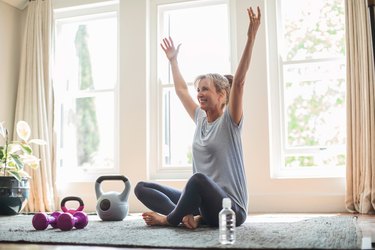
Tight on money, time or space? No problem — you can still log a solid workout at home and lose weight as a result. To make the host of your home workouts, prioritize moves that elevate your heart rate and strengthen your whole body.
One great option is high-intensity interval training, which can help you maximize fat burn, according to an April 2019 review in the British Journal of Sports Medicine.
"If interval training is done correctly, you can get into EPOC (excess post-exercise oxygen consumption)," says Mike Vaught, director of personal training at Snap Fitness in Chanhassen, Minnesota. "We like to call this the after-burn effect — your body still is burning a high amount of fat calories even though your workout is complete."
Keep in mind, though, that weight loss isn't just about working out. Loads of research (including an October 2014 review in the Journal of the Academy of Nutrition and Dietetics) shows that long-term weight loss is best achieved with the combination of eating right by cutting excess calories and choosing nutritious foods and staying active. Because as the saying goes, "You can't out-train a bad diet."
7 of the Best Exercises to Lose Weight at Home
Not sure where to start? Below are the best expert-approved exercises that'll help you lose weight with minimal (or no) equipment.
1. No-Push-Up Burpee
Tony Carvajal, a Miami-based certified CrossFit trainer with RSP Nutrition, says this full-body move burns tons of calories. "It will quickly get your heart rate going and work your entire body," he says. Plus, you can modify it to be low- or no-impact.
- Stand with your feet shoulder-width apart, arms by your sides.
- Bend your knees as you reach forward to place your hands on the floor.
- Jump (or step) your legs straight out behind you into a plank, and then hop (or step) your legs back under your body.
- Jump straight up into the air as you reach your arms overhead. (Take out the jump if needed.)
- End with your knees slightly bent and go directly into the next rep.
Reps: 3 to 5 sets of 10 reps, with 1 minute of rest in between each set
2. Kettlebell Squat to High Pull
Jeff Bell, co-founder and master trainer at Belleon Body NYC in New York City, says this is one of his favorite at-home exercises because it works every muscle in the body. For even more of an aerobic punch, he says to add a squat jump when you're in the bottom position before the overhead press.
- Hold the handle of a moderate-weight kettlebell in between your legs with your feet shoulder-width apart.
- Squat while keeping your back flat.
- Then, drive through the legs to return to a standing position as you pull the kettlebell to shoulder height, elbows out.
- Lower the kettlebell back to between your legs and squat again.
Reps: 10 to 15
3. Goblet Squats
Carvajal says goblet squats, like other squats, help you build lower-body strength, lean muscle mass and increased muscle engagement. They make for a great at-home exercise because all you need is a little bit of space and either a dumbbell or a kettlebell (a heavy textbook or a jug of laundry detergent can be convenient alternatives). "The prime movers are the glutes and quads, but other muscles in the lower body also contribute to the movement," Carvajal says.
- Stand with your feet between hip- and shoulder-width apart. Hold a dumbbell or kettlebell against your chest.
- Keeping your core tight, neck neutral, back flat and dumbbell or kettlebell in contact with your body, lower into a squat until your elbows touch your knees.
- Then, drive your heels into the ground as you return to standing.
Reps: 10
Read more: 6 Strength-Training Workouts You Can Do at Home
4. Skater Jumps
"Skater jumps are a great plyometric movement that increase the heart rate and strengthen the legs and core," Carvajal says. And they're a perfect exercise to incorporate into a HIIT workout.
- Start in the middle of your mat with your feet shoulder-width apart.
- Leap to the right, landing on your right leg only on the right side of your mat. Your left leg should tuck behind your right calf.
- Jump across to the other side of the mat onto your left leg. Your right leg should now be tucked behind your left calf.
- Repeat.
Reps: 30 seconds on, 30 seconds off for 10 minutes
5. Rotate-Elevate
"This is like a side plank on steroids and currently my favorite waist trimmer," Bell says. To make it even more challenging, finish each move by lifting your top knee up to tap your elbow.
- Start in a side plank, supporting yourself on your bottom elbow and placing your top arm behind your head.
- Rotate your top elbow toward the floor as if you were trying to tuck it toward your torso.
- Keep your pelvis level with little to no rotation. You should feel tension in your obliques (sides of your abs).
- Bring the elbow back toward the starting position behind your head. That's one rep.
Reps: 10 on each side
6. Plank Jacking Mountain Climbers
"This is an amazing fat-burning, metabolism-increasing workout that can be done in a small space at home," Carvajal says. When you're ready for more of a challenge, loop a resistance band around your ankles as you complete the exercise.
- While in a high plank, perform a set of mountain climbers, bringing one knee up to the chest, and then switching (left, right, left, right).
- Then, jump your feet apart, toward the outside of your mat, and back together four times, like you're doing a jumping jack on the floor.
- After performing the plank jacks, complete another set of mountain climbers.
Reps: alternate between mountain climbers and plank jacks for 60 seconds
Read more: Get Shredded With These At-Home Workouts for Men
7. Dumbbell Pull Complex
Fire up your metabolism while activating your upper-body muscles, including your back, biceps, traps (upper back) and forearms, with this single move. "This upper-body complex fuses a compound horizontal and a vertical pull pattern that jacks up your heart rate with an isolation exercise for the biceps," Carvajal says.
- Holding a dumbbell in each hand, perform two bent-over rows (lean forward at 45 degrees, let the dumbbells hang in front of your chest, and then pull them up to the sides of your chest).
- Then do one high pull (stand up and row the dumbbells from your thighs to your shoulders, elbows flaring out and up).
- And end with one biceps curl (curl the weights from thighs to shoulders, bending at your elbows).
Reps: Do as many rounds as you can in two minutes, and then rest for 1 minute. Repeat up to 4 times.
At-Home Workouts to Lose Weight
Mastered these moves? Time to put it all together! Here are two 15-minute workout routines for weight loss at home that use the exercises mentioned above.
Lower-Body Cardio Burn At-Home Workout
- 1 minute no-push-up burpees
- 30 seconds goblet squats
- 2 minutes skater jumps (30 seconds on, 30 seconds off)
- 1 minute plank jacking mountain climbers
- Rest 30 seconds
- Repeat 3 times
Full-Body At-Home Workout for Weight Loss
- 10 kettlebell squat to high pulls
- 10 rotate-elevates (each side)
- 10 no-push-up burpees
- 10 renegade rows (each side)
- Rest 60 seconds
- Repeat until you reach 15 minutes