What does fact checked mean?
At Healthfully, we strive to deliver objective content that is accurate and up-to-date. Our team periodically reviews articles in order to ensure content quality. The sources cited below consist of evidence from peer-reviewed journals, prominent medical organizations, academic associations, and government data.
- American Council on Exercise: How Women Build Muscle
- Medicine and Science in Sports and Exercise: Influence of Resistance Exercise on Lean Body Mass in Aging Adults: A Meta-Analysis
- Medicine and Science in Sports and Exercise: Influence of Resistance Exercise on Lean Body Mass in Aging Adults: A Meta-Analysis
- Journal of the International Society of Sports Nutrition: International Society of Sports Nutrition Position Stand: Protein and Exercise
The information contained on this site is for informational purposes only, and should not be used as a substitute for the advice of a professional health care provider. Please check with the appropriate physician regarding health questions and concerns. Although we strive to deliver accurate and up-to-date information, no guarantee to that effect is made.
How Long Does It Take Women to Build Muscle?
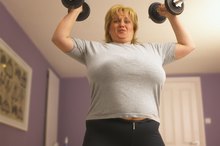
Building muscle is no easy feat. It requires dedication in the gym and an unprocessed, portion-controlled diet rich in protein, healthy fats and whole grains. Women may have an even harder time putting on significant muscle mass due to their lower levels of testosterone and propensity of smaller muscle fibers. You can expect an increase of muscle strength of 20 to 40 percent within a few months of consistent, heavy weight training. Whether this shows up as bigger, more defined muscles depends on your genetics and your diet.
Muscle Gain
An aggressive weight-training routine coupled with a high-protein, lower carbohydrate diet may yield as much as a 0.5-pound gain of muscle per week for men, but only half that for women. If you're a woman looking to gain muscle weight, expect to put on no more than about 10 to 12 pounds in a year. As you age, your gains may be slower -- but you can still put on an average of 2.5 pounds of muscle in just five months, indicates research published in a 2011 issue of Medicine and Science in Sports and Exercise. Muscle-building results are greatest in your first year of serious training and dieting; the results taper off the longer you train. Certain body types are more responsive to muscle-building strategies, too. If you're lithe and willowy, your gains may come more slowly and at a lesser rate.
- An aggressive weight-training routine coupled with a high-protein, lower carbohydrate diet may yield as much as a 0.5-pound gain of muscle per week for men, but only half that for women.
- As you age, your gains may be slower -- but you can still put on an average of 2.5 pounds of muscle in just five months, indicates research published in a 2011 issue of Medicine and Science in Sports and Exercise.
- Muscle-building results are greatest in your first year of serious training and dieting; the results taper off the longer you train.
Strategies to Promote Gain
The Best Workout Schedule to Lose Weight for Women
Learn More
It takes about 2,800 calories to build a pound of muscle, so an extra 100 to 200 calories per day supports your training efforts. You need close to 0.9 grams of protein per pound of body weight daily when you're actively training to build muscle. This supports recovery and growth, the International Society of Sports Nutrition notes. Cut out extra sugars and refined carbohydrates and focus instead on fruits, vegetables and whole grains. Healthy fats, such as those found in fatty fish, avocado and nuts, also support muscle growth by adding calories and offering fatty acids that reduce inflammation from heightened training. You also have to lift heavy -- aim for three to five strength workouts per week that include compound exercises using weights that fatigue you in eight to 12 repetitions.
- It takes about 2,800 calories to build a pound of muscle, so an extra 100 to 200 calories per day supports your training efforts.
- Healthy fats, such as those found in fatty fish, avocado and nuts, also support muscle growth by adding calories and offering fatty acids that reduce inflammation from heightened training.
Related Articles
The Best Workout Schedule to Lose Weight for Women
Learn More
Weight Gain From 5,000 Calories
Learn More
How to Lose Muscle Bulk in a Female
Learn More
How to Lose Fat & Gain Lean Body Mass
Learn More
Sprinting & Testosterone
Learn More
Can You Gain Muscle on a Low Calorie Diet?
Learn More
The Difference Between Muscle Milk & Muscle Milk Collegiate
Learn More

How To Lose Weight with Dumbbells
Learn More
Cures for Overtraining
Learn More
How to Maintain Muscle Mass While Losing Weight
Learn More
References
- American Council on Exercise: How Women Build Muscle
- The New Rules of Lifting for Women; Lou Schuler, Alwyn Cosgrove
- Medicine and Science in Sports and Exercise: Influence of Resistance Exercise on Lean Body Mass in Aging Adults: A Meta-Analysis
- Body Recomposition: What’s My Genetic Muscular Potential?
- National Public Radio: Seniors Can Still Bulk Up on Muscle By Pressing Iron
- Journal of the International Society of Sports Nutrition: International Society of Sports Nutrition Position Stand: Protein and Exercise
- buffguy900
- BurningHeart
- thebarbarianway
Writer Bio
Andrea Cespedes is a professionally trained chef who has focused studies in nutrition. With more than 20 years of experience in the fitness industry, she coaches cycling and running and teaches Pilates and yoga. She is an American Council on Exercise-certified personal trainer, RYT-200 and has degrees from Princeton and Columbia University.