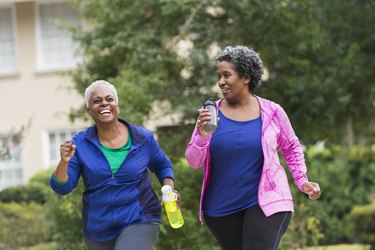
Every exercise plan begins with a single step. If you are extremely out of shape, focus on short-term goals so that you do not feel overwhelmed.
The American Heart Association recommends that healthy adults do a minimum of 150 minutes of moderate cardiovascular activity every week, the equivalent of 30 minutes five days per week. In addition, you should spend a couple of 20-minute sessions per week doing strengthening and flexibility activities.
Video of the Day
Video of the Day
On the Move
The simplest way to begin a fitness plan is to incorporate walking into your daily life. Set small goals such as parking further from where you work or taking an evening stroll around the neighborhood with family. Use a pedometer or your phone with an app or a wearable to measure the number of steps you walk.
After a week, divide the total number of steps by the number of days you walked to get your average number of steps per workout. Spend the next week slowly adding to your number of steps so that the week totals another 1,000 steps. Your long-term goal should be to walk 10,000 steps per day.
Make another goal. It's OK to amble for the first couple of weeks as you're just getting into moving purposefully. But at the beginning of the third week you're going to want to change that stroll into a brisk walk. It doesn't take the body that long to adapt to a new routine. Pump your arms while you walk. Get your cardiovascular system in shape along with your muscles, says Harvard Health Publishing.
Read more: The Best Way to Get Fit Fast
Stretching and Flexibility
Before you stretch, warm up your muscles by marching in place for five minutes. You can do simple stretches such as raising your arms overhead and then bending over to touch your toes.
Think dynamic instead of static stretching — more interpretive dance than Hatha yoga. Rotate various joints by circling your ankles, rolling your shoulders and wrists, recommends ACE Fitness. Reach side to side and make large circles with your body.
And speaking of yoga, join a beginner's yoga class. A qualified instructor will take you through a series of poses that will increase your flexibility and strength. Don't worry about what everyone else is thinking of your struggles while a new student, because really, they're thinking of their own.
Strength-Building Exercises
You do not need to pump iron to build muscle. Some simple modifications to your cardiovascular workout can add a strengthening component. Buy a pair of dumbbells — at least 5 pounds each to start — and perform exercises for your arms, chest and back, like the dumbbell curl, for example.
For more intense strengthening exercises, use your own body weight as resistance. Do push-ups against the wall or try a series of squats and lunges. Work your shoulder and pectoral muscles by raising weights overhead and lowering them.
As You Go Forward
As you gain fitness, slowly add to your workout schedule. Try a walking route that includes inclines, or vary your stride by raising your knees higher. Work on your core muscles by doing abdominal crunches. If you have a medical condition or an injury, consult with your doctor before starting a fitness regimen.
Was this article helpful?
150 Characters Max
0/150
Thank you for sharing!
Thank you for your feedback!