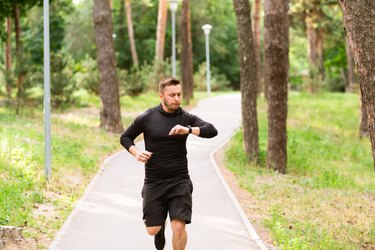
One of the trickiest things to master in a good workout — whether you're running, lifting weights or dancing in your living room — is challenging yourself without burning out too quickly. Because nothing is worse than going too hard too fast.
That's where RPE, or rate of perceived exertion, comes in. Gauging your effort allows you to easily figure out just how hard you're really working and when you should dial things up or down.
Video of the Day
Video of the Day
What Is the RPE Scale?
The RPE scale — also officially known as the Borg Rating of Perceived Exertion — is a method of measuring how intense your physical activity is. Perceived exertion is exactly what it sounds like: how hard you personally feel your body is working during exercise.
You can rate how much you're pushing yourself by paying attention to specific physical cues, like your heart rate, breathing, how much you're sweating or how fatigued you feel, according to the Centers for Disease Control and Prevention (CDC).
Although many people colloquially reference an RPE scale of 1 to 10 because it may be easier for some exercisers to visualize, the Borg scale officially ranks effort from 6 to 20, according to a July 2017 study in Occupational Medicine.
Think of what you would consider being a jog on the lower end of the scale versus an intense run or sprint on the higher end, says Holly Roser, a certified personal trainer and owner of Holly Roser Fitness Studios. Everyone will have a different RPE, depending on how fit they are.
Generally speaking, exercising at an RPE of 11 to 13 is ideal for a beginner with less training, but an RPE of 13 to 15 is recommended for intense activity, per a frequently referenced May 2012 study in the European Journal of Applied Physiology. The CDC says that aiming for an RPE of 12 to 14 is best for moderate-intensity exercise.
The bottom line is that the RPE scale is designed for you to self-monitor your physical activity so you can easily adjust the intensity as needed. If your breathing and muscle exertion are light, you may want to take things up a few notches. But if you're panting and can't keep up with the activity, you might want to take a step back. You can only be in that top level for a short amount of time, Roser says.
Related Reading
The Benefits of the RPE Scale
Applying the RPE scale to different modalities of fitness, such as HIIT workouts, strength training and running, can help you progress over time, says Jake Steinmeyer, a National Academy of Sports Medicine (NASM)-certified personal trainer at Warrior Wellness Fitness Studio.
He notes that the RPE scale is a good indicator of how fit you are and how you are progressing with your workouts, especially as you, say, grow comfortable exercising at higher RPE levels over time or get fit enough that the same activity now feels like a lower RPE.
"By honestly assessing where you're at in your given exercise, you can set goals to make sure you're constantly pushing yourself while also giving yourself a built-in safety net," Steinmeyer says.
It's important to make sure that you progress at a steady pace and maintain a safe level of exertion, he adds. Pushing yourself too hard too soon can be dangerous, so he advises gradually building up to more challenging levels of exercise. Once you reach an ideal level for your workout (12 to 14 for moderate-intensity exercise and 15 to 17 for vigorous exercise), try to maintain it instead of going higher.
The Borg Rating of Perceived Exertion was designed as a scale from 6 to 20 so that it would roughly align with a person's heart rate. For example, a person doing light activity around an RPE of 6 might have a heart rate of roughly 60 beats per minute.
However, this formula is not used much nowadays with the emergence of heart rate monitors, like a Fitbit or Apple Watch, Roser says. Plus, heart rate and level of intensity vary between individuals, so you're better off focusing on how you feel versus your heart rate.
"It can be particularly helpful for individuals to increase their target heart rate zones and toleration of intense activity to move up the RPE scale over time," Roser says. For instance, if you are constantly working out at a 10 to 11, it may come to a point where it then becomes a 6 to 7 for you. As you train more and get in better shape, your aerobic capacity will increase, she says.
Related Reading
How to Get Started With the RPE Scale
If you're a beginner, start by warming up with some light activity and then take note of how you feel as you do the rest of your workout. Every so often, check in with yourself — especially in terms of breathing, sweat and speech to see how you are doing.
Be mindful of inflection points, like if you can speak only a few words at a time after being able to hold a short conversation. This may mean you are going at an intense pace, so it might be helpful to dial it down a bit.
If you feel you are at an RPE under 12, here are some expert-approved tips to gradually increase the intensity of your workout:
Body-Weight Exercises: For body-weight workouts, Steinmeyer recommends adjusting your tempo. Go either blisteringly fast or slow as possible to increase the intensity and help you score in the higher end of the RPE scale. Other ways to progress include doing more sets and/or reps or performing plyometrics, he adds.
Strength Training: Roser recommends increasing 5 percent of your load each month and decreasing rest in between sets.
For a heavier weight set, you may reach the end of the RPE scale during reps 3 to 5, whereas, for a lighter set, you may approach it anywhere from reps 10 to 15, Steinmeyer says. "Weight training with the RPE scale is all about intensity and checking in with yourself as you come close to the last few levels," he explains.
Cycling: Add high-intensity intervals by alternating between going at a fast, intense pace and slower cycling. Climbing uphill is one way to increase the intensity without necessarily kicking up the pace.
Running: If you are using a treadmill, you can increase your mileage and add an incline over time, Roser says. If you're running outdoors, you can run faster for longer distances and eventually go uphill for more resistance, she adds.
Walking: Increase your speed and intensity over time. Start speed walking for 30 minutes every few days, then speed walk more often per week, ultimately walking at a fast pace every day of the week, Roser says. She says that walking uphill or upping the incline on a treadmill can be helpful for building strength as well.
Related Reading
- European Journal of Applied Physiology: "Associations between Borg’s rating of perceived exertion and physiological measures of exercise intensity"
- Occupational Medicine: "The Borg Rating of Perceived Exertion (RPE) scale"
- Centers for Disease Control and Prevention: "Perceived Exertion (Borg Rating of Perceived Exertion Scale)"