
Boxers draw their punching power from the ground up. The source of power for a punch starts with the long and powerful muscles of the legs, surges through the massive glute muscles and finishes through the abs and upper body muscles. Similar to cracking a whip, one small movement of the lower body radiates and grows more powerful as it goes up the body, ending with the contact of your fist.
To sustain the speed and force of your punches your heart and lungs have to work overtime to pump oxygen through your blood stream to keep the muscles going. A boxing workout trains your heart and lungs to become more efficient.
Video of the Day
Video of the Day
In addition to your cardiovascular system, boxing works most of the muscles of your body in some way. The leg, hip, core, and shoulder muscles are the primary parts of the body that produce a punch, and there are a few smaller muscles that help along the way.
Calves
Spanning from the back of your ankles to the back of your knees, your calves are strong muscles that help you press your toes into the ground and lift your heels up. When you throw a punch you move forward or side-to-side slightly.
Your calves start a punch by initiating a step in the direction of the punch. Even if you don't take a step, they help you lean your body in the direction of the punch. The power of your punch works from the ground up, and this powerful group of muscles is the first step.
Legs
Your quadriceps and hamstrings are the main muscles of your thigh. After the calf muscles start a punch, the legs produce some serious power. The quads and hamstrings are exceptionally strong muscles and help move your body in the direction of a punch. They also help you stand up higher or sit down into a punch.
In boxing, there is a move called a bob, where you quickly squat down and stand up to avoid a punch. A movement like this is primarily powered by your leg muscles.
Read More: Long-Term Effects of Boxing
Hips
The glutes are not only the biggest hip muscles, they're the biggest muscles in the body. They put a lot of power behind your punch because they help you twist your body. A punch is a rotational movement, which means that your spine turns. The glutes take over after your legs to turn your torso in the direction of the punch.
Core
Your core is a big group of muscles that run from your hips to your shoulders and cover everything in between. This means all of the ab muscles and most of the back muscles are part of the core.
Abs
The twisting motion in a punch is started by the glutes and carried on by the ab muscles. Specifically, the oblique muscles, which are located on the sides of your torso. The muscles run diagonally across your sides and are built for rotation. In other words: if you want ripped obliques, learn how to box.
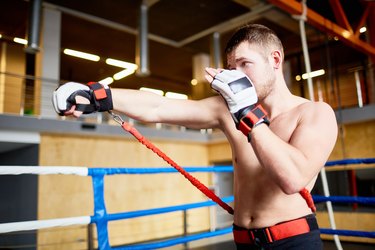
Lower Back
While the ab muscles are built for rotation and power, the lower back muscles also contribute. A 2011 study in the Chinese Journal of Exercise Physiology showed that the most elite female boxers use their lower back muscles in a punch. They also found that less experienced boxers use their lower back less than they should. In other words, the best boxers use their lower back to build more power into their punches.
Read More: What Are the Health Benefits of Boxing?
Shoulders
It's tough to find a boxer who doesn't have muscular shoulders. That's because all of the power that you develop from your lower body and core still needs to be filtered through the shoulder joint. It all comes down to the deltoid, which is the big muscle that covers your shoulder. After only a few minutes of punching practice, you'll feel this area of your body burning from exertion.
Arms
There are two major arm muscles -- the biceps and triceps. The biceps sit on top of the arm and the triceps are on the bottom. When you throw a punch, you extend your elbow out. The arm muscle that extends your elbow is your tricep, so that's the main part of the arm that's worked during a punch. The biceps are used slightly more during a hook or uppercut, but the triceps remain the major arm muscle used during a punch.
Is this an emergency? If you are experiencing serious medical symptoms, please see the National Library of Medicine’s list of signs you need emergency medical attention or call 911.