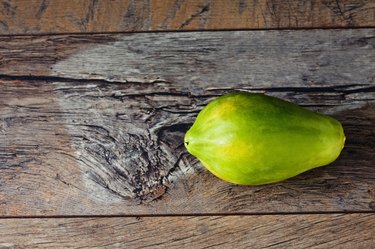
CNN cultural food writer Mark Wiens calls som tam one of Thailand's most popular salads. Traditionally made with grated green papaya, cooked and cooled string beans, dried shrimp, roasted peanuts, tamarind and lime juice, tomatoes, sugar cane paste or palm sugar and fish sauce, garlic and chiles, som tam is also known as Thai green papaya salad. A typical 1-cup serving of homemade som tam is low in calories and fat while providing protein, carbohydrates and essential vitamins.
Free of Saturated Fat
Video of the Day
Som tam contains approximately 97 calories in each 1-cup serving, with 16.2 calories -- around 17 percent of the total caloric content -- contributed by 1.8 grams of total fat. Prepared with only a small amount of dried shrimp, som tam contains a negligible amount of saturated fat. Variations that include pork or crab may have more. Each serving of the traditionally prepared salad contains 3.5 milligrams of cholesterol, or 1 percent of the 300-milligram daily limit recommended for healthy adults by the American Heart Association.
Video of the Day
High in Sugars
Every cup of a homemade version of som tam contains approximately 19.4 grams of carbohydrates, or about 80 percent of the dish's total calories.Of this amount, 12.9 grams are supplied by simple sugars, as much sugar as you would obtain from 1 cup of reduced-fat milk or one whole, medium-sized baked sweet potato. Som tam has 2.9 grams of fiber per serving, an amount that provides over 10 percent of the recommended daily intake of fiber for women 19 to 30 years old and 8.5 percent of the requirement for men in the same age group.
Source of Protein
The average adult woman needs 46 grams of protein daily, and a man needs 56 grams per day. With 3 grams of protein in each cup, a serving of som tam would provide 6.5 percent of a woman's needs each day and 5.3 grams of a man's. The bulk of the protein in traditionally prepared som tam is contributed by nuts and seafood, both of which are recommended by the Harvard School of Public Medicine as healthy protein alternatives compared to red meats like beef or pork.
Rich in Vitamin C
The green papaya that is the primary ingredient in som tam is rich in vitamin C. Each cup of raw green papaya contains approximately 85 milligrams of vitamin C, supplying 94 percent of the 90-milligram daily requirement for men and over 100 percent of a woman's 75-milligrams recommended daily allowance. The vitamin C content of foods like papaya decreases the longer it is exposed to light, air and heat. To get the maximum amount of the nutrient, prepare som tam only just before you plan to serve the salad.
- CNN Travel: 40 Thai Foods We Can't Live Without
- Bon Appetit: Thai Green Papaya Salad
- American Heart Association: Know Your Fats
- Centers for Disease Control and Prevention: Carbohydrates
- USDA National Nutrient Database: Nutrient Lists -- Nutrients: Sugars, Total (g)
- Centers for Disease Control and Prevention: Protein
- Harvard School of Public Health: Protein -- Moving Closer to Center Stage
- MyFitnessPal: Calories in Green Papaya Raw
- University of Maryland Medical Center: Vitamin C (Ascorbic Acid)
- ABC News: Preserving Vitamin Content in Foods