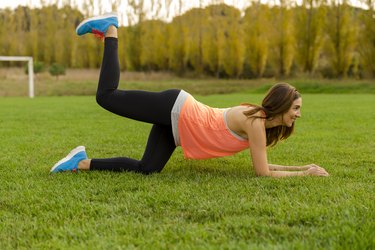
The donkey kick exercise goes by many names — including quadruped hip extension and bent-leg kickback. No matter what you call it, adding more donkey kicks into your fitness routine can strengthen your glutes and core, helping improve your performance in workouts and daily life.
- What is a donkey kick? It's an exercise where you kneel on all fours and use your butt muscles to lift one leg at a time behind you, kicking back the bottom of your foot toward the ceiling.
- What muscles does the donkey kick work? Donkey kicks isolate your biggest butt muscle, your gluteus maximus, according to Nedra Lopez Matosov, CPT and wellness coach. They also require core and shoulder stability because your entire body has to remain steady and balanced as your leg lifts.
- Do donkey kicks make your butt bigger? Depending on what else you're doing, donkey kicks can lift your butt, according to Emily Jacques, CPT, a Rumble and CycleBar instructor. Incorporating donkey kicks into your routine may help grow the muscle but you also need to add resistance (like dumbbells or resistance bands) to keep your muscles growing.
- What are donkey kicks good for? This move is wonderful for warm-ups on leg day or post-workout burnouts, Lopez Matosov says. It's also a great way to safely train core stability during pregnancy.
Video of the Day
How to Do a Donkey Kick With Perfect Form
Donkey Kick
- Start on all fours with your wrists below your shoulders and your knees below your hips.
- Keeping your hips square to the ground and your knees bent at a 90-degree angle, squeeze your glutes to lift your right foot toward the sky as if you are stamping the bottom of your shoe on the ceiling.
- Keep your core tight and don’t arch your back.
- Inhale as you lower the leg back down.
- Repeat on the other side, or complete all your reps on one leg before switching to the other side.
Tip
Make sure you don't dump all of your weight into one hand. Evenly balance your donkey kick through both hands and the leg that's still on the floor, so your body stays stable without dipping to one side.
Watch the Full Donkey Kick Tutorial
4 Donkey Kick Benefits
1. Glute Strength and Activation
"Donkey kicks mainly target the gluteus maximus, the largest of the three gluteal muscles," Jacques says. "It's a great lower-body burner."
And while donkey kicks can build strength at the beginner level, you do eventually need to add resistance to keep your muscles growing. A resistance band donkey kick (more on that below) is one variation that can keep your strength progressing.
But no matter your skill level, the move is great for waking up your glutes. That's why it makes an excellent warm-up move before a lower-body workout or run.
2. Core Stability
Alongside the butt-building benefits, donkey kicks are surprisingly good at activating your core. Throughout the exercise, you want to stabilize your hips, avoiding any side-to-side movement. That's where your core comes in, helping keep your pelvis in place, Lopez Matsov says.
3. Back Protection
Your glutes and core help support and protect your back, according Lopez Matosov. So, by building these muscles, you give your back extra protection, too. In the long run, this can help ward off lower back pain and hip problems.
4. Shoulder Engagement
As you're on all fours the entire time, donkey kicks demand shoulder strength and stability — similarly to a plank — Jacques says. To keep your upper-body stable and upright, donkey kicks activate your deep shoulder stabilizing muscles.
5. Pregnancy Safety
Core stability is also essential during pregnancy — both to prevent pregnancy-related discomfort and prep your body for labor and delivery. The donkey kick is a pregnancy-safe core exercise that can help keep the midsection strong and stable, helping reduce the severity of diastastis recti, or abdominal muscle separation.
4 Common Donkey Kick Mistakes
1. Your Core Drops
Although your glutes are the focus of this exercise, you don't want to miss out on the core-strengthening benefits. So, don't let your stomach sink and back arch while you lift your leg up and down.
Fix It
Keep your abdomen engaged the entire time (but don't forget to breathe!). When you lift one leg, re-engage your core by keeping your hips square and torso straight.
"Push through your palms, and keep the opposite toe down as the other leg lifts," Jacques adds. "That will help with the core stability."
2. You Point Your Foot
The angle of your foot may not seem like a big deal. But when you point your toe toward the ceiling, you don't access all the donkey kick's glute-building potential.
Fix It
Keeping your foot flexed during this move helps you contract your muscles and really feel the squeeze in your glutes, Jacques says. "Push the sole of your shoe up to the ceiling or imagine you have a wineglass on your shoe."
3. You Kick Too High
You don't need to lift your leg as high as humanly possible to benefit from the donkey kick. In fact, you really only want to lift to the point where your booty is fully engaged. Although it's a common donkey kick mistake, pressing too high can put pressure on your spine, causing lower-back discomfort.
Fix It
To avoid kicking your leg too high, maintain a neutral spine. Perform the exercise in front of a mirror, and if you notice your back arching, it means you're probably kicking your leg too high.
4. Your Elbows Lock Out
People tend to lock out their elbows by doing the move with their arms completely straight. But this can put extra stress on the elbow joints, Jacques says.
Fix It
Maintain a soft bend in your arms. Keep this in mind with every rep and regularly check in with your arms to make sure you haven't straightened them completely.
Are Donkey Kicks Better Than Squats?
For those who want a clear winner, you may be disappointed. One exercise isn't necessarily better than the other — it all depends on your personal fitness goals.
Both donkey kicks and squats are a great way to activate and strengthen your glutes. But if building muscle is your goal, squats may be the way to go, according to Jacques.
"You aren't going to be able to load a donkey kick like a squat," she says. "So although the donkey kick is a great exercise, a squat a going to be able to provide more options to add weight and hit the muscle group a little harder!"
Instead of choosing one over the other, do both! Donkey kicks make an excellent pre-squat glute activation exercise.
6 Glute-Burning Donkey Kick Variations to Try
1. Externally-Rotated Donkey Kick
- Begin on all fours with your wrists below your shoulders and your knees below your hips.
- Keep your knees bent, feet flexed and core tight as you squeeze your glutes to rotate your left knee out, pointing away from your right leg.
- Lift your left leg up behind you until your thigh is parallel to the floor.
- Inhale as you lower that leg back down.
- When you complete all your reps, switch sides.
Tip
"Move slow and controlled with this one, since it is easy to fall out of form," Lopez Matosov says.
2. Fire Hydrant
- Begin on all fours with your wrists below your shoulders and your knees below your hips.
- Keep your knees bent, feet flexed and core tight as you lift your left leg to the side, moving away from the right knee.
- Raise your leg as high as you can, keeping your hips squared to the floor.
- Inhale as you lower that leg back down.
- When you complete all your reps, switch sides.
3. Bent-Knee Donkey Kick to Leg Extension
- Start on all fours with your wrists below your shoulders and your knees below your hips.
- Keeping your hips square to the ground and your knees bent at a 90-degree angle, lift your left foot toward the sky as though you are stamping the bottom of your shoe on the ceiling.
- When your left knee comes in line with your butt, straighten your leg straight behind you.
- Slowly bend your leg and return to a 90-degree angle.
- Inhale as you lower that leg back down.
- When you complete all your reps, switch sides.
4. Straight-Leg Donkey Kick
- Start on all fours with your wrists below your shoulders and your knees below your hips.
- Exhale and extend your left leg straight out behind you until you feel a squeeze in your glutes.
- Inhale as you lower that leg back down.
- When you complete all your reps, switch sides.
5. Spiderman Donkey Kick
- Start on all fours with your wrists below your shoulders and your knees below your hips.
- Keeping your knees bent, raise your left leg behind you like a standard donkey kick.
- Lower your left knee.
- Again, raise your left behind you, knee bent, like a standard donkey kick.
- This time, draw your left knee to your right shoulder, engaging your obliques.
- Bring your left knee back again in a standard donkey kick.
- Lower your left knee to the ground.
- Repeat this pattern for all your reps, then switch sides.
6. Banded Donkey Kick
- Start on all fours with your wrists below your shoulders and your knees below your hips. Wrap a small resistance band around both legs, just above your knees.
- Keeping your hips square to the ground and your knees bent at a 90-degree angle, squeeze your glutes to lift your left foot toward the sky as if you are stamping the bottom of your shoe on the ceiling.
- Inhale as you lower the leg back down.
- When you finish all your reps, switch sides.
Was this article helpful?
150 Characters Max
0/150
Thank you for sharing!
Thank you for your feedback!