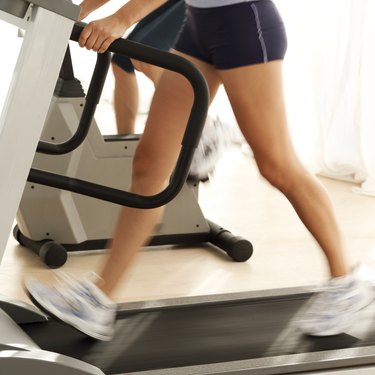
Walking on a treadmill will do everything but make your legs bulky. This type of exercise is an effective way to challenge your cardiovascular system, improve your health, strengthen your lower body and possibly even reduce your levels of body fat. Treadmill walking is a low-impact means of exercise that can be done every day, rain or shine.
Heart of the Matter
Video of the Day
Walking is one of the most popular forms of exercise and is one of the easiest activities to add into your daily life since it's something you already to throughout your day. Walking is a type of cardiovascular exercise, making the target muscle the heart. Aside from improving cardiovascular fitness, the American Heart Association suggests that walking also improves blood pressure, reduces the risk of breast and colon cancer and enhances mental well-being.
Video of the Day
Muscle Function
Rather than creating large, bulky muscles like those heavy strength training can build, walking will keep muscles relatively small. For a muscle to become bulky, it must be continuously overloaded with very heavy resistance and even then bulk is not a guarantee. Obviously, walking does not meet this requirement. Instead your legs become stronger as your fitness improves. The primary impact walking has on your muscles, is improving muscular endurance, which is the ability of a muscle to repeatedly contract for an extended period of time.
Tone It Up
Walking can be an effective way to decrease fat levels, which in turn can make your legs appear leaner and more toned. To use walking on a treadmill as a means to lose weight, you'll have to make a time commitment. For significant weight loss to occur, the American College of Sports Medicine recommends exercising at a moderate intensity for at least 250 minutes per week. Walking on a treadmill for 36 minutes seven days a week or 50 minutes five days a week will fulfill this recommendation. Increasing your walking speed and/or the incline of the treadmill will increase the intensity of your workout, lowering the time requirement.
Bulk It Up
If, indeed, your goal is to bulk up your legs, plan on hitting the weight room. Choose heavy weights that allow you to perform no more than 12 repetitions and focus on exercises that target the legs such as squats, lunges, deadlifts, step-ups, heel raises and leg presses. The National Strength and Conditioning Association suggests performing three to six sets of six to 12 repetitions to encourage muscle growth. Walking on a treadmill can still be a useful activity in your quest to build bulky legs -- the lower intensity of the exercise prevents your body from using muscle as an energy source. This will allow you to get your cardio in without compromising bulking efforts.